Monday, November 25, 2024


Sunday, November 24, 2024
Food for the journey

Sermon for the Sunday next before Advent
Today is the last Sunday
of the Liturgical year
and we find ourselves
on the mountain
with a great company
of men, women and children
who have gathered
to hear the Word of God.
Why here?
Why do we end our year
on the top of the mountain
with a hungry multitude?
[PAUSE]
The Church year
ends on the Saturday before Advent
and begins on Advent Sunday.
To be pedantic,
the beginning of the Liturgical day
is at sunset,
so Advent starts
at Sundown on the Saturday,
but this just emphasises
the completion of
the day,
the week,
the month,
the year.
With the setting of the sun,
the year goes round again.
And we go round again too,
not in a circle,
we never end up
exactly where we started.
We are travelling
along a groove
in an old LP vinyl record
slowly spiralling inwards
towards the centre.
Each Advent
we have completed
another circuit of the liturgy
through the many
Sundays after Trinity
which make Christmas
and Easter seem
a long way off.
It's a long journey every year
and today is the day
when we sit at the mountain
and take stock.
We begin to look at
how we have grown
in the Holy Ghost
and how we need
to work at repentance
for the year ahead.
We come again to the mountain.
And we are hungry and thirsty.
And ahead of us
is our next journey
to Bethlehem
to register for the census.
It's all a bit relentless.
Round and round and round we go
and where we stop
nobody knows.
[PAUSE]
Our ears prick up
as we hear the Holy Voice say,
"whence shall we buy bread
that these may eat?"
In our tiredness
our sadness,
our jadedness
and weariness with this world
and our journey through it
we hear the voice of the One
Who cares that we should not starve
or faint with hunger.
And then we hear
a voice of discouragement,
"Two hundred penny-worth of bread
is not sufficient for them,
that everyone of them
may take a little."
This voice of discouragement
always seems to be with us
always trying to scratch
a hole in our hope,
dampen our joy
turn us towards the ground.
Every year,
we approach Christmas
dreading the usual voices
claim that Christmas is a pagan holiday.
(It isn't,
Saturnalia
was never
on Christmas Day.)
Or the grumbling
about presents
and decorations
which has been going on now
since before Halloween!
The world's voices
seek to crowd out
our hope
which, at the end
of another year's journey
is in short supply.
Do we really have
to go around again?
Why can't Jesus return now?
[PAUSE]
But He has!
Into our hands,
into our mouths
given by the Holy Apostles
we are fed,
good wholesome bread,
bread that enters our bellies
and nourishes us
warms our hearts
strengthens our hopes
and turns us to the God
Who gives of Himself
for us.
Here, at this pause in our journey,
we are fed
with the Bread of Life.
Our Liturgical Year
ends with the Mass.
[PAUSE]
All our journeys
end with the Mass
The little journey
from pew to altar
to receive Him
truly present in the Sacrament
as He promises us;
The journey
through the week,
through daily work,
through daily encounter
with an unbelieving world
back to the food of Christ
in Church;
The journey from
Advent to Advent
treading and retreading
the journey from Nazareth
to Bethlehem
and in Bethlehem
to find again
the Real Presence of Christ;
the journey
from birth
to death,
through sin,
sorrow,
joy and righteousness
until we pass through Death
and into the Wedding feast of the Lamb.
Our journey always ends in the Mass.
[PAUSE]
But that's what the Mass is for.
It's the gift
Christ gives us
that we might keep going
keep encountering Him,
keep bringing ourselves to Him
with our need for healing
and for wholeness.
And it is the pinnacle
of our worship of God,
for we travel back to God
for the reason that
He is worth more to us
than the distractions
of this petty world.
[PAUSE]
Today,
we end our year
in worship of the Holy Trinity,
One God,
Three Persons.
And next week we begin again
in worship of the Holy Trinity
preparing for the coming Christ.
We begin again in Him.
Always, we begin again.
Monday, November 18, 2024
Sunday, November 17, 2024
False Truth

Sermon for the twenty-fifth Sunday after Trinity (using propers of the sixth Sunday after Epiphany)
Is the shroud of Turin
a fake?
In the past forty years or so,
competing scientific research
has deemed it
a fake from the Middle Ages
or undoubtedly
a relic from the First Century.
Many people
believe it to be genuine.
Many people
believe it to be a forgery.
And it seems
people are determined
to use the scientific method
to prop up their own
belief about what this cloth is.
It does seem,
given recent articles
that no-one comes to
study the shroud
without some preconceived desire
to prove that it shows
The True Christ
or a false Christ.
Does it show
the True face of Christ?
[PAUSE]
If it does,
then we have
some way of recognising Him
when He comes again.
Wouldn't it be awful
if He returned to us
and we didn't recognise Him?
Wouldn't it be awfuI
if we've missed His second coming
just because we didn't know
what He looked like.
Doesn't the Turin Shroud
give us a way of knowing
Who we're looking for?
Doesn't it give us
a frame of reference for our faith?
Doesn't it give us
the ability to say
"Yes! This is Christ!
Here He is!"?
No.
No it doesn't.
And why?
Listen to the True Christ.
"If any man shall say unto you,
Lo, here is Christ, or there;
believe it not.
For there shall arise false Christs,
and false prophets,
and shall shew
great signs and wonders;
insomuch that,
if it were possible,
they shall deceive the very elect."
If the Shroud of Turin
is real,
and there is every chance
that it is,
then it is an ikon
a way of seeing into
the Heavenly Truth.
But,
while ikons are so good
for the soul
and a necessary part
of Christian doctrine
no one ikon
is necessary.
The Shroud of Turin
adds nothing to our Faith
beyond any other ikon.
If the Shroud is a fake
then this takes nothing away
from our faith:
it still remains as much an ikon
as any ikon written on wood.
The Shroud is not the basis
of our faith.
Christ is the basis of our faith.
The Man
depicted upon the Shroud
the one depicted in the ikon
the one depicted upon the Cross,
He is the Christ
and basis of our faith.
[PAUSE]
But don't we say
"Here is Christ"
when the priest lifts up
the consecrated host?
Indeed we do,
but this is Christ in the Sacrament,
not Christ coming in glory
to judge the quick and the dead.
It is those people
who say "Here is Christ"
meaning the Messiah
at His second coming
who are talking about
a false Christ.
It is those people
who are thinking of a Christ
made in their own image
who hope for a return
of a false Christ.
[PAUSE]
But that is not how Christ will return.
He won't suddenly appear
in one place
so that we all have to pile
into cars and aeroplanes
to meet Him
He won't appear
on television
and tell us to do bizarre things
to prove our love for Him.
But if the Shroud is fake
how will we recognise Him?
[PAUSE]
The apostles tell us how.
They see Him
hear Him
and touch Him.
And their faith is ours.
We just need to preserve that faith.
Christian Doctrine
isn't just about
what to do
and what not to do.
It is about living,
studying,
praying,
and getting to know Jesus
as He is
through what the Church
has always handed down to us
since those feet in ancient time
walk closely with the apostles
and walk with us
through those who follow the apostles.
Christian Doctrine
will ensure
that we will truly know Him
when He comes again
in His own way
at a time when we least expect Him.
And then how much joy
will there be for us?
Wednesday, November 13, 2024
Sunday, November 10, 2024
Worth worship
Sermon for the twenty-fourth Sunday after Trinity

So many people
seem to think
that Jesus never claimed
to be God.
There are so many places
where He does make that plain
such as saying
"Before Abraham was, I am."
which causes the Pharisees
to pick up stones
since Jesus has just used
the same words
that God uses in the Burning Bush
to Moses.
Jesus does not say explicitly
"I am God!"
but it's there
in the Gospels.
And today
we see Jairus
- at least it's probably Jairus
since St Matthew
doesn't say -
approach Jesus
to heal his daughter.
And crucially
what's the first thing
Jairus does?
He falls down and
worships Jesus.
This is exactly
the same worship
that Our Lord tells us
belongs to God.
The Greek word
that we translate as worship
literally means
to kiss the hand
in the same way
that a pet dog
licks the hand of its master.
Is that how God wants us
to worship him?
[PAUSE]
The underlying idea
behind worship
is the amount of value
we put upon a thing
or a person.
Worship is worth-ship:
that's where the word comes from.
The question is
how do we demonstrate
the worth something
or someone has
in our estimation?
If we regard someone
as more important than us,
as possessing some
power over us,
as someone whom we need
to live our lives,
then we have to demonstrate
that respect.
We demonstrate it
so that the person we value
knows we value them,
and we demonstrate it
to remind ourselves
if how much
that person means to us.
You can certainly see
how people who are shown
into the presence of
an emperor
get on their knees
in knowledge
that he has the power
of life and death over you.
Your bowing down
is the outward act
of your expression
of the emperor's worth.
[PAUSE]
And we see Jairus
(if it is indeed Jairus)
worshipping Jesus,
bowing before Him.
A leader of the Jewish community
is bowing before this teacher
and so shows Him of greater worth
than his own standing
in the community.
But the Commandment says,
"Thou shalt not make unto thee
a graven image,
nor any manner of likeness,
of any thing that is in heaven above,
or that is in the earth beneath,
or that is in the water
under the earth;
thou shalt not bow down
unto them, nor serve them."
Now,
there are several times
when someone falls down
to worship someone
who isn't God.
This happens to St Paul
and Barnabus,
who are mistaken
for Greek gods,
and St John gets
terribly overawed
and tries to worship an angel
in the Revelation.
In each case,
where the worship
is misplaced,
they say,
"don't worship us
we are not God."
But Jesus doesn't do that.
There is no rebuke
for those
like the Magi,
the Leper ,
Jairus,
and the Disciples
especially after
St Peter walks on water
and again after the Resurrection,
all of whom
worship Jesus as the Son of God.
But worship
can go wrong.
[PAUSE]
The Roman Soldiers
who mock Jesus
before His crucifixion
worship Him
St Matthew tells us that.
What does that mean?
It means
that the soldiers
go through the motions
of worship,
bowing down
and genuflecting.
But it isn't true worship
because the intention
to honour Jesus
is not there.
They do not see Him
as being of any value to them
so they have no respect for Him.
There is no actual worship here,
just the appearance of worship.
They worship Him in truth
because Jesus is truly God
but not in spirit
because they do not love Him.
[PAUSE]
And then there are
the Israelites
who make a Golden Calf
and worship it.
They believe that
the God who saves them
from Egypt
has the likeness of a calf.
But this is not true.
God does not have
the image of a calf.
The Israelites
are worshipping in spirit
because they intend to worship the calf
but not in truth
because the calf is not God.
Further,
in the persecution under the Romans
Christians are compelled
to burn incense to the pagan gods.
They could do so,
secretly intending
to burn the incense
in honour of God.
But this is worship in spirit
and not in truth.
The outward sign
and the inward intention
do not marry up.
[PAUSE]
Jesus says,
"God is a Spirit:
and they that worship Him
must worship Him
in spirit and in truth."
Jairus worships Jesus
in truth because he
perceives that
Jesus is God
and in spirit
because he believes
that Jesus can raise
His daughter
from the dead.
St Paul says that Jesus is
the image of the invisible God.
When we see God with our eyes
it is Jesus Whom we see.
This makes sense
because the Father
is the source of all being
and stands outside the gaze
of anything He has created.
And the Holy Ghost is a spirit
who does not have a body.
It means that Jesus
is the focus of our worship
because we have someone
visible to bow down to.
It means
whenever we see
a picture of Jesus
we can bow down
not to the picture
but the one in the picture.
[PAUSE]
We Catholics are often accused
of worshipping statues
but we know this is not the case.
We venerate the saints
because we see Christ at work in them.
We venerate Mary greatly
because we see Christ born in her.
And we worship Christ
the image of the invisible God.
And we do what the Church has done
from the earliest times.
We venerate ikons,
sacred images,
because of who they depict.
Our outward worship
is towards a picture
of Christ
and our inward worship
is towards the Christ depicted.
We worship Christ truly and in spirit.
We don't worship
the block of wood
with paint on it,
but the truth of Christ
the visible God.
If people cannot tell the difference
then they are only watching our worship
at a superficial
and unspiritual level.
[PAUSE]
As Jairus worships
the image of the invisible God
so must we venerate His image
with Jairus.
Ikons of the saints
help us remember that
they are truly real
and truly alive
- spirit and truth.
Ikons of Our Lady
help us remember
that God becomes a man
so that man can become like Him
in spirit and in truth.
Ikons of Our Lord,
show us the picture
of the One Who saves us
by showing us His very self
in spirit and in truth.
We are not worshipping
a graven image,
but Christ Himself through
that image in the truth
of His Incarnation
and we do so in spirit
because we love Him.
Monday, November 04, 2024
Anglican Catholicism and the Reformation
Why the Reformation is not something that Anglican Catholics celebrate.
Sunday, November 03, 2024
Present Tense Saints
Sermon for the Sunday in the Octave of All Saints

Our Lord sits
on the mountain
to teach.
His disciples
are those who
have climbed after Him
scaling the rocky crags
against gravity,
against comfort,
against the better judgment
of others
to hear this Man teach.
Already,
they show themselves
to be blessed
for "blessed are those
who hunger and thirst
for righteousness' sake
for theirs is
the Kingdom of Heaven."
And how the disciples
demonstrate that!
In clambering uphill
they have demonstrated
their hunger and thirst
for the teaching of Christ
because they know
that what He teaches
is not just righteous
but Righteousness
itself.
Last week,
we recognise
Jesus as our King
and this week
we follow Him
and set ourselves apart for Him
from the World.
And if we set ourselves
apart from the world
for Righteousness' sake
God sets us apart for Him.
We become holy.
We become saints.
[PAUSE]
We are only as holy
as far as we are apart from
Sin, the World and the Devil.
Our salvation is
precisely the end of
our separation from God,
our return to the full health
that God has wanted for us
from Eternity.
Our Lord promises those
who hunger and thirst
for righteousness' sake
a place in His Kingdom
which St Peter describes as an
eternal Kingdom,
something that even
the prophet Daniel knows to be true.
Something is Eternal
if it is connected
with God's age.
Just as we have
the Stone Age,
the Iron Age,
the Bronze Age,
whatever is Eternal
is of the God Age.
Think about that,
because,
for God,
Time is not a limitation.
He is as present now
as He was a million years ago
and a million years to come.
All Time is present to God
at once.
And this is the Eternal life
that He offers in His Kingdom.
He offers His saints
to be of His Age,
Eternal,
not simply everlasting
but unbound to Time.
St John tells us
that we cannot understand
what we will be like
when we are in His Kingdom
but we will be like Him
because we will see Him as He is.
When Jesus says
that God is not the God of the dead
but of the living
He shows us that
Abraham,
Isaac,
Jacob,
Moses,
Elijah
and all the saints are still alive
and that Death
for the saints
is an event,
not a state of being.
The saints are not dead.
[PAUSE]
And, we know that St Peter says
the ears of the Lord
are open to
the prayers of the righteous,
and their prayers ascend
before God like incense.
St Jerome says,
"If the Apostles and Martyrs,
while still in the body,
can pray for others,
at a time when
they must still be anxious for themselves, how much more
after their crowns,
victories, and triumphs are won!"
We also no that
nothing in Heaven and Earth
or under the Earth,
not even life and death
can separate us
from the love of Christ.
And the saints are righteous
because they show
the love of Christ to us
even as Christ in Heaven
shows His love for us on earth.
[PAUSE]
So,
the saints are alive,
but are no longer
bound by Time and Space.
The saints still love us
because they are perfected
in the love of God,
and Love is something
that requires action.
The saints have passed
through death
but are neither
separated from God
nor from us
because nothing separates us
from the love of God.
The saints pray
just as they have
throughout their lives
hungering and thirsting
for Righteousness' sake.
Prayer is more than just words.
It is a communication
at a deeper level between
us and God
and
us and those who love God.
Likewise,
we pray for our departed loved ones
for their happiness in God.
This prayer is an expression
of our continued love
for those who have died.
The saints prayer for us
is an expression of
their continued love
for us who are yet to
undergo death.
This is true communion
for these prayers
bring us closer to God
because God is love.
This is precisely
the communion of the saints
a communion expressed
through mutual prayer
and, at its summit,
Christ Himself
in the Blessed Sacrament
of the altar.
[PAUSE]
We should rejoice
that we have such
a cloud of witnesses
cheering us on
bringing their concerns for us
to God,
and that our prayers
do the same
for those in need
whether living
or departed.
There will be those
who try to show us
that we are wrong,
who say the saints are dead
who say the dead heart nothing
who say that praying for the dead
does nothing.
But these are they
who do not understand prayer
who do not understand death
and who do not understand
that Love and Power are the same in God
and grow in the hearts
of those who hunger and thirst
for Righteousness' sake.
May Holy Mary,
Mother of God
and all the Holy Angels and Saints
pray for us
and may the souls
of the faithful departed
through the love of God
rest in peace.
Amen.
Monday, October 28, 2024
St Simon and St Jude: piercing zeal
Where Christians should direct their enthusiasm in evangelisation.
Saturday, October 26, 2024
Just answer the question!

Oh He's infuriating!
Why doesn't He answer
the question.
Yes or no.
"Art Thou a king, then?"
But you know why
Jesus is going around the houses
in answer to the question.
It's not about being truthful
it's about being truthful
under the circumstances.
Is Jesus a king?
[PAUSE]
Of course He is.
The apostles say, "Jesus is Lord"
and the psalms say
"The Lord is king
and hath put on glorious apparel."
It's a no brainer.
But it's how you tell the truth
that matters.
Preconceived ideas
make things difficult.
If you are a military person
and someone calls herself
a captain.
You're going to think:
Army - an important commissioned officer
in charge of a platoon
or
Navy - an even more important officer
in full charge of a vessel.
But what if she means
she is
the captain of the rugby team?
The confusion
could be amusing,
irritating,
or even dangerous.
The same is true
with the title, "doctor".
A doctor of philosophy
is dangerously useless
when a doctor of medicine
is needed urgently.
[PAUSE]
It's clear
that Jesus wants
to refrain from using the title
because it could
be very dangerous.
The people
have all tried
to proclaim him king
but Jesus
slips away from them.
A king
could cause
a misunderstanding
that could result
in many deaths.
The people want
a triumphant military Messiah
to cast out the hated Romans
and restore their land.
That's not the salvation
that Jesus is thinking.
To call Himself king
would give Pilate
a grave cause for concern
that the people
are about to rise up.
It is a question of kingdoms.
[PAUSE]
Of course,
Our Lord is King of the Jews,
but He is King of the Jews
because He is
the King of Kings.
His Kingdom is more
than Judaea.
It's more than Rome.
It's more than
all the kingdoms
of this little planet.
His Kingdom is not of this world.
It cannot be explained
in earthly terms
of treaty, jurisdiction
contract, and alliance.
If a King
favours one part
of His Kingdom
over another,
it splits the kingdom.
To fight the Romans
for the Jews
might liberate the Jews
for a time
but it would not
liberate the Romans,
and Jesus is King of the Romans.
To have that view of Kingship
defeats the purpose
of the Incarnation,
defeats the purpose
of the Cross.
[PAUSE]
The Kingdom of God
is established in us
by one covenant alone
and that is the covenant
of the Blood of Christ.
In drinking that cup,
we accept Christ our King,
and in accepting Christ our King
we accept a King
Who fights for us
and with us
against the darkness
that seems to enslave us
by separating us from our King
and His Kingdom.
And, because He is our King,
He issues His Royal command to us
to fight under His banner
against sin, the world and the Devil
to play our part
in our salvation
and the salvation of others
by co-operating with His grace.
Our salvation comes
by faith and trusting in our King
and by works of love
that proceed from faith
through our willing acceptance
of His Kingdom.
[PAUSE]
Jesus always uses His titles
carefully, judiciously and in perfect truth
so as not to confuse
or scandalise.
Likewise,
our proclamation
of His Kingdom
must be done
carefully, judiciously and in perfect truth
which can only come by love.
Love is the Royal Command
for us to obey.
Thursday, October 24, 2024
My Community

Dom Bruce de Walt (left) died on 20th September, peacefully and having been assiduously and lovingly looked after by Prior Simon and Dom Francis as well as the staff of his nursing home.
With the passing of Dom Kenneth (pictured beneath the holy crucifix) there are now just two monks remaining from the Pershore-Nashdom-Elmore-Salisbury community. Indeed, Dom Francis joined the order in Nashdom.
Dom Bruce was not what you would call orthodox either in belief, nor in manner, but he was a Godsend. He reminded me, an earnest doctrine-scrutinising Anglican Papalist, that life has to be lived and lived with some joy. His passions were always on display: I have heard him snap and complain and grumble; I heard his laughter, his naughty joke and mischievous expressions of his thoughts. Although, the Rule rather prohibits all of these, Dom Bruce reminded me that St Benedict wanted moderation.
St Benedict knew of the frailties of human beings. The laughter he witnessed was cruel and at the malicious expense of others: Dom Bruce was often cheeky but he didn't rejoice in the misfortunes of others. St Benedict hated murmuring, having in mind the Israelites complaining against God and Moses in the desert; Dom Bruce complained often but he was always loyal to his community and valued its integrity - something which murmuratio does not allow.
Dom Bruce remained a full part of the CofE, unapologetically accepting the decisions which caused me to question my membership before I had to leave. That didn't bother me: I am most content with being an Anglican Catholic, having withdrawn from full Anglican Papalism, when I joined the ACC, but this departure from the CofE didn't split my sense of community with the monks even if I am not in communion with them. I am still proud (if that is the right word) to retain my oblation with Salisbury Priory and I pray for them daily, though now I pray for Dom Bruce along with Dom Kenneth and Abbot Basil in a different section of my intercessions from those who still have an earthly conversation.
Dom Bruce reminds me that Christians who disagree should not do hatred. I have heard several Christians declare others as "satanic" or "non-Christian" for not being Calvinist. I certainly would not think of anyone in that way for not being an Anglican Catholic, even if I firmly believe that it is the truest expression within the Catholic Church. My love for Dom Bruce has not diminished, nor for Prior Simon or Dom Francis - they are my community even if we are separated.
God bless them and keep them safe, for they are precious to His Church.
And may the Angels bear Dom Bruce to His eternal rest in the arms of Our Saviour.
Monday, October 21, 2024
Saturday, October 19, 2024
Not seeing is believing?

Do you believe
in ghosts?
What about
the Loch Ness Monster?
The Yeti?
Fairies, pixies and little folk?
What would it take
for you to believe?
Photographic evidence?
A YouTube video?
Or would it have to be
something you see
with your own eyes?
[PAUSE]
A nobleman rushes to Jesus
and asks Him
to heal his dying son.
And Jesus tells him
"Except ye see signs
and wonders,
ye will not believe."
It's a strange thing
to say,
isn't it?
After all,
this nobleman
has only heard
of Jesus' fame
and clearly believes
that He can heal his son.
He's clearly
not after signs and wonders
but the healing of his son.
He's not after proof
to believe
but already believes.
So why does the Lord
tell Him,
"Except ye see signs
and wonders,
ye will not believe."
[PAUSE]
There is a great beauty
in using the language
of Cranmer, Coverdale
and King James
in our worship.
But often it reveals
something
that modern English
does not.
In particular,
Old English
can tell the difference
between
you singular
and
you plural.
We say "thou, thee and thine'
when we are speaking
to one person.
We say "you, ye and, your"
when we are talking
to more than
one person.
And Jesus is saying "ye".
"Except ye see signs
and wonders,
ye will not believe."
He is talking
to a group of people,
the man among the bystanders.
You see that
we know that the man
already believes
and so
Our Lord
is about to use
the faith of this man
as an example
to all those
who will not believe
unless they see signs
and wonders.
And what happens?
[PAUSE]
There is no flash or bang.
There is no waving of hands
or making clay
or anything obvious at all.
The man takes Jesus
at His word
and starts the journey home.
And we know that
this journey
took more than a day!
What faith
this man has!
And his household greets him
with the great news:
the son lives.
And St John
doesn't even bring us
to see the boy,
either.
We are just told
that the son lives
and that is that.
We leave the situation
with the father
going back to his house
rejoicing.
The miracle
isn't for us to see.
It is a miracle
for us to believe
because we trust
in Our Lord.
It is a miracle
that brings us
face to face with
the joy that we can't see,
the peace which passes
all understanding,
the love we see through
the glass darkly.
We don't need to see Christ
to believe Him
but when we do see Him
we shall be like Him
for we shall see Him as He is.
Monday, October 14, 2024
Saturday, October 12, 2024
Right to refuse

A wedding!
A feast for the senses!
The taste of the sumptuous food,
well-prepared,
succulent,
and delicious!
The sound of joyful music,
laughter,
happy conversations
and thanksgiving!
The smell of the food
but also the perfumes
and incense!
The feel of the warmth
energy and vibrancy,
the dancing and revelry
of the guests congratulating
the Happy Couple.
The sight
of gorgeous dresses
of the King dressed in His
most regal and elegant clothes,
of the Bride and Groom
in their finery
and clearly very much in love.
Who would refuse
an invitation to this feast?
Would you?
But there are that would.
[PAUSE]
It seems you don't have
to come if you don't want to.
You are allowed to stay away.
Parties aren't for everyone,
it's true.
For some people,
the business of socialising
is difficult and many stay away.
And that's okay.
But even then,
if it's a family friend
getting married
or an invitation from a king
or someone you really love,
then even an introvert
might be persuaded
just to put their head around the door
and enjoy just a bit of the festivities.
Who knows,
with this king
there might be a quiet room provided,
or a chance to go out
into the lavish gardens
and enjoy the feast
in beautiful surroundings
with the noise of the party
carrying on in the background.
This is a feast for everyone.
In this kingdom,
there are many mansions
prepared for those
who accept the invitation.
You can still come
even if you're
not a social animal.
And yet people
still don't want to come
and, worse, kill the people
carrying the invitations!
Who would do that?
[PAUSE]
There are clearly
those who hate the king
and yet they have been invited,
freely to enjoy
the great feast.
It's their hatred
that causes them
to reject the invitation
and even try
to stop others being invited.
There are even those
who will go to the feast
but show contempt for it
by not dressing appropriately.
They will be cast out.
They have chosen
not to participate
and they are the ones who miss out.
[PAUSE]
We always have a choice
whether to enter
the Kingdom of God
and God honours that choice.
But He honours it with justice.
We cannot expect
to enter into the wedding feast
of the Lamb
if we are dressed inappropriately.
We are given a wedding garment
to put on
this is the white robe St John
records in his Revelation.
It is the white robe
of those baptised in the name
of the Father, Son and Holy Ghost.
It is the white robe
that signals that we belong to Christ,
that we love Him
and seek to invite others
into His feast.
It is the white robe
of love,
of working with God's grace
in our hearts
for the good of all.
Those who try
to gatecrash the party
do not have this robe
and are cast out
because the Lord says,
"I never knew you!"
even if they say,
"Lord, Lord!"
[PAUSE]
It is clear,
that we do not have to enter
the Kingdom of God.
It is also clear
that we enter that Kingdom
accepting the terms
of the King.
If we choose
not to enter
or to try and enter
on our own terms,
then we shall be shut out
from this wonderful feast.
But we can be assured
that, should we choose
to accept the invitation,
should we choose
to put on our wedding garment,
then the door will be opened
and we shall enter a feast
that goes beyond the understanding
of what it means to be enjoyable.
That is our invitation.
That is God's promise to us.
Monday, October 07, 2024
Saturday, October 05, 2024
Killjoy woz 'ere

There has always been
that type of person
who likes to put
a downer on everything.
"I'm just trying
to be realistic here,"
they say.
While it is truth to say
that life is not always
a bed of roses,
life is not always
not a bed of roses
either.
Our bed of roses
has thorns
but it has gorgeous flowers, too.
... if you like roses, that is.
There will always be
someone who doesn't
and will take great glee
in telling you why not.
[PAUSE]
A paralysed man
is brought to Jesus.
What's the first thing
Our Lord says to him?
"Son, be of good cheer!"
He doesn't say
"thy sins are forgiven thee"
- not straightaway.
He doesn't say
"Arise, take up thy bed,
and go unto thine house"
- not straightaway.
No.
Straightaway it's,
"Son, be of good cheer!"
In this first clause,
Our Lord calls the man, "Son".
A term of familiarity,
a term of acceptance,
a term of love.
Then, He says,
"Be of good cheer!"
A message of hope!
A message of healing!
And a message of intention.
Our Lord wants the man
to be joyful
and live a life
freed from the shackles
of his condition.
But,
rather than allow
joy its rightful place
in this encounter
between the patient
and the Eternal Doctor,
there are those
who can see
only sin,
only transgression,
only condemnation.
And they seek to steal this joy
to fill the emptiness
of their being right.
And so the Lord
shows them the truth
that He is God
by healing not only
the spiritual paralysis of sin
but also
the physical paralysis of disease.
Jesus is showing us
that sin is a sickness
of the soul
and He can save
both soul and body.
[PAUSE]
The trouble is
that there are
thieves of joy
among Christians too.
These are those Christians
who see nothing but sin
in human beings
These are those Christians
who try to spread the Gospel
by focussing on
Man's total depravity
and our need for Salvation.
Every conversation
with this sort of Christian
involves the words
sin, heresy, immoral,
and even Hell!
How can we expect
to share the Good News
if the only thing that is good
about what we say
is the full stop
at the end of our
final sentence?
[PAUSE]
We Christians know
that we are sinners
but we also know
that God made us,
that God loves us,
and that
the Creator of this magnificent universe
with all its complexity,
variety,
from supernova
to neutrino
wants us never to be
separated from Him so badly
that He will become
one of us,
die for us,
rise from the dead for us.
We are dead to sin and,
if we live the life of faith,
sin need never be a real problem
because if we do sin
then we have an advocate in heaven
who will save us from it.
Of course,
sin is serious
and we must repent,
but we are given the opportunity
to get up from our sickness
take up our beds
and walk in joy
at knowing Christ Himself.
We are not to be killjoys
but bringers of true joy
in Christ.
Monday, September 30, 2024
Saturday, September 28, 2024
The backroom boys
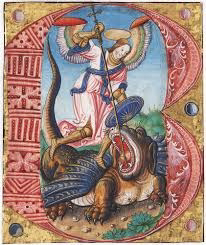
We are in that strange situation
where what we hear in the Gospel
does not seem to fit
with feast of the day.
Our Lord
speaks of the importance
of being as humble as children.
He speaks of the fate
of those who would corrupt them.
He speaks of clear and decisive action
to prevent sin.
Then and only then
does He speak briefly
of the angels
that represent His children
in Heaven.
There is no mention
of St Michael.
In celebrating Michaelmas,
are we focussing
too much on things
that are really unimportant?
[PAUSE]
The thing is
that angels are very important.
We see them throughout
Holy Scripture,
we know three of their names
from the Bible:
Gabriel, Michael and Raphael.
They herald important events,
offer healing to the righteous,
and battle evil with swords drawn.
We know Our Lord
has legions of angels
at His disposal.
So why, on this celebration
of the Angels
is there so little in the Gospel?
[PAUSE]
Angels are background workers.
Their days are spent
in service to God.
As spirits,
they have no bodies,
just appearances of bodies
when rare circumstances demand.
They don't operate
in the same part of Creation
that we do.
We don't see them
because our eyes are physical
and the Angels are spirits.
But God tells us they are there
and on our side.
We also know
that there are those spirits
who wants us to fall
and be destroyed.
There are spirits of hate
and malice,
who corrupt those
who are weak enough
to be corrupted.
There are spirits
who are corrupters
of the children of God.
We have seen them
almost from the beginning
tempting us
to eat the forbidden fruit
and turn from Almighty God.
These beguiling spirits
are the cause of much
of our misery
because they exploit
our weaknesses.
It s these spirits
that God bids us
amputate from our lives.
[PAUSE]
We don't always see
the evil until it's too late
but, if we listen,
we can learn to hear the words
of temptation
which seek to corrupt us.
Our duty is
to keep our humility,
realise our need
for someone greater to look after us
in our weakness,
and not try to be greater
or more powerful than we really are.
We differ from the angels
because we have bodies.
While those bodies limit us
they are gifts of God to us
and they are to be used
for the Glory of God.
Of course,
having a body
makes us open to corruption
sin and temptation.
Our Lord says
that we are better off
cutting off bits of our body
than entering Hell.
But we need not do that
if we recognise the work
of the angels around us.
For,
behind the scenes,
we know that St Michael
has already fought
with that old serpent
and cast it away.
It is the Devil
and his angels that have
caused offence
and are cut off
and thrown into the pit
so that we can be free
from the same fate
through the resurrection
of Our Lord Jesus Christ.
Behind the scenes,
the angels climb up and down
the ladder connecting
Heaven and Earth
on our behalf
bringing us messages of hope
and instruction,
protecting us
lest we should dash
our foot against a stone.
It is not permitted for us
to use the angels as our servants
for they obey only
the Divine Master.
Any spirit that would obey us
is a spirit that seeks
to take advantage of our bodies
and corrupt us
with enticements and trinkets
which we need to cut out of our lives
so that, like the angels
we might obey only God
in our service of Him.
[PAUSE]
Our Lord tells us
that the angels are there
before the throne
on our behalf
but we must keep our focus
on being children of God.
But, if Our Lord says
that they are there,
then we ought to venerate
their feast day in gratitude
for their service to us.
For they will take our veneration
and give it to the One
to Whom all glory is given
a glory that is not just
reflected in angels
but in all of His creation.
Including us.
Including you.
Yes. You.
Monday, September 23, 2024
Anglican Catholicism and the Book of Common Prayer
Why does the Anglican Catholic Church use the 1549 BCP and not the 1662?
Subscribe to:
Posts (Atom)

