Just how infinite is God?
Showing posts with label Mathematical Spirituality. Show all posts
Showing posts with label Mathematical Spirituality. Show all posts
Monday, May 04, 2026


Friday, December 14, 2018
The Multiverse and Reality
I posted a few years ago on the question of the Subjunctive God in which I raise the issue of divine omniscience being perfectly compatible with our freewill. God knows all the ways in which we might act in any given situation.
This raises some interesting possibilities in itself as it seems that we influence reality itself in the decisions that we do and don’t make. It is our decisions that make the potential actual and, although we create nothing, our existence as described in Genesis ii does seem to suggest that we have a power over creation.
“And out of the ground the LORD God formed every beast of the field, and every fowl of the air; and brought them unto Adam to see what he would call them: and whatsoever Adam called every living creature, that was the name thereof.” (Genesis ii.19)
Of course, the naming of things has a deeper significance in the Pentateuch. To know a name is to hold some power over the thing names: the noun becomes a symbol of mastery which is why we are never given the true name of God other than a verification that He is.
What do we mean by “Reality”? Good question. As I try to think this through, my working definition (and one that is likely to change) is that Reality is all that is, how it acts in regard to its members and how it presents itself to conscious thought. Is God part of reality? In that He is, yes. In that He is the same as His Creation, no. God’s existence is not contingent on anything else. Science tells us that the Universe is a bundle of contingencies described by Laws of Physics which posit that it must itself exist. The Borde-Guth-Vilenkin theorem based on scientific principles tells us that any inflationary universe is not past-complete: if a Universe is expanding, then it must have a beginning.
Many scientists posit the existence of other universes set inside a grand Multiverse. They do so due to irregularities in the behaviour of gravity and the question of dark matter, dark energy and the theory of M-brane theory which arises from String Theory. In the late 20th Century, it was speculated (by Turoc, I think) that the Big Bang occurred as a result of a collision between two vast membranes floating in the universe. Of course, the existence of parallel universes is going to be as difficult to prove as the existence of God. Many scientists seem to have replaced the untestable hypothesis of God with an untestable hypothesis of the Multiverse. Even then, apart from applying the Borde-Guth-Vilenkin Theorem to the Multiverse, we still have the question as to why M-branes are colliding, why quantum fluctuations happen, and why there is something rather than nothing, and by nothing, I mean no thing.
I firmly believe that in God we live and move and have our being. This might smack of panentheism: God-in-the-Universe but it’s how we break that word “panentheism” up that really matters. Clearly God is distinct from His Creation otherwise there is Sin in God because there is Sin in Creation. I favour pan-entheism i.e. God present in all things, not panen-theism i.e. all things part of God, yet God standing beyond. I don’t think I’ve made that very clear in myself and see it as part of my development in my relationship with God.
It is how we live and move and have our being that the empirical physical science strives to answer. The paradoxes of Quantum Mechanics seem to present us with a challenge to our understanding of reality. The double-slit experiment tells us that a particle can effectively be detected in two places at the same time, whilst Quantum Entanglement seems to suggest a “telepathy” between particles that is faster than light. These paradoxes do give rise to deeper research and deeper theories. Nothing can be completely observable to human measurement. What actually is may be different from what we observe. Can it be that Quantum Mechanics gives us a separation between Aristotelian Substance and Accident?
Clearly, in the Omniscience of God, all possibilities and modes of Existence are present at once to Him, yet there is only one of those possibilities that becomes actual and we seem to be responsible for that becoming through the exercise of our will.
Does this put us in the role of creators with God as this sounds like the exaltation of the human at the cost of the Divine Kingship of God. Are we gods?
No. I’m not saying that, though I believe that our sanctification by God permits us to share in His Divine Nature as He partakes of our Human Nature. We are beings endowed with the faculties of intellect and choice however imperfect they may be. Sin is the result of us having choice, and it is through our faith God in Our Lord Jesus Christ that we will find the way to repentance by turning always to Him. We find ourselves in the presence of God who loves us so much as to give us space to be ourselves as He wants us to be, and to respond to His love with autonomy being drawn to Him by the glory of His Being, not coerced to Him by His power. He can and does wield that power very clearly though not always perceptibly. What we do does affect reality – we can’t deny that for that is how Sin spreads through the Cosmos. I merely speculate on a mechanism as to how, given the understanding of Science, this might be the case.
Unlike Fr Anthony who seeks the Truth through a Romantic and Classical Liberal Philosophy, I must remain a Scholastic and one who understands things through a Platonic Mathematics. I hope not to be as self-defeating as Frege or Ayer in their taking of logical positivism to unnatural and indefensible extremes. However, I am coming to see the business of being human as a voyage through the realms of the possible and bearing witness to what is the reality and what is a false impression of the reality. My understanding of what is will, I hope, always be on the ascent to the Divine with many a swoop and a dive, I expect.
Nothing is certain in Science, but things are certain in Mathematics and Logic, though these require the Revelation of God to get us toward the truth as they do nothing without Him. To my mind, these are the waters upon which the Church has set sail. They may be ten dimensional branes, or they may be the brainwaves of God. In either case, our Science can only be perfected in Him and He is the limit to which we tend.
Friday, June 22, 2018
The matter of matter matters matters
I am grateful to Professor Jordan Peterson for crystallising a few thoughts in my head. He has given me a very succinct idea of what the meaning of life is - or rather he has explained to me what we mean by "the Meaning of Life". Specifically, the meaning of life is seeing that everything we do in our life matters. Our actions have to matter somewhere along the line or we suffer some psychological morbidity. We lose heart and meaning when our efforts are shown to be of no consequence or little worth and this is quite a killer in more senses of the word than one.
One of the great questions of today among many people, particularly the young, is "What's the point?" I remember that when I taught in school, every year someone would ask me what the point of mathematics is.
Sometimes I provided an answer along the lines of showing how Mathematics gives us a clearer picture when solving certain problems.
For example we have this famous riddle.
Three people check into a hotel room. The clerk says the bill is £300, so each guest pays £100. Later the clerk realises the bill should only be £250. To rectify this, he gives the bellboy £50 to return to the guests. On the way to the room, the bellboy realises that he cannot divide the money equally. As the guests didn't know the total of the revised bill, the bellboy decides to give each guest £16 and keep £2 as a tip for himself. Each guest got £16 back, so now each guest only paid £84, bringing the total paid to £252. The bellboy has £2. And £252 + £2 = £254 so, if the guests originally handed over £300, what happened to the remaining £46?
Clearly, mathematics has a part to play in answering this question which I leave as an exercise in the informal fallacy to the reader (though, if pressed, I might put the solution in the comments).
I have been known to answer this question by saying that the exercises of mathematics are just that, exercises to strengthen the brain's capacity for rational thinking in the same way that a foot ball player learns ballet to strengthen muscles and to develop greater control over his/her body.
I have also answered the question, citing a luminary whose name escapes me, along the lines of "what's the point of a newborn baby?"
Indeed. What is the point of a newborn baby? What is the point of us?
This is a problem that philosophers have wrestled with over the years. Christianity does have a succinct answer in that the purpose to which we have been created is to love the One who Created us. Of course, this does open up a raft of further problems, like the Problem of Evil and the like. What Christianity does is, more or less, what mathematicians often find themselves doing. We show that a solution to a problem exists, but not what that solution is explicitly. Indeed, there are times that we simply cannot write the solution explicitly.
For example, we can easily show the existence of the number π just by drawing a circle of diameter 1' and then knowing that the circumference must be π' long. What we can't do is write down the exact value of π because it is an infinitely long, non-recurring decimal as shown as late as the 19th Century by Ferdinand von Lindemann. A solution exists, but we can't write it down.
The syllogisms (well, not quite syllogisms - Aristotle would be horrified!) that Christianity makes are
A1) If there God exists then He loves us.
A2) God exists
Therefore
A3) He loves us.
B1) To love someone means taking a personal interest in what they do.
B2=A3) God loves us.
B2=A3) God loves us.
Therefore
B3) God takes a personal interest in what we do.
C1) To take a personal interest in what someone does gives that action meaning.
C2=B3) God takes a personal interest in what we do.
C3) Our actions have meaning.
The argument is logically sound, but we do need to establish that the premises A1, A2, B1 and C1 are actually true, and this is where the theist and atheist can spend their time arguing. Nonetheless, if Christianity is correct, then it is God who give meaning to our lives and, since God creates us from Eternity, that meaning that He gives us is always there in His intention to create us.
Now, let's look at the situation without God. Ultimately, if we believe that what we do matters, then we have to be prepared to say why. We can look at the scientific fact that, in a few million years, nothing will remain of the human race whatsoever. A few thousand million years later, if the current model is correct, everything will be dust floating around in dark, empty space. Thus, there can be no long-term meaning of life in the Universe without an Eternal Being to give it and Eternal meaning.
To combat this, any belief that our life has a meaning must accept that the meaning is short-term. We have to accept that eventually all memory of us will perish, and we have to be comfortable with that. It does put saint and sinner on an equal playing field as all acts whether morally good or morally bad will fade away eventually. Adolph Hitler and Mother Theresa of Calcutta will be no different. The morality we have now is ultimately no different from any other morality. An act condemned in 1054AD may now be acceptable in 2132AD, so we cannot say that this act is absolutely moral or immoral. Thus, in a Godless universe, moral relativism is more or less the only alternative. There is no point in holding onto any single moral tenet because it won't make a hill of beans difference when reality consists of isolated neutrons drifting through an endlessly expanding cosmos.
There is much to this approach that I find troubling. First, it has to be said that human beings seem innately preoccupied with discovering meaning. Science keeps asking "why?" and "how does that work?" Mathematicians wrestle with solving Diophantine Equations and seemingly intractible problems such as Goldbach's conjecture. We look at the stars and try to understand. We look at each other and, by and large, see something unfathomable in each other. We fall in love, and that gives us some reason to keep going. We suffer and die for causes that seem bigger than us. If we do all this to try and give life a purpose, why on earth do we do so if there is no actual purpose?
The Existentialists decry any attempt to find meaning in life, and where does that get them? They still cannot answer the question why, if there is no meaning of life, one should not commit suicide? We certainly can imagine Sisyphus happy rolling his boulder uphill only for it to roll down again but why should we let his example dictate our own view of things? Why not laugh at the absurdity of life and toast it with cyanide? If life is pointless, why do we have a medical profession? If they can't stop death, why not euthanise everyone who ails? In a meaningless universe, Doctors and Nurses are the worst charlatans of them all - tyrants who will force us to go on living until we fall apart finally into our own nothingness.
But I don't believe this for a minute. I believe in my heart of hearts that each human being has an intrinsic worth no matter who they are. It's one reason why I am pro-Life even if that renders me impossible moral dilemmas. I would rather agonise over the situation where the baby is endangering the life of a mother than for neither of them to matter at all. I would rather weep bitter tears with the woman who has been raped than to say coldly that her ordeal is nothing and will be over soon anyway, because that is what the universe will say. Where does this worth, this dignity come from? Looking at humanity and its capacity for self-delusion, self-obsession and self-destruction, I simply cannot see this humanity as being the source of its own worth and dignity. Nor can I see a dispassionate universe giving us this dignity. There can only be one source and that is God Himself.
Until the Atheist can crush out from my understanding the intrinsic worth of every single human being whoever lived, I refuse not to believe in God, I refuse not to believe in His love, and I refuse not to believe in His expression of this worth He gives us as He writhes in pain upon the Cross.
I matter (even though it is difficult to believe sometimes) and you matter (I take that as a given) and the fact that you matter matters. Indeed the whole matter of matter matters to me, too. Convoluted, maybe, but the more we believe that nothing we do ultimately matters the more likely humanity will suffer loss of life on scales unprecedented as we have already seen in the 20th Century, and it will occur as something perfectly acceptable to the morality of the Day while all the other Days will look aghast and turn aside in shame.
Thursday, May 10, 2018
Ascension to the Outside

For God all the dimensions of existence lie open before him like some hazelnut in the palm of His hand. No wonder He can appear in locked rooms and ascend from view. This is what Our Blessed Lord can do with ease. His earthly ministry finished, He ascends, stepping out of the small piece of reality to which we are confined, to stand "outside" it all to be with the Father. Quite what this "outside" is we can't know or understand: the only possibility that our human minds can reasonably deduce is that this "outside" is God Himself.
This seems as absurd to the human mind for which time and position, size and weight, concrete and abstract are the framework of our understanding what reality is. If St Thomas Aquinas is correct and the simplicity of God renders Him identical with His Divine attributes, then this must go against anything that we can understand of our own reality and our own being. And yet, it is God Himself who gives us the framework of understanding in the poverty of our fallen existence. It is God who gives us objectivity whereby we must ascend out of very ourselves in prayer and in consideration for others.
While we must rejoice in the colour of life that our subjective experience gives us, the existence of God is an objective reality upon which we cannot impose any of our subjectivity, but must rely on how He reveals Himself to us. If we want to know God, then we must learn to ascend to Him in the practice of prayer and doing good things according to His Will. This will necessarily take us outside our own perceptions of what is.
As God prepares us for life with Him, that process being Salvation through redemption, justification, sanctification and glorification, so do we become more fully us by letting go of that which we believe defines us and does not. All our labels and self-descriptions are nothing: in the beginning, all God creates us to be is man and woman to live with Him in the Garden of Eden.
Our Lord ascends, and in so doing we forget about His face though we glimpse it through the ikon. We forget about what He eats or wears; we forget about his size and shape; we forget about all those psychological, sociological, and political labels with which we may have confined our thinking about Him. What remains of Him for us is the Word, now two-thousand years distant. Yet, the Word stands outside, and thus always is what it is. What we are to receive is the Holy Ghost binding us to the outside by bringing that outside within us so that our earthly knowledge of our self becomes just a shell - a shell that will be discarded when we too ascend.
Thus, the Church can never be "the Modern Church" because "modern" is part of the shell to be discarded. If our Faith is not of Eternity, then it is nothing and to be thrown off. If our Faith roots itself in the here and now, then it will be left there and come no further. If we want a Faith that changes with time, then we have no faith at all because Time itself will be discarded on the Outside. "The Modern Church" is a selfish institution, introspective and self-satisfied, accepting the limp and frail aspects of ourselves as the only things that must be included. There is nothing of Eternity therein, just empty words, empty logic, and empty comfort.
Yes, the Church must be radically inclusive, because it must include what really is, and separate it from the Hell of being insubstantial. It must accept people as they are, casting away their labels, and allow them to change by casting away their labels for themselves. It is the radically inclusive Church that helps human beings become the men and women they were created to be in God by helping them ascend to the Outside, an Outside that lies within. That ascension has been gifted to us in the Ascension of Our Lord.
Thursday, April 12, 2018
Mathematical Sehnsucht
I find, to my amazement, that I have had something to contribute to Fr Anthony's Blue Flower project. While I won't reproduce it here, I will perhaps mention that Mathematics does begin to give expression to the Transcendent and I may expand on that in a future article for the Blue Flower if there is sufficient interest.
Do please look out for this publication as there will be articles written by those of greater academy than me. I'm told it is aiming to be out in June.
Do please look out for this publication as there will be articles written by those of greater academy than me. I'm told it is aiming to be out in June.
Thursday, March 09, 2017
Self-Definition and Souls
My confrere, Fr Anthony Chadwick has revealed that he has Asperger's syndrome. As a teacher, I have had to deal with a lot of students with learning difficulties which include students with Aspergers. As an examinations officer, I have had to make arrangements for many students who require some provision for their difficulties. In most cases, the cause was dyslexia of some kind. In a very few cases, I found out later, some of these diagnoses were acquired by paying an educational psychologist a sum of money - the psychological/medical version of simony. At the time, these folk could acquire extra time (as much as 40% extra time) in examinations.
The trouble is that Life doesn't give you 25% extra time after you leave school. You don't get 25% extra time to meet deadlines, nor do you get 25% extra time to cross a road. These days, the regulations have been tightened so that it is much more difficult to get extra time in an exam. That is a good thing in my opinion.
The fact of the matter is that Life is tough and unfair. I have much respect for Fr Anthony who has lived with Aspergers undiagnosed for nearly all his life. Clearly, the condition has given him some explanation, some answers for the way his life has gone. Yet also, he must have unique insights into a life where interactions with other people are difficult, trying to read their expressions, trying to deal with social cues which are almost invisible, and then dealing with the aftermath when he got these wrong.
Yet, Fr Anthony did not diagnose himself with Aspergers. He may have recognised aspects of the condition in himself, but needed the affirmation of modern science to make the confirmation. To often, people diagnose themselves with things and then expect the world to fit around them. This is another example of the self-definition of which we must beware.
I may seem to many to come across unsympathetically to the transsexual/transgender person. That I will not indulge the reality of their sensations is true. I do not believe that all truth is relative - how can it be? There are things that are objectively true otherwise there can be no truth at all.
1) All truth is subjective.
2) If all truth is subjective then the truth of the statement "all truth is subjective" is subjective.
3) The truth of "all truth is subjective" cannot be verified.
4) Statement (1) is possibly false.
So if "all truth is subjective" is true, then it is possibly false. On the occasion that it is false, then we have a contradiction. On the occasion it is true, then it becomes an objective statement contradicting itself. Certainly we have no justification in believing that all truth is subjective. We do have justification in believing that some truth is objective.
Ouch! Still with me? I'm not sure that I'm still with me!
My point is this: it is entirely possible that my feelings/impressions of reality/experiences although very genuine in their sensation are wrong. There is an objective reality there which exists utterly independently of our opinions. There will be things about our very selves which can be true even if we feel the opposite.
As a Christian, I believe in the existence of God and that He is responsible for the existence of all things that come into existence. It is He who defines what reality is, and our lives are lived trying to experience that reality. That reality is not necessarily what we experience it to be, and it takes our lifetime to reconcile ourselves with the harsh truth of reality.
We all have that terrible experience when we realise that we aren't who we want ourselves to be. We might think ourselves as more academic than we actually are. We might think of ourselves as being fitter, more capable than we actually are. We might think that we were born in the wrong time. We might think that we are the opposite sex to what we are.
This realisation of reality seems to cause two reactions - acceptance whereby we recognise reality and try to improve what we can and accept our limitations, or denial, whereby we cling to our perception of reality which is actually a fantasy and try to impose that fantasy on the world.
It seems to me that Christianity is an attempt to embrace reality with God. Humility is the acceptance of what God has ordained and co-operation with that ordination. The point of the Church is that all we, injured by the lies of the Devil, can find refuge in the company of others suffering the same horror of the fact of reality while embracing the truth of God's love for us in Our Lord Jesus Christ. As Christians, we must draw others to us even in their fantasies, but we cannot indulge their fantasies which will draw us away from what is truly real, namely God Himself.
The true response of the Christian to the self-defined is that of the recognition of the first reality, namely of a soul on whose behalf Our Lord made His sacrifice for redemption. That is where we must start. We must first see a person - that is objective. Then we must apply the Lord's directive - "love thy neighbour". No exceptions.
Monday, December 12, 2016
Eternity in an hour
To see a World in a Grain of SandI've quoted from William Blake's Auguries of Innocence before on how we can see the whole of God's Creation in the very small. My recent conversations with my peers on Hell, although a frightening topic, was very fruitful as it forced me to confront my understanding of Eternity. The framework of our conversation was the question as to whether we are to go a finite duration punishment or an eternal separation. Can mortal man separate himself from his Creator eternally?
And a Heaven in a Wild Flower
Hold Infinity in the palm of your hand
And Eternity in an hour.
I leave that answer, such as it is in its paucity, to my previous posts.
My question now turns to what Eternity is and how God can be Eternal. As usual, as befits my Rational, Anglican Papal, mathematical methods, have a working definition, but I realize that all my definitions must, in some way, be merely working definitions.
A definition is a statement about what is, and, if we think about it, only God has the authority and scope to say what is. God is the Being from whom we derive our very being: who am I, then, to presume to say what is? Yet, clearly I do have some possibility. God is incarnate: He speaks to us, interacts with us, provides a bridge for us back to God the crossing of which washes us clean in a tide of blood. This means that we can have some definitions that will work as far as our understanding of being is concerned. God saves us, and we have sufficient knowledge of what saves means in order to know that we need to be saved. However, we also know that we are not saved by knowledge otherwise the unborn, the ignorant, and the incapable cannot be saved. We have sufficient understanding of being to know that being with God will fulfill our existence, and separation from God will cause us anguish, the like of which we would be better off never knowing.
However, we have insufficient knowledge of how God exists. There is an established philosophical debate about whether God is timeless (i.e. utterly beyond Time) or everlasting (i.e. within Time but unchanged by it). Each position has its problem: an Eternal God cannot interact with Time; an Everlasting God cannot have created Time. At least, these are the problems that confront human thinking, and ones that cause atheists much joy in thinking that they have a proof for the non-existence of God. This misses the point though. We are temporal beings and, although we have capabilities to express questions about timelessness and "everlasting"ness, our powers of reason are liable to break down. I can make philosophical enquiry into the situation, but philosophy is not theology, and theology is more pertinent.
The Bible is not clear on the question of Eternity. Indeed, we find ourselves back to αἰώνιος and ἀίδιος which underlie the philosophical problems as stated above. We have a Platonic Eternity which is "out there somewhere" and an Aristotelian Time which Newton would use to great effect in his theory of Absolute Space and Absolute Time. If anything the revolution that Einstein puts forward in his theories of relativity indicates that, due to the idea of simultaneity being subject to one's motion, Plato may indeed be right and that the past and future are "out there somewhere". This does seem to suggest, then, that the Creation that God has created exists in all Time, with Time as an ingredient within Creation, God standing "outside" of it yet His interactions with it all made from this "outside".
If this is true, then we do indeed have an Eternal existence, our soul being our totality within the Creation that God has made. Our consciousness of how time passes is thus an accident of how we experience being. Our consciousness is narrow and requires some kind of opening up our into the truth of reality. This is not something that can be done via any process of ours because all of our activity is necessarily dependent on our relationship with Time. It is how God can open our minds for us, as I believe that He did with St John the Divine in opening up the mind of a little human being to the complexity of Existence. Look at this Apocalypse, this Book of Revelation and see just how difficult it is to pin Time into it. There is silence in Heaven for about half an hour, but only for the perception of St John who is used to thinking in terms of Time.
This is such a beautiful possibility, but it is only that being, as it is, dependent upon the observations and theories of mortal man. Yet, if it is true, then it means that our dead still exist, preserved in the fabric of spacetime for God to draw out into His Eternity at His decision. We have nothing to fear, then, for whatever awaits us, we are being gazed upon in Love by the true Being Whom we cannot comprehend. All of our lives are open to Him and He truly does offer us true life in Him. I can only see that life in Him being Eternal. I don't know how we will experience it, but I know that, if those closing chapters of St John's Apocalypse are anything to go by, it will be more beautiful, more peaceful, more lovely than any human sense can behold. This is truly Heaven!
Friday, November 25, 2016
Quantum Christianity and Category Error
I alluded to the findings of Quantum Mechanics in my last post. I am not as well versed in the theory of Quantum Mechanics as I'd like to be. When I have a bit more time on my hands, I'll perhaps try and get it up-to-scratch, but then I'm a (former) mathematician, not a physicist. There is a difference.
My line of work has always been in the abstract which is a lot more interesting, because in mathematics, as I said earlier, we can play with the rules and see what the outcome is. We get some beautiful ideas which we can use to solve problems. Personally, I am a bit of a mathematical Platonist in that I believe that mathematics is discovered, not invented; that numbers exist, but not as material objects. Interestingly, each branch of mathematics seems to find some physical application. Even complex numbers, and hyper-complex numbers (the quaternions) are being used in your computer right now, yet you won't be able to count apples with them.
As far as I see it, Quantum Mechanics is a remarkable theory which can predict the motions of subatomic particles with an alarming degree of accuracy. Indeed, it even gives a limit to how accurately we can ever make measurements. The idea is that energy is not a completely continuous quantity but comes in packets called quanta. Albert Einstein then demonstrates that there is an equivalence between matter and energy, and so we have a direct impact of quantum mechanics on our material world. We no longer can measure where a particle is, but only where it probably is. Thus, the Quantum Mechanic combines the certainty of classical Newtonian Mechanics with probability and statistics to formulate her theory.
There are startling conclusions to this, which prove to be troubling (I state them in their popular versions, rather than the mathematical formalism):
1) (Heisenberg uncertainty principle) We cannot simultaneously know where a particle is and where it is going. If we know one for sure, then we cannot be sure about the other.
2) It is entirely possible that while a particle is probably right in front of you, it might actually be on the Moon.
3) Our observations of a particle actually affect the motion or state of that particle.
4) (Schroedinger's Cat) "a cat imagined as being enclosed in a box with a radioactive source and a poison that will be released when the source (unpredictably) emits radiation, the cat being considered (according to quantum mechanics) to be simultaneously both dead and alive until the box is opened and the cat observed."
5) (Wave-Particle Duality and The double slit experiment) A single particle of light, when directed at an obstacle with two apertures through which it may pass, passes through both of them. Consequently light can be considered both as a wave and as a particle.
I cite the popular versions precisely because these are the versions that have filtered down into popular thinking. The calculations that this theory makes, as I said above, are supremely accurate and make it a good scientific description of the way things work. However, Quantum Mechanics seems to break down as soon as we introduce gravity, and further, breaks down when we try and reconcile it with another supremely accurate theory - General Relativity. The theory we have for the very small does not match up with the theory we have for the very large.
The five facts that I have stated above do not marry with our experiences of life, and it is how we exaggerate these ideas that perhaps makes more mockery of the beauty of Quantum Mechanics, and our experiences of reality precisely because we misinterpret them.
1) If the Uncertainty Principle could be scaled up to our level, then we would never be able to catch a ball, let alone land a man on the moon.
2) It would take a length of time longer than the lifespan of the Universe for all the particles in your body to transport you suddenly to Mars.
3) If this were scaled up, then football matches would be a hoot!
4) Bishop George Berkeley's philosophy of things existing because we observe them would make a bit of a resurgence.Perhaps this is a proof of God's existence?
5) Bilocation would not be reserved to certain saints.
My line of work has always been in the abstract which is a lot more interesting, because in mathematics, as I said earlier, we can play with the rules and see what the outcome is. We get some beautiful ideas which we can use to solve problems. Personally, I am a bit of a mathematical Platonist in that I believe that mathematics is discovered, not invented; that numbers exist, but not as material objects. Interestingly, each branch of mathematics seems to find some physical application. Even complex numbers, and hyper-complex numbers (the quaternions) are being used in your computer right now, yet you won't be able to count apples with them.
As far as I see it, Quantum Mechanics is a remarkable theory which can predict the motions of subatomic particles with an alarming degree of accuracy. Indeed, it even gives a limit to how accurately we can ever make measurements. The idea is that energy is not a completely continuous quantity but comes in packets called quanta. Albert Einstein then demonstrates that there is an equivalence between matter and energy, and so we have a direct impact of quantum mechanics on our material world. We no longer can measure where a particle is, but only where it probably is. Thus, the Quantum Mechanic combines the certainty of classical Newtonian Mechanics with probability and statistics to formulate her theory.
There are startling conclusions to this, which prove to be troubling (I state them in their popular versions, rather than the mathematical formalism):
1) (Heisenberg uncertainty principle) We cannot simultaneously know where a particle is and where it is going. If we know one for sure, then we cannot be sure about the other.
2) It is entirely possible that while a particle is probably right in front of you, it might actually be on the Moon.
3) Our observations of a particle actually affect the motion or state of that particle.
4) (Schroedinger's Cat) "a cat imagined as being enclosed in a box with a radioactive source and a poison that will be released when the source (unpredictably) emits radiation, the cat being considered (according to quantum mechanics) to be simultaneously both dead and alive until the box is opened and the cat observed."
5) (Wave-Particle Duality and The double slit experiment) A single particle of light, when directed at an obstacle with two apertures through which it may pass, passes through both of them. Consequently light can be considered both as a wave and as a particle.
I cite the popular versions precisely because these are the versions that have filtered down into popular thinking. The calculations that this theory makes, as I said above, are supremely accurate and make it a good scientific description of the way things work. However, Quantum Mechanics seems to break down as soon as we introduce gravity, and further, breaks down when we try and reconcile it with another supremely accurate theory - General Relativity. The theory we have for the very small does not match up with the theory we have for the very large.
The five facts that I have stated above do not marry with our experiences of life, and it is how we exaggerate these ideas that perhaps makes more mockery of the beauty of Quantum Mechanics, and our experiences of reality precisely because we misinterpret them.
1) If the Uncertainty Principle could be scaled up to our level, then we would never be able to catch a ball, let alone land a man on the moon.
2) It would take a length of time longer than the lifespan of the Universe for all the particles in your body to transport you suddenly to Mars.
3) If this were scaled up, then football matches would be a hoot!
4) Bishop George Berkeley's philosophy of things existing because we observe them would make a bit of a resurgence.
5) Bilocation would not be reserved to certain saints.
The trouble is that these mathematical results have entered into our understanding of the macroscopic world in which Quantum Mechanics becomes unwieldy. Keeping track of the the billions of individual particles in your body would become very difficult, and yet we seem to be beginning to say that our common sense is wrong, because Quantum Mechanics says that it's wrong.
We now use something like the Schroedinger's cat argument in order to be comfortable saying that we are something that we are not. That's not how the argument goes. The mathematics is far more complicated and involves adding things together. There is no physical way of adding a dead cat to an alive cat: there is no way that you can be a Christian and refuse to believe in the existence of God. Many people use Schroedinger's Cat exactly for this purpose to hold together two opposite points of view, cry out that all truth is relative, and then explain away the resulting cognitive dissonance as the world "getting at them." An atheistic Christian is not the sum of a theist and an atheist - human beings aren't numbers nor quantum wave functions, so we cannot mathematically add them, nor perform a wave superposition with them. It seems that some people are labouring under a particularly insidious category error.
God either exists or He doesn't: there can't be a middle ground, though His existence is not beyond doubt - even St Thomas Aquinas grants that. There is no probability that He exists for the simple reason that if He does, He will not possess a quantum wave function describing His state. If God exists in one universe of the famous multiverse then, by the very attributes that He possesses, He must exist in every universe in the multiverse. It's also a good point to make that the existence of the multiverse is just as much a physical speculation as the existence of God. Evidence that supports the existence of the multiverse can also be explained by other things, such as the possibility that the energy is nor conserved. (How does one even prove that the total energy in the universe remains constant in the first place?) Probability requires a background framework from which values and measurements can be deduced. There can be no background framework to measure the probability of the existence of God.
It is the popular misconception of scientific method and result that gives rise to forms of pseudo-science which give justification to claims that are not only ridiculous but damaging to the framework and stability of Society. It also prevents real science from being done. Paul Feyerabend insists that Science must be a proper anarchy if it is to make inroads into the truth.
Many people now think that the truth must be relative. Mathematics refutes that. Mathematical truth is indeed truth. If one accepts the axioms and the methods of inference, then one is bound to accept the conclusion. Yet mathematics is not necessarily the only access to truth, though it needs to be proved that truth exists beyond the physical world. Physics can't prove that, so it uses Occam's razor to deny that there is anything outside physics. Mathematicians can be tempted to do the same. If we reject the idea of objective truth, then on what basis? Perhaps one needs to reject traditional logic and thus ways of engaging in communicating with other people.
Yet, in all this philosophising and discourse, we often forget something important. Human beings exist, and are not abstract. Our Lord bids us to value them because, if God exists, He wanted to create Human Beings. That's some value. In our dealings with others, we are not allowed to forget their intrinsic value and needs which trounce any theorising and abstract discovery. Love needs to be promulgated, and that's the truth.
Friday, August 19, 2016
Infinity Trinity
Fr Anthony Chadwick has accused this blogling as being highbrow. ☺ It isn’t meant to be, just rather the crazed meanderings of my mind. I am grateful to those who read it and find sympathy with what I write and who perhaps find some words from the mouth of God on this page. I am His instrument, but my thoughts are very fallible, so I am merely a leaky pot seeking transformation and repair by my Creator.
One of the things on my mind is the worry if this country were to succumb to a fundamentalist Islamic Caliphate. Would I be denounced as a polytheist, or as a person of the book? The question is purely academic. I don’t seek to die as God’s goodness is great to me, but I would truly wish that, should I need to, that I be able to lay down my life for my God, family and friends. I doubt that any of my arguments would sway the executioner’s knife, but I am no polytheist. I believe in One God in Three Persons, the Blessed Trinity.
This does cause non-Christians a major struggle. It’s meant to. The search for God is not an academic exercise – it’s not that sort of knowledge we should be seeking. To know God is to encounter Him on the level of persons. We are capable of reflecting on the beauty of infinity and are thus so drawn to awe and wonder about God’s being.
Infinity has many fascinating and counter-intuitive properties. Consider the Banach-Tarski Paradox.
Yes, I know. It’s maths! Well, don’t be afraid of it because it’s all numbers. Think about what it says. It is mathematically possible to break up a perfect sphere into pieces and reassemble them into two spheres the same size and shape as the original. If you don’t understand, don’t worry. You don’t NEED to understand it. Just think about what it means.
Infinite objects have peculiar properties. I can talk about a thing called V which is the collection of all sets. You probably know what a set is, but it can be proved logically that V is not a set. However, when we talk of V, we seem to be able to talk about it like a set. This infinite collection is neither a one, nor a many, but both a one and a many.
My point? It is mathematically feasible for something to be essentially a one and a many.
God, being God, is responsible for the existence of mathematics and if He of all beings cannot be thought of as both a one and a many simultaneously, then surely He is smaller in conceivability than His Creation. It is entirely possible that God is more than a Trinity, but He has revealed Himself as a Trinity. Do we have the whole revelation? As far as our Salvation goes, we have enough, and anything more is part of this gradual coming to know God on the level of persons. As Olivier Clement says, our destiny is to become one human being in a multiplicity of persons.
What is really needed is for us to stop looking for God intellectually and look to recover Him spiritually. If our Church exists only as an intellectual construct based on theoretical theological and philosophical premises, then that isn’t a Church – it’s another form of Gnosticism. The Faith exists so that even the most intellectually disadvantaged person is not just able to be saved, but also cherished for being who he is and further can know God.
Our real need Is, at times, to put down the books and the scrolls, and the annals, and get to know God. As I’ve said before, the Creeds help us know something of the God we seek. In our prayer lives and in our spiritual being we encounter many spirits whom we must test. If the “god” we meet is not the one in the Creed, then we know that we’re on the wrong path. However, once we know we’re on the right path, we need to learn more, to become more Holy, and to relate to the One Who created us.
As this world grows darker, our inward lives need care, our spirits need nourishment, and the light needs to burn brighter. However, let us not fall into the trap of an inward looking, introspective faith. Let us remember to turn our gaze outward to those folk with dead eyes and sad faces, remembering that we must stand with them and bring them the care, light and nourishment too. Not by brow-beating, nor intellectual argument, but by good, old-fashioned loving-kindness. Let us help them to approach God in awe and wonder, not by trying to understand infinity but by just being with Him.
Friday, March 04, 2016
Infinity and Trinity
I've finished yet another reading of Infinity and the Mind by Rudy Rucker. As a mathematician, I always hear some strange ideas from people about infinity. Is it a number? Well, yes and no. It is not a number in the sense of standard arithmetic. In standard arithmetic, numbers can be added, subtracted, multiplied, and divided providing we are not dividing by zero. Share four cakes between two people and each person gets two cakes; i.e. 4÷2=2. Share four cakes between no people, how much does each person get? Dividing by zero is not technically infinity - it is technically meaningless.
Infinity is sort of a number when it comes to counting things. The trouble is that there are different types of infinity. Indeed there are bigger and bigger and bigger infinities until one reaches the Absolute Infinity - except we never reach the Absolute Infinity. All this is mathematically sound.
Now how do we understand infinities? We can say that they are the number of objects in a set. For the non-mathematician, a set is just a collection of specific and identifiable objects. We can call the set of numbers {1,2,3,4...} the set N for example. I call the set of all numbers which can be expressed as a decimal (which may be infinitely long, like pi), R. It turns out that there are more numbers in R than in N.
Where on earth can this arcane discussion be going? As Rucker points out, a set is a Many that can be thought of as a One. Rather than think of all decimals, one by one, we can just conceive of R and use that to prevent ourselves from wasting intellectual resources.
The point is, we comprehend infinities by comprehending sets. Sets are the key thing here. You might think we can form a set of anything such as the set of all cats in Hull in 2016, or the set of bishop's wives - you are the set of all the cells in your body! Yet there are sets that cannot exist as sets such as the set S of all sets which don't contain themselves. That's a tricky concept and you can take time to think about it and enjoy the logical conundrum, or move on and just hold to my conclusion. There is no universal set, no set of all sets, but there is a class of all sets.
The point is that we can easily talk of the class of all sets as one object, in which case it really ought to be a set, but it can't be a set without some awful logical contradiction taking place. We can even conceive of T the class of all possible thoughts and the same thing happens. It is not a set. If a set is a Many that can be treated as a One, T is not. It is a single conceivable thing which cannot be treated as a single conceivable thing.
For the Christian, this sounds very familiar. We hold to a Unity that is a Multiplicity - a Three-in-One. Of course this is impossible by anything bound by the laws of Physics, but perhaps we see that in the laws of mathematics such a being can be possible albeit beyond finite comprehension.
I do apologise if I lost my readers along the way here. My aim was simply to show that the Doctrine of the Holy Trinity, although utterly transcendent, permits itself to be seen as a shadow in mathematical thought. Beyond that we must keep silence and lift ourselves above such Earthly thoughts.
Thursday, August 20, 2015
Drawing out education
Today sees the publication of the GCSE exam results, a week after the A-Level results. Forthose of you not familiar with the British education system, GCSEs are taken usually by 15-16 year olds; A-levels are taken usually by 17-18 year olds and are used among other things by universities to select prospective students. Of course, one of the effects that this has on the education system here in the U.K. is that schools can be tempted to teach children to pass exams. Is this a bad thing? Well, this depends on how you view education.
After quite a few years of being involved in education, I still find myself wondering about what it is that I'm doing. One might say that, as a teacher, I am imparting knowledge on my pupils. Clearly, I have a syllabus to follow which gives a structure to the course but this does mean that pupils don't really get a say in what they'd like to be taught, nor do I get a say in what I'd like to teach them. I was taught things which do not get taught now. Even then, my teachers were taught things that they never got to teach me, so there is always a bit of melancholy when the syllabus limits you.
Ultimately, though, I believe that I have to teach myself out of a job. For my students' sake I must become redundant. One of my main goals as an educator is to teach my students how to teach themselves. As they grow up, children need to know how to form, pursue, and evaluate forms of inquiry. Mathematics, of course, is a purely abstract discipline: it is not a physical science. However, the word "mathematics" is intrinsically linked with the Greek word mathetes meaning "disciple". Mathematics is the art of being a good learner. This is why it is absolutely fundamental in education beyond money and mensuration. It gives a framework for argument and proof which other subjects utilise and in which they converse.
The art of mathematics comes in the necessity of practice. Not only is following the rules necessary, but it is knowing why the rules work in the first place. Look at this sequence of fractions:
3/3 = 1/1 = 1
4/8 = 1/2
5/15 = 1/3
6/24 = 1/4
7/35 = 1/5
Is this just pure coincidence, or is there something about fractions of the form (x+1)/(x2-1) that mean that they always cancel down to 1/(x-1)? For the mathematically experienced, this is an obvious result that comes from looking at algebra rather than arithmetic. It's also not a coincidence that the sum of the first n odd numbers is n2. Many of my pupils will forget this fact quite quickly. What I hope they don't forget is the ability to at least formulate the question properly.
The child may ask "if God made the world then who made God?" which is a perfectly reasonable question on the face of it. However, but drawing out from that child the ideas that underpin that question, the child will see the answer for herself. This method of "drawing out" is the literal meaning of education.
This does seem to be the reverse of the exam system. Rather than drawing out ideas from the child, efforts seem to be made in cramming information in. The average human being can get by in life without ever needing the knowledge that the Battle of Borodino took place in 1812 or that the giant squid is architeuthis dux, or that E flat major is the relative major to the key of C minor. Yet, these facts may indeed be examined upon and one's place at university may rest upon knowing these facts.
The trouble with cramming in facts is that it creates an imposition on a pupil to which the pupil may not necessarily have subscribed. I am sympathetic to my fifth form student who takes one look at the differential calculus and says, "when will I ever need to know that!?" I try to explain about the understanding of rates of change, of velocities and speeds, and even the ideas of maximising commodities subject to constraints, yet I do question whether the syllabus allows for true education or relies on just simple cramming.
Ah, but education should be about preparing children for dealing with real life problems. I find it interesting that, despite lots of education, we still suffer from the same real-life problems without a satisfactory solution. Perhaps our education system is to blame, or perhaps we keep looking in the wrong place for the solutions and never allow ourselves to be educated in the right way. We bewail the competitive nature of employment and the rat-race, seeking a quieter and calmer lifestyle, and yet the levels of competition for jobs and university places is growing. Is this competition right? Does a good education give one a competitive edge? If it does than why do people continue to compete for a resource rather than find ways to distribute that resource fairly?
Albert Einstein said, "To obtain an assured favourable response from people, it is better to offer them something for their stomachs instead of their brains." Perhaps, then, the Education System should be more a training in utilising resources to attain favourable responses from people. However, then we would find ourselves in the position in which people become means to ends rather than ends in themselves. Already we seem to have done away with any notion of learning for the sake of learning.
There is something inherently wonderful about education in itself. To take pleasure in knowing why something works is wonderful, but so is the pleasure in not knowing why something works and engaging in the task of finding out. This really does allow each one of us to engage with the world around us as we are rather than what we are prescribed to be. We only find out who we really are when we learn to interact with the world around us. We only ever find our passions in life by trial and error, by painting pictures and realising that we've not got the colours quite right. The child that always asks, "please sir, have I done it right?" needs to develop the confidence to know precisely for himself whether he is right or wrong and how it matters to him. We know that 2+2=5 is wrong mathematically, but the act of appreciating why it's wrong possesses a beauty in itself and that beauty is not smugness..
With a world that is constantly geared to the dread dichotomies of success/failure, right/wrong, true/false, we seldom see failure as an education experience. "This organisation does not tolerate failure", said Blofeld, and his thinking ensures that any error is met with the fires of Hell itself. This is why Christianity is quite the reverse. It is only in the task of recognising our errors and turning to God that we realise who we really are. We only find ourselves when we allow ourselves to be drawn out into the arena of Creation and, trusting in God's mercy when we fail, realise who we are through understanding our capabilities and limitations. We need to educate ourselves out of the pass/fail dichotomy if we want to see the true colours of living.
Ulitmately, all competition is meaningless in itself as, at the end of the game, all the pieces go back into the box. It is what remains after the game is played and how we have been drawn out of ourselves by the process. True education will seek to give a pupil that which extends beyond the narrow confines of the work place, and the best education will lead that pupil to become a disciple of God Himself.
Tuesday, August 11, 2015
St Benedict's Priory 2015: Growing pains and taking pains to grow
I've just returned from my retreat to visit my Monastic Community in Salisbury. The four monks are well, though Dom Kenneth being 92 is now rather less mobile than once he was. However, the community has accepted that it is unlikely to grow and, indeed, may not be able to support growth. That's immensely sad, but fair - there are things we should not cling on to and we must trust God to sustain that which needs to be sustained and allow to pass that which God allows to pass.
With the numbers of religious believers declining in the West, we often find ourselves praying for growth. The trouble with growth is that it often involves competition. There is a mathematical parallel that I can draw here, but I realise that not many people will be comfortable with it - I beg their indulgence. Suppose that the world consisted of two countries Alpha and Zeta on the surface of the globe. Both countries can grow in area only so far as they are necessarily competing for area. Eventually the international boundaries of Alpha and Zeta will meet in one common boundary and the two countries will make up the whole of the globe. From that moment on, for Alpha to increase in area will mean that Zeta must decrease in area. There will come a point where there can be no mutual flourishing for Alpha and Zeta. One must decrease so that the other decreases.
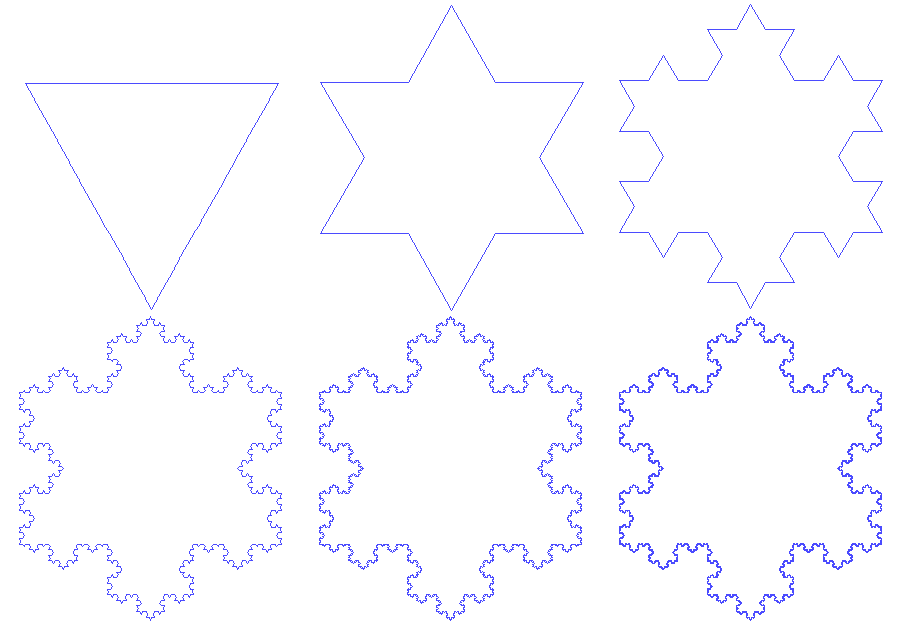
Interestingly enough, if Alpha and Zeta were interested only in increasing the length of their boundaries, then it is entirely possible for them to do so without eventually running into direct competition. If you don't believe that a shape can have a finite area and infinite perimeter, then you haven't yet met the Koch Snowflake which has exactly those properties:
Now what has all this got to do with the Church? It's clear that most churches measure growth by way of numbers. Various statistics are drawn up from regular church attendance as well as the numbers of people attending the major feasts. I blogged on this last year, Of course, this view is rather difficult for the ACC here in England. We are tiny in number and that makes us appear to be the lunatic fringe. some people look at our size and, because it is insignificant in comparison with the Church of England and the Church of Rome, we are regarded as a cult or bunch of people playing dressing-up. Naturally, they dismiss us and walk away before we can demonstrate to the contrary. What can we do to prevent people from viewing us as a cult? We need to grow more so that our views are seen to be more acceptable. For the secular culture, people will not join because we are too small - it's a vicious circle.
The ACC in the UK, like many other small catholic denominations, will never quite be seen as socially acceptable until it has become significantly larger.There are more people who describe themselves as being Jedi on Census forms than who would describe themselves as Anglican Catholic.
For the Church of England, the issue of growth presents itself at odds with the Five Principles. Already we see that, on the issue of Chrism Masses, the independent adjudicator has been called in to examine a dispute between WATCH and SSWSH. The trouble is that WATCH (the organisation pressing for the ordination of women) is diametrically opposed to the Society of St Wilfrid and St Hilda. These represent the countries Alpha and Zeta in my mathematical thought experiment above. Given that the CofE is committed to the mutual flourishing of those who can and those who cannot accept the ordination fo women, it becomes difficult to see how that mutual flourishing can take place if they are competing for the same resource of congregation numbers, or synod votes for that matter. Of course, what happens is none of my business, but one factor that I know needs to grow in this whole debate is that of generosity.
While I was on retreat, I resolved to be as generous as I can be. I'm no longer in communion with my community, but I still love them dearly. It was a joy to be with them and to say the offices with them and to take part in their living. I attended Masses, but did not go up for communion - there is only so far I can go and the differences between our theologies are so different as to be prohibitive. I resolved to be generous because I know that I can be much less than generous on occasions. I do reject the doctrine of the CofE with a clear conscience, and will continue to do so on the grounds that I believe fundamentally that she has erred and strayed like a lost sheep. Yet I cannot afford to reject its people because they are not just like me but, indeed, they are still part of me, and I part of them. I spoke to my first clergywoman since leaving the CofE, and I did not burst into flames. She told me of the work that she had been doing taking toothpaste to the deprived Palestinians on the West Bank. I have to say, that her actions show greater faith than many of mine! I accept her as I would a Methodist minister and pray that the fruit of her labour for Christ may be rich and glorious.
The strength of the ACC is that it has a clarity of doctrine which allows everyone to see what we mean. We cannot hide the truth and indeed we follow the Lord's command not to hide the light of truth under a bushel. This is vitally important. The danger that I face as a member is that I may be guilty of not just shining the light but burning people with it. That's a very medieval response. I still shudder at the thought of poor Archbishop Cranmer bravely enduring the flames that seared his aged flesh, or the noble St John Cardinal Fisher losing his head before his naked remains were pitifully left on display. This behaviour really should have died out by now, but has it? Looking around the internet the answer is "no"!
Real Christianity is not lived on the internet but in the lives of those struggling to live the Gospel through the desire of drawing closer to God. You will not find real Christianity in any sermon unless it is viewed with the eyes of the Truth which will necessarily involve compassion and love. Any internet tirade that ties people to stakes will not have the fullness of God's Word in it. The Word of God will always be a call to repentance from sin, but it will also be a call to love. We have to take pains here to ensure that above all things it is love that truly grows.
The Love that God is is not tame, it will not be cosy or gentle, but it will burn with a passion fiercer than any flame. We have to dare to let that flame grow in us, burning us so that no sin remains in us. We have to stoke that fire that was ignited paradoxically through grace that comes from the water of Baptism and fanned into fire at Confirmation. If we bear the flame of the Love of God, then we should wield it in a way that only we get burned, not other people. The only thing that people should see is the light that comes from our burning. We will not be consumed, for we have the potential to be burning bushes like that which Moses saw. We burn as beacons, not as stakes, and we do this by practical action and examined living in the light of the fire wherewith we burn.
If the Church really wants to grow in the UK, then she must bring kindling with which to be ignited. We must bring to the Holy Ghost ourselves to burn and burn brightly with His light. Notice how a fire spreads. It may have separate tongues of fire, but it is still the same flame. It will compete against itself for fuel and oxygen, but if these are in plentiful supply, then there is no competition. We are the fuel for the fire, the Holy Ghost is the oxygen for the fire. We can grow only by burning with love for God and working His will in the world by loving others. That's the growth that the Church needs - not the number of candlewicks but the brightness of the flame with which they burn!
If our words and actions contain no Love, then there will be no kindling of the fire and no growth at all. How bright is your Church?
With the numbers of religious believers declining in the West, we often find ourselves praying for growth. The trouble with growth is that it often involves competition. There is a mathematical parallel that I can draw here, but I realise that not many people will be comfortable with it - I beg their indulgence. Suppose that the world consisted of two countries Alpha and Zeta on the surface of the globe. Both countries can grow in area only so far as they are necessarily competing for area. Eventually the international boundaries of Alpha and Zeta will meet in one common boundary and the two countries will make up the whole of the globe. From that moment on, for Alpha to increase in area will mean that Zeta must decrease in area. There will come a point where there can be no mutual flourishing for Alpha and Zeta. One must decrease so that the other decreases.
Interestingly enough, if Alpha and Zeta were interested only in increasing the length of their boundaries, then it is entirely possible for them to do so without eventually running into direct competition. If you don't believe that a shape can have a finite area and infinite perimeter, then you haven't yet met the Koch Snowflake which has exactly those properties:
Now what has all this got to do with the Church? It's clear that most churches measure growth by way of numbers. Various statistics are drawn up from regular church attendance as well as the numbers of people attending the major feasts. I blogged on this last year, Of course, this view is rather difficult for the ACC here in England. We are tiny in number and that makes us appear to be the lunatic fringe. some people look at our size and, because it is insignificant in comparison with the Church of England and the Church of Rome, we are regarded as a cult or bunch of people playing dressing-up. Naturally, they dismiss us and walk away before we can demonstrate to the contrary. What can we do to prevent people from viewing us as a cult? We need to grow more so that our views are seen to be more acceptable. For the secular culture, people will not join because we are too small - it's a vicious circle.
The ACC in the UK, like many other small catholic denominations, will never quite be seen as socially acceptable until it has become significantly larger.There are more people who describe themselves as being Jedi on Census forms than who would describe themselves as Anglican Catholic.
For the Church of England, the issue of growth presents itself at odds with the Five Principles. Already we see that, on the issue of Chrism Masses, the independent adjudicator has been called in to examine a dispute between WATCH and SSWSH. The trouble is that WATCH (the organisation pressing for the ordination of women) is diametrically opposed to the Society of St Wilfrid and St Hilda. These represent the countries Alpha and Zeta in my mathematical thought experiment above. Given that the CofE is committed to the mutual flourishing of those who can and those who cannot accept the ordination fo women, it becomes difficult to see how that mutual flourishing can take place if they are competing for the same resource of congregation numbers, or synod votes for that matter. Of course, what happens is none of my business, but one factor that I know needs to grow in this whole debate is that of generosity.
While I was on retreat, I resolved to be as generous as I can be. I'm no longer in communion with my community, but I still love them dearly. It was a joy to be with them and to say the offices with them and to take part in their living. I attended Masses, but did not go up for communion - there is only so far I can go and the differences between our theologies are so different as to be prohibitive. I resolved to be generous because I know that I can be much less than generous on occasions. I do reject the doctrine of the CofE with a clear conscience, and will continue to do so on the grounds that I believe fundamentally that she has erred and strayed like a lost sheep. Yet I cannot afford to reject its people because they are not just like me but, indeed, they are still part of me, and I part of them. I spoke to my first clergywoman since leaving the CofE, and I did not burst into flames. She told me of the work that she had been doing taking toothpaste to the deprived Palestinians on the West Bank. I have to say, that her actions show greater faith than many of mine! I accept her as I would a Methodist minister and pray that the fruit of her labour for Christ may be rich and glorious.
The strength of the ACC is that it has a clarity of doctrine which allows everyone to see what we mean. We cannot hide the truth and indeed we follow the Lord's command not to hide the light of truth under a bushel. This is vitally important. The danger that I face as a member is that I may be guilty of not just shining the light but burning people with it. That's a very medieval response. I still shudder at the thought of poor Archbishop Cranmer bravely enduring the flames that seared his aged flesh, or the noble St John Cardinal Fisher losing his head before his naked remains were pitifully left on display. This behaviour really should have died out by now, but has it? Looking around the internet the answer is "no"!
Real Christianity is not lived on the internet but in the lives of those struggling to live the Gospel through the desire of drawing closer to God. You will not find real Christianity in any sermon unless it is viewed with the eyes of the Truth which will necessarily involve compassion and love. Any internet tirade that ties people to stakes will not have the fullness of God's Word in it. The Word of God will always be a call to repentance from sin, but it will also be a call to love. We have to take pains here to ensure that above all things it is love that truly grows.
The Love that God is is not tame, it will not be cosy or gentle, but it will burn with a passion fiercer than any flame. We have to dare to let that flame grow in us, burning us so that no sin remains in us. We have to stoke that fire that was ignited paradoxically through grace that comes from the water of Baptism and fanned into fire at Confirmation. If we bear the flame of the Love of God, then we should wield it in a way that only we get burned, not other people. The only thing that people should see is the light that comes from our burning. We will not be consumed, for we have the potential to be burning bushes like that which Moses saw. We burn as beacons, not as stakes, and we do this by practical action and examined living in the light of the fire wherewith we burn.
If the Church really wants to grow in the UK, then she must bring kindling with which to be ignited. We must bring to the Holy Ghost ourselves to burn and burn brightly with His light. Notice how a fire spreads. It may have separate tongues of fire, but it is still the same flame. It will compete against itself for fuel and oxygen, but if these are in plentiful supply, then there is no competition. We are the fuel for the fire, the Holy Ghost is the oxygen for the fire. We can grow only by burning with love for God and working His will in the world by loving others. That's the growth that the Church needs - not the number of candlewicks but the brightness of the flame with which they burn!
If our words and actions contain no Love, then there will be no kindling of the fire and no growth at all. How bright is your Church?
Wednesday, November 26, 2014
Choosing our daily bread: Part 2
As I continue to ruminate on the choices that we face in life, I continue to enjoy my sausage sandwich on brown bread. Aside from the problem of Evil that I thought on in my last post, there is the problem of there being free human choice itself. It's a problem that perplexes many Christians. Can we choose to be saved from our sins? Is Salvation in the same category as the white/brown bread problem with which we started?
First of all, is everyone going to be saved? Our Lord Jesus tells us that there will be many who say to Him "Lord, Lord" who will not enter into the Kingdom of Heaven. The answer is therefore no, there will be those who are not saved. However, what does it mean to be saved from our sins? St Paul reminds us that the wages of sin is death and St John's Revelation would remind us that this is the second death which eternally separates us from God. If there is no God then there is only death. If there is a God then there is hope of escaping death.
It is clear that that God makes the choice. What would that choice look like? Ah. Now here's the rub because it presupposes that we know how God thinks. Clearly we can't do that. However, God allows us reason about Him because He wishes to communicate with us. So let us try, and put forward an argument which, though imperfect and certainly not worthy of the mind of God, may illuminate things. What is the criteria which will ensure that God will save us?
If He chooses not to save us, what will the reason be? If we have no input into whether we are saved or not, then only God is responsible for our death. He may have good moral reasons for doing so, but it is very hard to see what they are. After all, He chose to create us, and then He chose to reject us. The moral reasons for doing so will have to take into account the fact that we were not responsible and, further, could do nothing to alter the outcome. Our rejection is down to what we are and not what we do. If we are rejected then, as St Paul shows us, we are rejected from Eternal life because of sin. The gospels show us that sin can be forgiven. If we are rejected then it must be because our sin is part of our being and that we possess necessarily the nothingness of Evil. Where did that come from?
Evil must be present in our lives as a result of our ability to choose and the story of Genesis iii shows us that it is by eating of the fruit of the tree of knowledge of Good and Evil that sin enters the world. Our ability to choose is then infected by the possibility that we are free to choose contrary to the will of God. This infection has Satan as its cause as a result of his free choice. One can assume that angels and archangels have a greater freedom in which they can exercise their choice. To know God means we also need to know what God is not. To know the presence of God means to know the absence of God. It seems reasonable to me that Evil is a necessary privation for Creation.
Evil is where God is not and it is therefore true to say that that which is Evil cannot logically be in the presence of God. Thus God's choice is down to what He considers to be salvageable from Evil. His very presence makes the choice. If our Evil can be purged by His presence in our lives then we will remain. If it can't then we will not remain. The decision as to whether we are salvageable must be God's.
Of course, God makes the choice in His present which is Eternity. We are not eternal but temporal. Whatever choices we make are made in Time and are thus eternally present to God despite the fact that our present as insubstantial as a line in multidimensional space. It seems to me, then, that from God's point of view our free choices are actually part of what we are. Our free choices in Time become what we are in God's perception of us and thus give Him adequate reason for accepting or rejecting us from Eternity. We can freely choose Him in our ever changing present and this choice becomes what we are in God's view of us.
The problem that Christians face is that of standing before God on the Day of Judgement and giving an account of ourselves. We naturally perceive it as a temporal event, however it can't be unless we have a richer sense of Time as God has. We have no power to save ourselves by making an eternal choice. We have the power to make choices in our own narrow time and those choices affect us ontologically. We are saved only through God's choice made from eternity when, from our point of view, our lives are complete.
Can it be that the problems of free-will and Salvation are some forms of category error in comparing judgements made in our time with judgements made from Eternity? Our decision in our time do affect our Salvation because they make us who we are in the eternal standpoint where only God can save. Responsibility for our sins is ours because they occur in Time. If we are saved from Eternity then we are saved only through God's effort because in Eternity we are as complete as we can be of ourselves.
We read in St Mark's gospel that "He that believeth and is baptized shall be saved; but he that believeth not shall be damned" (St Mark xvi.16) and in St Matthew, we read "he that shall endure unto the end, the same shall be saved" (St Matthew xxiv.13) The act of believing is a choice given our value-judgements and a choice that must be followed through to the bitter end. We are not saved at a single point in Time, but we are saved from the inevitability of Time. This is why St James exhorts us to have a lively faith, why St John begs us to repent and keep repenting, and why we are in constant need of forgiveness and the concomitant justification. From an point of view beyond Time we are what we have chosen to be.
Do our choices force God's decision? Do we contravene God's authority? St Paul again reminds us that "Charity suffereth long, and is kind; charity envieth not; charity vaunteth not itself, is not puffed up;Doth not behave itself unseemly, seeketh not her own, is not easily provoked, thinketh no evil; Rejoiceth not in iniquity, but rejoiceth in the truth; Beareth all things, believeth all things, hopeth all things, endureth all things." St John tells us that, "God is love; and he that dwelleth in love dwelleth in God, and God in him." The words "Charity" and "Love" are identical and we can see that it is an attribute of God's very self not to seek His own and to endure all things. God is His own limitation. If He permits us free will, then it is not our choice that is the cause of His limitation, but His own Divine nature - His fidelity to us as beings possessing knowledge of Him and of not-Him and the concomitant choice.
It seems reasonable to me that our free-choice affects our Salvation, not as a limitation on the power of God, but rather as a fulfillment of what He intends us to be in His Divine self-limitation. I know that many would disagree with me and even put up a proof-text battle. However, if the argument has existed this long then proof-text battles simply don't work. I simply offer my own limited understanding of what I perceive that I must do to be saved, namely: to believe in the Divine person of Our Lord Jesus Christ, His love for me and the reality of His Resurrection from the Dead and its concomitant promises, to believe this to the end, to receive God's grace in the Sacraments, to promulgate Love which is the substance of God, and seek to be of the Body of Christ which is Resurrected through Him. If I'm wrong, then I pray God will convince me otherwise.
Now, white or brown. Do I get a choice today?
Tuesday, November 25, 2014
Choosing our daily bread: Part 1
"Full sausage on white, please."
The lady behind the counter of the college refectory said, "I'm sorry, my dear, we've only got brown. We're on a health drive here."
So I had full sausage on brown without a moment's consideration. Yum! And another inch on the waist.
Of course, afterwards it got me thinking. Is it quite right that we should remove choice in order to promote healthy eating in our young folk?
I'll leave questions of College Refectory policy to those who know better, but it does pose an interesting and oft-asked question. Is it right to remove choice from a dependent for the dependent's own good?
It would be quite wrong for a parent to leave a pair of scissors near a one year old, or a box of matches within the grasp of a five year old. I'm sure that's some form of neglect and rightly so. The parent can't say, "Oh, it'll teach him to learn to respect scissors," or "Oh, she'll know not to do that next time." Clearly the harm that can be done by scissors and matches is something we'd rather not contemplate; suffice it to say that any damage could very well be permanent.
Of course, with white and brown bread, we have a different question. How are we expected to learn to make the right decision if the decision is not presented to us? How can we learn to make choices in life if we never make them during our formation?
There are lots of big choices that a child has to make growing up - choice of school, choice of subjects, choice of university, choice of career, choice of friends. It's no wonder that parents can, at times, fear the potential ramifications of the wrong choice. So much rests on our ability to choose and the fear comes when we are faced with a choice that we cannot take back.
Sometimes it is the choice that we can't take back that can change our lives for the better. Marriage is a fine example, particularly when one adheres to the indissolubility of marriage. This forces the couple to really check whether they are suited and, if things get difficult, to find ways of negotiating the rough patch and becoming stronger as a result. Marriages that cannot be broken are so much more worthwhile than marriages that can. The monastic life involves burning bridges. If one enters a monastery, takes vows and then decides to leave, then a new life has to be built from scratch. The life left behind will always be there though and the former Religious will have to find a way of coming to terms with that history.
Is it possible to make a wrong choice? Giving matches to your three year old (sorry parents who squirm at that!) is clearly the wrong choice even if the three year old flushes them down the toilet. Is there nothing good that can come from that? Perhaps a sense of relief that your three-year old doesn't know how matches work or is not interested in playing with fire? Would one take that risk though?
Surely a truly wrong choice is that out of which no good can come at all. Most choices will have a down side, even great pain, great humiliation, even death! There are British Christians flying to Iraq to battle ISIS. Are they making the right decision? If one considers the possibility of death as being a bad decision, then yes. If one values the principles by which one lives as having a greater value than one's life, then no. The goodness of a choice depends on what's at stake, and what's at stake depends on what one values.
So, going back to the lack of choice of bread. Why was that choice removed? Well, had the choice been there, a child could have evaluated the situation, "There is a choice between brown bread and white bread. Brown bread is healthier, but I don't like the taste." At this point, the value judgement comes in: "Do I value the immediate gratification over my health?" Then the decision is made. Thus the argument in full is:
1) (Choice) Brown bread or white bread.
2i) (Evaluation) Brown bread is healthier.
2ii) (Evaluation) White bread tastes nicer.
3) (Value judgement) Immediate taste trumps inches on waist.
4) (Conclusion) I'll choose white bread.
However, I doubt that a child would have actually reasoned thus. I think the evaluation for most children would be:
1) (Choice) Brown bread or white bread.
2) (Evaluation) White bread tastes nicer.
3) (Conclusion) I'll choose white bread.
In short, the child does not consider all the alternatives for evaluation. It is not sufficiently educated to make a full evaluation based on the data. If it does not have all the alternatives, should it be allowed to make the choice?
Here is where the Refectory policy of removing choice comes in. If there is only brown bread, then the argument becomes:
1) (Choice) Brown bread.
2) (Conclusion) I'll choose brown bread.
At least, that's the Refectory's hope. Of course, the choice the child faces is then:
1) (Choice) Brown bread or nothing.
2) (Evaluation) White bread tastes nicer.
3) (Conclusion) I'll choose nothing.
Thus the child doesn't eat unhealthily (here) but the Refectory loses money from those children who then buy their full sausage sandwich on white elsewhere next time. A child who, for medical reasons can't eat brown bread but only white, will either choose to risk their health or go hungry. That choice may not be easy in some cases. If a hungry child chooses to risk it and has a severe allergic reaction landing them in hospital, with whom does the responsibility of that choice lie? Technically, it is still the child, but that responsibility is diminished by the lack of alternative choices.
Much of this depends on value judgements or, as the economists and game-theorists term them, pay-off matrices. Game theory is actually quite fun even when it gets technical.
The key here is about education. If we educate our children to understand that health matters and that the occasional full-sausage-on-white is okay provided one eats a healthy diet, then the child can make their own decision. A child allergic to brown bread but still chooses it despite there being the option of white bread only has itself to blame. The option was there, but not chosen. The Refectory cannot really be held responsible, at least not in the same way that it could if it failed to provide the alternative.
It seems quite reasonable that whoever has most choice has most responsibility for the results of that choice. If the results of that choice result in the death of a child, then the one who made the choice is culpable.
We're faced with choice all the time. We can choose to use a solicitor because they have done the best work compared to others. We can choose the to smoke thirty cigarettes a day because it makes us feel relaxed in a job that could kill us due to stress. It is our value-judgements that colour our choices, but do we really have the ability to choose? Do we really have the ability to make value-judgements?
That is the subject of much philosophical debate. Can free-will exist in a deterministic universe? Is the universe truly deterministic?
Do we have a choice to be saved?
From what? Our sins.
Do we need to be saved from our sins? Are we obliged to accept a value-judgement based on a morality imposed by others? This depends if we agree that there are objective moral values. If we agree that the murder of a child who will grow up to cure a disease is morally wrong, then we have evidence for the existence of objective moral values. If we have existence of objective moral values, then we have some evidence (though not incontrovertible) of God.
Of course, for Christians, the existence of God is not in question. However, God, being the first cause of everything, is responsible for the creation of everything. St Thomas Aquinas would say (as well as others) that evil is not a thing, but the absence of a thing, so God did not create Evil. In themselves, things are good because God created them. So can He be called to account for choosing to permit Evil in His creation? One must first ask whether humanity has the right to try God. St Paul reminds us that we are faced with the clay trying to question the potter's motives for making it in the given form.
However, we are then faced with the fact that the inscrutability of the Creator's motives may be precisely that which drives His Creation from Him. If the Creator is showing inconsistency then there is a reason (whether justified or not) why someone chooses to abandon God. Let's look at the decision.
1) (Choice) Accept or Reject God.
2i) (Evaluation) I am told that God loves me.
2ii) (Evaluation) I am in pain and God has not relieved that pain.
3) (Value Judgement) My pain is more consistent with reality than that which I am being told.
4) (Decision) Reject God.
Like it or not, that's the argument that convinces many people that either God does not exist or that if He does then He is not worth any attention. Somehow such a person needs to be convinced of the argument:
1) (Choice) Accept or Reject God.
2i) (Evaluation) If God exists then He wanted to create me. He must therefore want me to exist.
2ii) (Evaluation) I want to be loved.
2iii) (Evaluation) I am in pain and God has not relieved that pain.
2iv) (Evaluation) God may have good moral reasons for not relieving that pain.
2v) (Evaluation) If God does not exist then there is no good reason for me being in pain.
3) (Value judgement) The hope that there is reason for my pain is better than there being no reason.
4) (Decision) Accept God.
Personally, I wouldn't call that argument fully compelling given the nature of some people's suffering. For me I see and hear of truly awful things that I want stopped right now. Even the thought of them is intolerable to me. God seemingly does nothing. However I believe that God can see everything and bring good out of everything, but I will certainly be interested in His reasons for why this has been allowed. If God does not exist then there can never be any point to this misery. I would rather trust God and believe that He wills everyone's good, permitting Evil only insofar as it can produce a good which renders the pain suffered truly worthwhile. Given that the pain in the world is so awful, I will be expecting a great deal of good! I think God, however, can pull that off.
Wednesday, October 01, 2014
Beauty, Happiness, Mathematics and God

I was struck by a bit of a vision today. By this, I don’t mean that I was thrown to the floor by bright lights, angelic choirs and the glory of the Beatific Vision – I’m not meant for that yet, otherwise it would have happened.
As I sat in the college chapel, my mind conjured up the
image of a plane of glass in the chapel floor which raised itself up at an
angle. I thought that within the glass was a picture of a cloud as one might
find painted onto glass in a stained glass window. As I looked more closely, I
could see that it was a galaxy, moving and swirling like a drop of milk in
black tea. Of course, this is in perfect keeping with the origin of the word
galaxy. It occurred to me that I was being given a window into another
dimension, a vision of another multiplicity of worlds beyond the shallow
horizons of my own little mind.
I do love looking at astronomical photographs. I still
cannot take in that what I’m looking at is not just millions of miles away, but
millions of miles in size and millions of years old. The scales are
mind-boggling, and yet perhaps we forget that there are a million square
millimetres in a square metre. The telescope is capable of giving us windows
into the infinite, resolving angles ten-thousandths of a degree wide. Here is
William Blake’s infinity in the palm of our hands.
Being a (largely failed) mathematician, my mind is always
looking for the structures inherent in Creation. That’s probably high-minded of
me and I do confess that praying Psalm 131 is not an easy task. Is it high
minded of me to try and comprehend what’s going on? I’m hoping that it isn’t in
the proviso that I understand that I will never completely understand what is
going on until I have seen God face to face. Even then…
I often wonder what my students find beautiful. For teenage
boys, it seems that beauty is an ill-defined affair and perhaps that’s because
they lack the language for saying why something Is beautiful. They have not yet
refined and honed the senses or the descriptors that will inspire them the most,
but they are surely capable of appreciating beauty. In my teens, I remember
being struck by the beauty of the solitary church bell and by Italian
Renaissance Organ intonations. They certainly transported me beyond my own
little world. Yet, I cannot be sure that my school mates had ever had that
experience, and I dared not ask them. If they did, then perhaps this beauty was
something that was so personal to them that even in the telling it would ruin
it for them. Sometimes language destroys a dream rather than brings it into
existence.
Beauty has always been something difficult to define,
perhaps rightly so if the adage “beauty is in the eye of the beholder” is
correct. What is certainly clear is that beauty resonates within the individual
like that solitary church bell. I fail to see how it is possible for someone to
register beauty without reacting to it on more than just the rational level.
The resounding of that bell of beauty allows the senses of our mind to be
transported to places beyond our physical senses. There is a sort of happiness
here, even when one finds beauty in a sad film like Atonement. There is a
happiness in one’s emotion, as if one is feeling pleasure in actually feeling
something other than the background level of emotion.
Sometimes language destroys a dream. I don’t find that with
mathematics, though. Mathematics doesn’t destroy dreams in my experience,
largely because mathematics deals with the necessarily abstract. I’ve
challenged some of my students to tell me what algebra is, but find the
repeated phrase “it’s maths with letters in it” coming back to bite me. When
one realises that algebra is looking at the processes of arithmetic without
taking things for granted, one can see some truly wonderful structures coming
into play. Algebras allow us to ask the great “what ifs” of arithmetic. What if
two times three is not the same as three times two? What would happen to
subtraction if we weren’t allowed to have negative numbers? What happens if I
allow negative numbers to have square roots?
Algebra answers these questions by producing new algebras,
rings, groups, semigroups, division rings, and quandles. Thanks to Descartes,
these lead into geometry and topology in which shapes bend and warp, blow up, project
and expand in so many ways, even into higher dimensions in which situations
make more sense. We understand more about our universe by looking at space and
time together. This gives us four dimensions, though we are hard pressed to
visualise anything that might be going on in 4D. Tesseracts and hyperspheres
are the province of the fiction of Robert Heinlein and his ilk, but that just
shows how mathematics yields dreams rather than destroys them.
I know that mathematics passes most people by. I can
sympathise as it has passed me by too. There is another old adage, “those who
can, do; those who can’t, teach.” Mathematically, I fall into the latter
category. I’m not fishing for sympathy
here: while I’d like to have progressed further into academic mathematics, I
was simply not clever enough to do so. There is no shame in that, and perhaps
it does help me appreciate that mathematics is a hard mistress to woo. I have
some affinity, then, with those who struggle with the rough terrain that comes
before one enters the darksome mathematical jungle. I can lead the curious to
the edge of the wild but, if they can go, they must go without me.
Fractions frighten people, and negative numbers really do upset those whose experience of the world is knowing how many beans make five. How many of us know how many beans make minus five? Of course, what may well be going is in effect a category mistake, after all, negative numbers are not numbers that can count how many physical objects there are. They can count how much money someone owes, or what the temperature of liquid nitrogen is – you need a reference point for that, a zero level. However the realisation that, under the same basic rules of arithmetic that everyone knows that minus one times minus one MUST yield positive one is a moment when one can appreciate that mathematics has a strange beauty that doesn’t really intersect this world in ways we would think.
Yet mathematics goes further and gives us a glimpse of the Divine. Those of us who cannot understand how God can exist without physical space or time would do well to know that numbers do just that also. We can determine statements of truth and falsehood about numbers just like we can with physical objects, and so their existence is assured. However, they have no space, nor time. They do not exist in an area of the brain, but are objective in their presence. Numbers really do point the way to God.
Of course, there are those who would read strange numerological significances in Holy Scripture but take them too far. Seven signifies perfection, forty the nature of penitence, three the completion of the loving family. These numerological fancies are just illustrations, just stories to colour our understanding of the world around us. Those who try to force arcane meaning or significance onto numbers are missing the point. This includes physicists who try to impose ridiculous limits on mathematics by meaningless notions like adding up all the positive whole numbers and getting a negative twelfth. Forcing that kind of physical limitation on that which is not physical is as destructive as language is to the dream.
As I look at my students, my worry is that they will seek contentment in the material world. There is nothing wrong with God’s Creation as I said in Sunday’s Sermon, but to look at the world and see everything in terms of clumps of matter and worth and commodity and fashion misses the true beauty that exists in what is really there. Can they see beauty in a muddy puddle or a plastic bag blowing in the wind? If they can, then perhaps our walk together has been fruitful for all of us.
Subscribe to:
Posts (Atom)

