Saturday, August 31, 2024

The Position on Salvation


Sermon for the fourteenth Sunday after Trinity

Position is everything 
in life, they say.

If this is true,
then it's worth watching 
the position of the ten lepers
who ask for healing
as Our Lord enters their town.

Because of their condition 
they stand at a prudent distance 
from Jesus.

That is the done thing.

We're used to that
even in this day and age.

When COVID lockdowns happen,
business is conducted at a distance.

So the lepers are acting
in a socially acceptable fashion
when approaching Jesus.

That's their starting position.

Then they are told
to show themselves to the priests
who have the responsibility 
to declare them clean
or not.

And now we see them set off.

Their distance from Jesus 
is increasing 
but necessary for them
to be declared clean.

It is then
that salvation comes to them.

Salvation in the sense 
of being salved, cured, healed.

Nine continue on their way
recognising the cure
but still walking away from Jesus
more concerned 
with being declared clean
and being restored to society.

Their cries of relief
are heard
but they must go to the priests
to praise God.

But the tenth,
the Samaritan,
a man who has no position
in the eyes of the Jewish society,
turns back to Christ.

His position 
becomes prostration 
at the feet of Jesus,
no longer far off 
but in a closeness
that would be obscene
if he were still a leper.

But it is here,
at the feet of Christ 
that glory is given to God.

It's not that the nine others 
aren't giving glory to God
in the temple,
it's that this one leper
recognises the grace of God
in his healing
and recognises that the source
of this grace is not far off
but here, right here,
standing and waiting for his thanks
with blessing upon blessing
in His holy and venerable hands.

[PAUSE]

This is a key moment 
in that it points directly
to Jesus as God,
not a prophet,
not a messenger,
not an angel
but Christ Our God.

Further,
it shows that,
while we come to Church
to find and worship God,
He is always near us.

Our Church will always
make His presence clear
to the world,
but,
for us Christians
who seek first 
the Kingdom of God
and His righteousness,
He is always nearer than we think
to receive our praise and thanksgiving,
and our prayers and supplications.

[PAUSE]

The Christian religion
preaches the truth
that God is always with us
which is why Our Lord Jesus Christ 
is the One Whom Isaiah calls
Emmanuel - God with us.

Seven centuries before 
the Incarnation,
Jesus is near Isaiah 
just as He is near 
Abraham, Isaac and Jacob
centuries even before that.

[PAUSE]

And now,
many centuries after,
Jesus is present here for us
to be worshipped 
and adored.

He has given us
the sacrifice of the Mass
not only to make His presence 
visible to us
but for us to take away with us
in the depths of our hearts.

Our tenth leper 
shows us 
that we can always 
give glory to God
at the feet of Christ 
where we are 
and that doing so 
brings us ever closer to Him
and to our Eternal joy.


Monday, August 26, 2024

Saturday, August 24, 2024

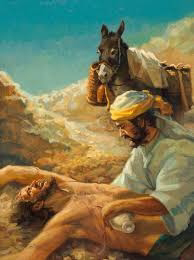
Oiling the Samaritan


Sermon for the thirteenth Sunday after Trinity 

One of the reasons
that many of us give
for not wanting to live
a long time ago
is the poor quality
of healthcare.

We don't want to live
with leeches
or knives used for bleeding 
or the horrible way
In which those suffering 
from mental diseases
were treated.

Indeed,
if we were lying bleeding 
by the side of the road,
would we want someone 
to pour oil and wine
onto our wounds?

[PAUSE]

"Ah!" you might say,
"the ancients often know
better remedies for illness
than we do now."

It's a good point
given how artificial 
much of our treatment 
appears.

Indeed, we have found
that olive oil can be used 
as an anti-inflammatory 
and disinfectant.

We have found that wine
can stimulate blood flow
and has other properties
that help the healing process.

But they have their limitations.

You wouldn't want 
to use them 
if the wound is infected.

But for a temporary solution 
to a wound
you could do a lot worse 
than pour oil and wine on it.

[PAUSE]

For the Samaritan
binding the wounds
of the poor traveller,
a temporary solution 
is all you need.

Once you get him 
to the inn 
and pay for his care,
then those wounds 
will be washed
and treated carefully 
and heal
ready for the Samaritan's return.

But oil and wine
will do for now.

[PAUSE]

Does this mean
that, in order to be
a good neighbour 
we need to be carrying around
oil and wine just in case?

Well that might do 
for the likes of Jamie Oliver
having balsamic vinegar,
turmeric and quince zest
in his back pocket,
but for us
that seems unlikely.

Remember,
Our Lord is expecting 
us to have mercy,
not whip up sour dough
at a moment's notice.

But one thing 
that is good to know
is that the Greek word for mercy
- and you know it 
when we sing 
Kyrie eleison -
is related to the pouring on
of oil.

Each time
we show mercy
we are pouring oil 
onto wounds
or onto troubled water.

We anoint with oil 
as a cleansing and purifying 
substance.

It eases stiff necks
and softens proud hearts.

This is why we are told 
to use oil
in our sacraments.

As the oil cleanses us outwardly, 
inwardly we are cleansed 
by the Holy Ghost Himself.

We show mercy
when we seek 
to calm a situation 
and dispel evil thinking,
cruel intentions 
and defuse anger.

Just as the Samaritan 
seeks to cleanse the wounds 
of the poor embattled traveller,
so do we seek 
to cleanse the wounds of Sin
not by condemnation 
but by forgiveness, truth, beauty 
and love.

[PAUSE]

We use oil 
at Baptism,
Confirmation,
Ordination,
and Unction
so that the Holy Ghost 
may bring us His peace in our lives.

He is the oil
that will ease our path
back to Heaven.