Monday, July 28, 2025

Anglican Catholic Soundbites


Why we have to be careful about the language we use to bring Christ to the people and people to Christ.

Sunday, July 27, 2025

Judging disciples


Sermon for the sixth Sunday after Trinity

"You Christians
are so judgemental!"

We hear that a lot,
but what does it mean?

We often find ourselves
in situations 
where the Christian life
runs contrary 
to the life of the world.

We have seen this 
in the public votes
in Parliament 
which have ruled
that there are circumstances 
in which it is lawful
to take the lives of innocent people.

We also live in an age
where profoundly 
destructive worldviews 
are being taught 
uncritically 
to those who are
learning how to live life.

And we Christians speak out
and get pilloried for doing so.

But we have to be careful
because people do not like to be judged.

Why not?

They think that
what they are doing
is good,
not harmful,
beneficial,
even beautiful.

And the basis for their judgement 
is that it "feels right" and
"isn't hurting anyone "
and "isn't trying to control people".

The basis of their sense of righteousness 
is themselves 
or it is the culture around them 
telling them that they are right.

Their righteousness 
is man-made,
not God-made.

Their righteousness 
will change with the times
and they will look back on the past
and declare it immoral
"by today's standards."

But "today's standards"
will be immoral by tomorrow's.

[PAUSE]

Our righteousness 
as disciples of Christ
has to exceed the righteousness 
of the Scribes and Pharisees 
of today.

Let's be clear,
there is no-one more 
educated in the Law
than the Pharisee. 

It's his job to know 
and to follow all the little bits and pieces
of the Divine law,
but his basis for the Law
is the law itself.

The Pharisees righteousness 
is based on a law
which is indeed God-given
but applied by a greater law
namely the Pharisee's
self-righteousness.

But doesn't the Church 
follow the Divine Law?

What makes the Church
any better than the Pharisees?

[PAUSE]

Our Lord shows us
that the law 
goes beyond the letter.

To.murder someone 
means more than 
sticking a knife into them.

We can commit murder
by calling someone a fool
and kill their place
in our hearts.

We can commit adultery
by looking lustfully at a women 
just as well as getting her
into bed.

The law of the Pharisee
is written on parchment. 

The law of God
is written on human hearts.

We've seen the effects
of applying the written law
inhumanely 
and the effects have been appalling.

If the written law 
has the capacity
to end the life of 
an innocent person 
then innocent people will die
and the world will think
that it has done a good thing.

And anyone who objects
will be regarded as
judgemental
and inhumanely
for allowing people's suffering 
to continue. 

[PAUSE]

This, of course,
ignores the sovereignty of God
and His ability
to turn our suffering into joy,
perhaps not in this life
but Eternally so.

All pain and suffering on earth
will end in time
and the heart that seeks
the righteousness of God
will find peace in Him.

Man does not have the capacity
to see the fulness of another's pain
nor the value that it possesses.

Man can only walk with those 
who suffer and tend
the wounds inflicted. 

Only God can reach the cause
of pain
because pain tells us
that something is wrong,
that there is a conflict 
between what is and what should be.

The righteousness of this world
seeks to numb that pain
by providing a distraction 
or a pleasure to distract
from sorrow
rather than addressing 
the actual cause.

[PAUSE]

It is only through Christ
that we can see true righteousness 
which will exceed the righteousness 
of Scribe and Pharisee 
because it is based
on Love
- not the sentimental feeling,
- not the legalised idea of compassion
- not the politically correct form of caring.

God is Love
and God is Righteousness. 

He is the basis of morality 
and if we make our judgements
based on His love,
then the World can call us judgemental
as much as it likes
but our judgement will be good
because it will pour the love of God
into the wounds of the suffering
and they will be healed in Him
eternally.


Saturday, July 19, 2025

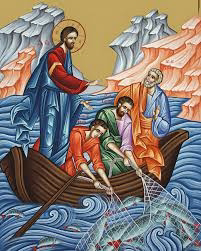
Baited breath?


Sermon for the fifth Sunday after Trinity 

What does He say
that draws people to Him?

What words does He use
that makes Him worth listening to?

What is it about Him
that makes crowds of people
gather around Him
to the extent
that He can only teach
by launching Himself 
out onto the Sea of Gennesareth
and using the natural acoustics
to magnify His words?

Our Lord is clearly 
a phenomenal teacher.

But then,
we must admit,
He does back up
His extraordinary claims
with miracles.

If Our Lord is
the great Fisher of Men
what is He using as bait?

[PAUSE]

It is interesting that
St Peter probably does not use bait
to catch the fish.

This is why he fishes at night.

The idea is that the fish
don't see the net as well
and swim into it unawares.

If this is the case
then we see why St Peter
thinks Our Lord's words
to cast the net in broad daylight
as odd and perhaps
even a bit exasperating.

The result: two ships full of fish!

Clearly something 
has drawn them to this place
where they can be caught. 

Just like the crowd.

Something has drawn them
to this place
where they can be caught
by God
in broad daylight.

Why broad daylight?

If you can see the net
then you can choose
to swim into it
or not.

Ironically, 
it is those who swim 
into Our Lord's net
who are saved.

Unlike St Peter,
Our Lord uses bait. 

He knows that there is something 
for which each of us
is truly longing.

It may not be something 
that we realise we long for.

It may be a longing 
which we mistake for another longing 
or one which we try to cover up
with something 
more accessible 
and immediately gratifying. 

Our Lord knows
what we truly long for
and He can supply it.

And this is something 
that we crave because 
we are created
and we look to our Creator
to make us whole again
from the wounds 
Caused by the battering 
that sin, the World and the Devil
inflict upon us.

Our Lord Himself is the bait.

He says,
"no man can come to Me, 
except the Father 
which hath sent Me draw him: 
and I will raise him up 
at the last day."

It is the Father 
that draws us,
and if we see Jesus
then we see the Father.

And it is Jesus
who will raise us 
from the depths of Death.

How?

Because in consuming His flesh
and drinking His blood
we become one
with Christ's humanity.

But it is the Divine nature of Christ 
that draws Him up from Death
into Heaven
to stand before the Father.

If we are one with Christ
then we are drawn up into Heaven
to stand before the Father.

We have been caught
and landed
like a prize carp
on the end of a line.

While the carp may be cooked
and eaten
we have been drawn to life
and joy.

This is what Salvation is.

And we need to fall for it,
hook, line and sinker.

Sunday, July 13, 2025

Oh, for crying out loud!


Sermon for the fourth Sunday after Trinity

How's your Greek?

A quick test.

What's the Greek 
for mercy?

You have no clue
until you remember
that you have sung
your "Kyrie eleison" today
and "Kyrie eleison" means
"Lord, have mercy!"

"Hooray!" you think 
"The Greek for mercy 
is eleeos!"

You're right...
but you're not right,
though you must be praised
for your reasoning there.

You're not right in the sense
that Our Lord isn't using
eleeos when He tells us
to be merciful
even as Our Heavenly Father
is merciful.

And now you're thinking,
"Oh, for crying out loud!"

And now you'd be nearer the mark.

[PAUSE]

We're often presented 
with trying to reconcile
the mercy of God
with the justice of God.

How can we be both
merciful and just
to a murderer that says,
in all sincerity,
"I'm sorry, please forgive me!"

We can't let him off,
but neither can we ignore 
his plea.

The Greek for mercy here
is oiktos,
and the "oi" bit
is a cry.

The mercy that is oiktos
should make us
cry "Oh!" to someone's predicament. 

Oiktos is the mercy 
that cries out in compassion
that recognises 
a human being in distress.

Oiktos causes us
to raise our eyes
from a list of misdemeanours 
and see a human being,
fallen and broken through life,
and yet failing and breaking others.

Oiktos is to see ourselves 
in another 
in all the pain and sorrow of life
and hold onto that.

Oiktos is having compassion
in the highest order.

But what of eleeos?

Why do we ask God 
"Kyrie eleison"?

[PAUSE]

Eleeos is active.

Eleeos has the sense
of pouring oil on troubled water.

Oiktos is what motivates eleeos.

The cry of "oh" and recognising
the distress and misery in another 
causes us to act with compassion.

Not by condemnation for sins, 
but by finding a way to be generous
without diminishing sin.

Our God is generous and merciful.

He fills the barrel of mercy and love 
and shakes it
and presses it down 
to make more room
for mercy and love.

God, the perfect judge
knows full well how to deal
with repentant murderers.
 
He even made one a saint!

Oiktos forces us
to see the human being 
behind even the most vile of crimes.

Criminals should receive 
our pity that their brokenness
should influence them
into committing their crimes. 

That doesn't excuse them.
They made their choice 
to commit crime 
and that must be addressed
proportionately,
fairly and fully
in law for the good of society.

But we must not ever,
for the love of God 
demonise a criminal
on account of the crime.

A criminal is a human being
and a human being
is the object of God's love.

Yet, we don't want to love him
because of his crime, 
so we turn him into a demon 
because that makes it easier for us
to cope with.

[PAUSE]

Our Lord 
is telling us 
not to take the easy path 
to judgement
and condemnation. 

He is telling us 
that we need to react
in mercy.

Yes, to hear the blood of Abel
crying from the ground
but also to hear the cry of Cain
fearing for his life 
in his land of banishment 
for murdering his brother.

As Christians
we are called to a life
knowing that we cannot 
judge or condemn a criminal
to Hell,
and that is a life of discomfort 
because we see sin,
and we see the sinner,
one we must hate
the other we must love
and yet separating the two
is far from easy.

We have to live in that tension.

We have to live 
concerned that sin is called out
for what it is
and yet seeing our very selves
in the face of the vilest offender.

We only love our neighbour 
insofar as we love 
the worst of humanity.

That's hard.

That's so hard.

It's hard to the extent
that we cry out "Oh!"

And then God hears "Oh"
and that stirs his oiktos
the mercy that hears the cry
of one troubled,
even scandalised by 
the Divine love even for the most wicked.

And He has mercy 
- eleeos -
on us because 
we will probably fail
to be merciful 
even as he is merciful.

Even if we fail,
we must never despair
of the mercy of God -
the mercy that hears a cry
and the mercy
that seeks to do something 
about it
- all for crying out loud.

Saturday, July 05, 2025

It's just one...


Sermon for the third Sunday after Trinity

"Oh it's just one..."

"...just one biscuit 
that's been dropped 
on the floor."

"...just one page 
that's been torn."

"... just one person
who missed the bus."

"It's just one..." is a 
handy little phrase
that we like to use
so that we know 
we don't have to care anymore.

Just one thing 
is lost, broken or won't fit,
so we can put it aside
and worry about
the other things 
that aren't lost or broken
and which fit into our scheme 
nicely.

That surely seems reasonable.

We can't worry 
about every little thing.

If we do
then we will
burn ourselves out
with too much worry,
caring too much about
things we can't control,
sweating the small stuff.

If we worry about 
every little thing
then it hurts us,
we become exhausted
and fearful.

Some of us 
are like that
and they need reassurance 
and care
for a condition that 
afflicted their lives.

Indeed,
the people who worry
so much 
that it becomes 
a disorder
must themselves 
not be written off.

"It's just one
of those people
with OCD."

This makes for
an uncomfortable dilemma. 

Do we care about things
too much
or too little?

[PAUSE]

The Pharisees
care a lot about 
the observance 
of the Law.

They are rigorous
and will let neither
t be uncrossed
or i undotted.

But woe betide anyone
who does not observe the Law,
the sinners, 
the publicans,
the prostitutes, 
even
the leprosy,
the maimed,
the sick.

They are completely 
written off.

"Oh they're just sinners. 
Not worth the time of day."

Human beings
who have no worth?

Human beings
in their God-given complexity 
in their God-given dignity
that have no worth?

And the Pharisees 
are effectively saying,
"Jesus, don't corrupt yourself 
with these sinners.
Just associate yourself 
with us, instead."

These sinners 
have been completely written off.

They have no value.

There is no chance 
of forgiveness,
reconciliation 
or rehabilitation.

Once a sinner
always a sinner. 

Oh doesn't that 
sound utterly dismal?

[PAUSE]

Where the Pharisees 
write people off,
Our Lord seeks to 
write people on.

Anyone 
who comes to Him
will be heard,
will be healed, 
will be loved.

No exceptions.

"Ah," say the Pharisees, 
"you just said,
that it would be 
harmful to care too much
about things."

"Things," Pharisee? 

People aren't "things!"

While we simply 
cannot worry about
the needs of everyone,
we don't see people 
as things.

If Our Lord speaks 
of the joy of finding
a lost sheep,
or a coin,
then how much more joy
can there be
for finding 
just one lost human being?

That joy makes
the Universe rattle
with millions of angelic feet
dancing in jubilation 
on the head of a pin.

And that's just one human being.

Just one human being
returning to God
sets heaven ablaze
with delight.

Just one human being.

Just you.

If that's the joy 
you cause God
when you return to Him
then imagine 
the joy of so many other
people who repent.

There are infinities
too small to contain that joy.

[PAUSE]

It's very true
that we human beings
can care too much.

We can stress,
overwork 
and forget about ourselves 
in order to care for 
absolutely everyone.

We can sweat the small stuff.

But perhaps we just need
to look at what we are valuing.

Just as the Pharisees 
value the Law 
above the spiritual 
and physical needs
of those around them,
so can we value the wrong thing
in helping other people
to the extent 
that we burn ourselves out.

God gives us two commandments
and one is certainly,
"love thy neighbour 
as thyself.

But the first commandment
is to love the Lord our God
with all our heart and soul 
and mind and strength.

Love God before Man.

Why?

Because it is 
in loving God first
with all the faculties 
that He has given us
that we learn to love
our neighbours 
as part of our own being.

And this regulates us.

We cease to dismissal others 
as just one of the crowd
and we cease to dismiss ourselves 
as just one of the crowd too.

In our prayers,
we present ourselves to God
Who doesn't see our prayer
as just one among many
but values it
because He values us
as individuals
and refuses to turn us away.

He possesses every magnitude 
of infinity 
to care intimately 
and fully for
every single human being
in every aspect
of their lives.

And he will not let us go.

In our prayer,
we bring our tears, sorrows,
cries for forgiveness,
cries for justice,
our bitterness,
our grief,
our loneliness
our longing for someone 
to love us just as we are.

And God hears
each of these
and, in the invisible mystery 
of His action
finds us and
brings us home,
not writing us off,
but writing us on His Sacred Heart.

Saturday, June 28, 2025

Clearly apostles


Sermon for the Feast of St Peter and St Paul

There is just 
so much noise.

A million voices
ricochet around us
spreading confusion 
and misinformation. 

We hear so much
that claims to be news
but isn't.  

It's fake news.

And that which is called
"fake news"
sometimes turns out
to be true.

And we don't know 
what to believe.

[PAUSE]

We don't know 
what to believe 
until we hear a voice
"Thou art the Christ,
the Son of the Living God."

A moment of clarity. 

The clouds of confusion part.

Not St John the Baptist.
Nor Elias. 
Nor Jeremiah.
Nor another prophet.

But the Christ!

Peter's words
might just be more words
among so many.

Just another statement 
of fake news.

What makes them different?

[PAUSE]

It's the truth!

If Our Lord tells us
that He will rise from the dead
and then does so.

If He preaches,
and then backs up His words
with miracles. 

If He touches the hearts of people
and inspires them to love
and go to their deaths for love, 
then He is telling the truth. 

His is the voice 
that we should believe.

And St Peter 
confirms that with his words.

In St Peter,
there is clarity 
a rock on which the Faith will grow.

Christ the chief cornerstone of the Church
and Peter the rock.

And to St Peter 
are given keys 
the authority to bind 
and loose sins.

That authority 
isn't given to St Peter alone 
for St John tells us
that it is given to all the Disciples
when the Lord 
breathes the Holy Ghost on them.

St Peter has the truth
as do the other apostles.

And as does St Paul.

[PAUSE]

St Paul,
the zealous Pharisee
is given the truth 
that blinds him for a while.

He is blinded to 
the cacophony of sights
which,
like the noise,
disrupt and confuse our lives.

The blindness of St Paul
helps him to be
refocused on the truth,
a truth which he once thought
unpalatable 
but now defends 
with his every breath,
with his every word.

And to him
is given authority 
to bind and loose sins
as he becomes 
one of the first bishops 
to receive episcopal consecration 
at the hands of the Apostles.

He is given the authority 
of the Truth
to cut through the swathes
of falsehood 
through the doctrine 
he has received through
the grace of Christ.

[PAUSE]

For us,
the noise is louder than ever.

False gospels are being preached.
The truth is supposedly 
being debunked.
The saints are still being 
contradicted
and even vilified.

For us, 
there is much confusion
and disharmony. 

But for us,
there is also truth
a truth which grounds our Faith.

Our Faith begins
when we say with St Peter
to the face of the man Jesus
"Thou art the Christ
the Son of the Living God."

That is where we put our trust.

That is where we ground 
our knowledge,
our belief, 
our faith.

And we grow 
by reading the first writte documents
of our faith
which are the letters of St Paul:
Gospel written before
the gospels.

This is how we cut through
all the noise.

We shut it out
and listen to the Holy Apostles 
for they speak with greater clarity
than the world can know 
and yet wants to prevent us
from knowing.

Jesus truly is the Christ
the Son of the Living God.

Saturday, June 21, 2025

Articulating Christ's Body

Sermon for the Sunday in the Octave of Corpus Christi

"The Sacrament of the Lord's Supper
was not by Christ's ordinance
reserved,
carried about,
lifted up 
or worshipped."

Does that sound familiar?

And yet,
we do reserved the Body of Christ,
we do carry it about,
we do lift it up
and we worship Christ
in the Most Holy Sacrament. 

Are we being wrong?
Are we being idolatrous?
Are we blaspheming?

[PAUSE]

One reason why 
we Anglican Catholics 
do not regard 
the Thirty-Nine Articles
as being authoritative 
is because of their ambiguity.

They were designed to appease
polarising factions 
within the Church of England.

They were designed
to stop the struggle 
for the Soul of England
to be a war within the streets.

And that's why 
the Articles have 
a historical importance 
that has allowed 
Anglican Protestants 
to walk with Anglican Catholics 
until comparatively recently.

So they are necessarily ambiguous. 

And this Article 
about the Sacrament of the Lord's Supper,
which we Catholics 
commonly call the Mass,
is deliberately ambiguous. 

It's true to say
that Our Lord
at the Last Supper
does not tell His Disciples
to reserve His Body
nor to carry it about
nor to lift it up
nor to worship it.

Neither does He expressly 
forbid it
even though He knows full well
the tendency of human beings
to fall into Idolatry.

He remembers the Golden Calf incident 
all too clearly.

And He does not forbid 
the reservation,
the carrying around,
the lifting up
or the worship
of His Body.

Why not?

Why does He not forbid it?

[PAUSE]

There is three underlying factors
behind how we Catholics
treat the Sacrament of the Mass.

Simply, it's Faith, Hope and Love.

By our Faith in Christ
we believe that 
what we behold
in the Sacrament of the Altar 
really, truly and fully 
is the Body and Blood
of Christ.

It is what He promised:
His flesh and blood
so that we might have life within us.

By our Hope,
we believe that showing people 
the Body and Blood of Christ,
displaying our faith
that what seems to be 
a disc of unleavened bread
is truly the Body of Christ,
we may stir in the hearts
of people hungry for hope 
the truth of Christ's presence with us.

By our Love, 
we reserve that Sacrament 
so that those who are unable 
to come to Mass 
may partake of the Body of Christ
and we carry it
to those who are too sick
to receive it.

And we do not worship 
bread and wine
because we believe 
that they have been transformed 
into the true Body and Blood of Christ,
Body, Soul, Mind, Humanity and Divinity
all that pertains to
the Person of the Son.

And the Son is God
and God is to be worshipped 
for our benefit
not His.

[PAUSE]

No. Christ does not command
that we should take the Sacrament 
of His Supper
and reserve it,
carry it about,
lift it up
and worship it.

He does not command that
but He does give us Himself
to be present with us
and to be consumed by us
so that we might love God
and neighbour.

We reserve the Love of God 
for our neighbour to eat.
We carry about the Love of God 
to our neighbour in his frailty.
We lift up the Love of God
for our neighbour to see.
We worship the Love of God
for our neighbour to share.

This is why
we put the Consecrated Host
into a monstrance 
for people to see
and be blessed 
so that one day they might receive.

[PAUSE]

The Articles of Religion 
are not authoritative 
for us Anglican Catholics 
especially when they give the impression 
that what we do is not 
part of the Catholic Religion. 

We don't need to hold them now
because, we pray,
we know better than going to war
with Anglican Protestants
whom we love despite our separation.

Nonetheless,
the Real, Objective and Physical Presence 
of Our Lord in the Most Holy Sacrament 
should draw us closer to Christ
in faith, hope and love for our neighbour.

Food for thought?
Or food for prayer?


Saturday, June 14, 2025

From the top


Sermon for Trinity Sunday

We know that Jesus can speak Greek.

Greek in Israel for Jesus
is like English is for us.

It's a language 
that everyone knows
but often not well.

Indeed, 
some older people
who have taken up English
later in life sometimes struggle
to say what they mean.

And even now,
we hear that confusion
and it is a confusion
that still affects the way
that people translate
Holy Scripture from Greek 
to English.

St Nicodemus hears our Lord say
that we must be born anōthen
- that's the Greek word.

It's a word that describes
the garment taken from Our Lord 
at His Crucifixion:
that seamless garment
woven from the top.

So anōthen is a word 
that we could translate
as "from the top".

The trouble is
that there are two meanings
to the phrase "from the top".

[PAUSE]

It could mean,
afresh or again,
and this is what St Nicodemus hears.

St Nicodemus hears
Our Lord say
we must be "born again"
which is why he gets confused 
and thinks that his poor mother
is going to have to suffer 
a terrible fate.

But that's not what Jesus means.

He us using the other meaning 
of "from the top".

He is talking about
being born from above 
from Heaven,
by the power of God

This is why He talks about us
being born of water and the Spirit.

It's a clear indication 
of our need for Baptism.

It is through the waters of Baptism
that we are born from above
into the Kingdom of God
and thereby into Eternal life.

This birth from above
is not from this world.

It is a birth that lies beyond
our experience in life
and why it is given to us
as a Sacrament. 

We see the external water
and know that,
through the covenant with God 
we are born in the Holy Ghost.

Our Baptism is Baptism by the Holy Ghost.

And our birth in Him
can only be known
in this world
through the water in the font.

And what on Earth 
has all this to do 
with Trinity Sunday?

[PAUSE]

What on Earth?
Well, that's the point exactly.

If we are born from above,
then we are aware of things above
which have only pale shadows 
here on Earth.

And our God,
The Triune God,
The Three-in-One,
Father, Son and Holy Ghost
Whom Earth and Heaven adore,
is not a thing of the Earth.

He is not created -
His Incarnation took
our Human Nature 
into His Godhead
- He is not created.

And this means 
we cannot expect
to understand 
with minds of Earth
the Truth from above
that God is Father, Son and Holy Ghost.

We know it 
because He shows it to us
in the words of Scripture and the Fathers
and the rational intelligence 
that draws its Holy conclusions
from the words of Scripture and the Fathers.

We know it by His revelation,
not by looking at shamrocks
or ice-water-steam 
or one flame on three wicks.

They are imperfect illustrations 
and even the most complete
theological understanding 
by the greatest Doctors of the Church
is like straw
compared with the reality of God
that is revealed from the top down to us.

[PAUSE]

If the world gives us grief
because it does not understand 
the Holy Trinity,
that is not our problem 
because the world listens 
with ears of clay
to words born from on high.

Our task is to spread the news
of Our Lord Jesus Christ,
and to baptise as many of those
who believe 
so that they may be born
from the top.

Saturday, June 07, 2025

A greater feast

Sermon for Whitsunday

"My Father is greater than I"

Those who hate Christianity 
love to trot out this verse.

"If the Father is greater than Jesus,"
they say,
"how can Jesus be God?"

The most obvious answer
is that Our Lord is speaking
of Himself as a man,
not in His Divinity. 

Because He does not think it
a prize to be equal in Divinity
with the Father
He humbles Himself
by being made Man,
thus giving a place
for His obedience to the Father
to show us how we must be
obedient to God.

But we human beings
are always thinking in terms
of greater and lesser,
better and worse.

That's the way our mind works.

We might say
that the Father is greater than the Son
because the Father begets the Son.

But the Father cannot be a Father
without the Son.

The relationship between 
Father and Son
reveals their identities
as two distinct persons
but a single God.

But today is Whitsun,
not Trinity Sunday.

Where's the Holy Ghost?

Shouldn't we be focussing on Him?

[PAUSE]

We see the Holy Ghost
sent from the Father 
in the Son's Name,
and yet He is often presented
as an instrument. 

Our Lady conceives by the Holy Ghost.

The Apostles speak in
foreign languages
through the Holy Ghost
Who falls upon them.

Our Sacraments bestow grace
through the Holy Ghost.

The Holy Ghost is described as
the Spirit of God
or the Spirit of Jesus.

The Holy Ghost 
seems more like a pipeline
to the Father and the Son
rather than a distinct person
in Himself.

This won't do. 

It's not enough.

[PAUSE]

The Holy Ghost is a distinct person
from the Father and the Son.

Our Lord Himself
describes the Holy Ghost
proceeding from the Father.

But God is indivisible,
and not made of anything,
so how can anything 
proceed out of God
that is not God Himself?

This procession
shows the relationship
between the Holy Ghost
and the Father.

We sing "breathe on me,
Breath of God"
because that's the best
we little human beings
can understand what
proceeding means.

In this sense of procession
the Holy Ghost 
proceeds from the Father alone.

It is an analogy 
that shows us how
God the Holy Ghost
comes forth
from the Father
to be God in us,
in the same way 
that the Son
is begotten of the Father
to be God with us.

But if there is a relationship
with the Father
there must be 
a relationship with the Son.

And there is.

The Son is conceived by the Holy Ghost.

The Holy Ghost is breathed
upon the disciples 
through the Son.

The Word is carried on the Breath
and the Breath issues forth 
because of the Word.

The Holy Spirit 
is God.

It means that 
we worship Him,
we pray to Him,
we relate with Him.

Indeed,
we relate more with Him
than any other Person
of the Trinity.

Certainly,
we pray, "Our Father,"
and we pray, "Jesu, mercy!"
but our inner prayers
our cries of "Lord, help me!"
those fleeting flicks
of our attention to God
are present directly
to the Holy Ghost.

St Paul tells us
that every time 
we praise God
it is because the Holy Ghost
dwelling within us
gives us the ability
to praise God.

We speak through Him,
we learn through Him.

By His grace, 
He bestows Himself upon us
at our Baptism and Confirmation.

The priest says,
"the Lord be with you."
and we don't say,
the vacuous 
"and also with you,"
but rather
"and with thy spirit"
because we pray
that what our priests 
breathe out on us
is the Breath of God
in the sacraments 
they must distribute.

[PAUSE]

Our awareness of the Holy Ghost
must move away from thinking of Him
as being like spiritual petrol
which reinvigorates our faith,
but rather to recognise
His living in us.

We look upwards
to the Father. 

We look around us
to the Son.

So we must look within us
to the Holy Ghost,
and worship Him
accordingly.

Saturday, May 31, 2025

Told you so!


Sermon for the Sunday after Ascension 

It always seems
a bit odd to hear Our Lord's words
after we have witnessed
His Ascension into Heaven.

Indeed, 
what is most jarring
is that we have been hearing
his words
on the night before He dies.

And today,
the Sunday after Our Lord ascends,
we hear Him tell His disciples
that they will be killed 
for their witness to His truth.

And, having said that, 
He says,
"But these things have I told you,
that, when the time shall come,
ye may remember that 
I told you of them."

Does that mean
that during the oncoming tribulation 
that our beloved apostles endure,
the memory of this night
pops into their heads
with Jesus saying,
"told you so!"?

[PAUSE]

People who say,
"I told you so!"
are usually berating us
for not following their advice. 

"Told you so" comes with
an air of smugness
and satisfaction 
that misfortune has come upon us
because we haven't followed
someone's advice.

But we don't see that in Our Lord.

So why does He effectively say
"Told you so"
to those whom He loves
as they suffer for His sake?

Clearly He doesn't mean it like that.

Clearly, he wants them to remember 
that He has not forgotten them.

In a few hours, 
Our Lord will be dead
hanging on the cross
and it will be easy for 
the disciples to forget 
the promise of Resurrection
amid the sorrow and anguish.

[PAUSE]

But remembering 
is an activity that
we don't fully appreciate 
these days.

Remembering is not just
being able to recite your phone number
or a thousand digits of pi.

Remembering is
 literally a re-membering
- a putting back together
of an event.

For the disciples,
remembering Our Lord's words
is absolutely vital.

It is their calling,
their witness, 
their testimony of all
that Jesus says and does
in their sight.

In their persecution, 
they remember that
Our Lord told them so
and that His promises are true.

And they remember
that they have received 
the Holy Ghost,
Who proceeds from the Father
Who us sent by the Son
who comes to us
with strength - 
cum forte -
for us to use to proclaim 
the Word of God.

[PAUSE]

The night before Our Lord dies
is a night to remember, 
to piece back together,
and we do just that here in the Mass.

We are re-membering
what Our Lord told us to do.

And in re-membering 
the Last Supper
we are given the presence 
of Christ Himself 
in the Holy Sacrament
so that we, too,
like the Apostles,
may go out and tell the truth
about Christ.

And, as we increase in faith,
and see the work of God 
at our hands,
as we suffer our persecution, 
our temptation, 
our repentance,
our humiliation, 
our cross,
all for His sake, 
we will see Our Lord in His glory 
pointing to our place 
in His Kingdom
and saying,
"Told you so!"

Sunday, May 25, 2025

Asking for a beating


Sermon preached at the Cathedral Church of St Augustine of Canterbury on Rogation Sunday

Are you ready to get up
and beat the bounds, today?

Ready for a nice little walk 
around the parish?

Beating the bounds
occasionally happens today,
but not so much
and definitely not in its
traditional form.

Usually during
Rogationtide
or on Ascension Day,
the parish priest
is supposed to lead his people
to the edge of the parish 
and walk around it.

Along the way,
a group of boys,
usually choirboys or servers,
are supposed 
to beat the boundary stones
with green branches.

Often, rather than 
just beating 
the boundary stone,
it would be the boys
that were beaten
instead.

Perhaps that's something 
we could reinstate?

[PAUSE]

But why?

Why beat the boys?

The maim reason,
it appears,
is to ensure that
the next generation 
knows where 
the parish boundary is.

By beating the stones,
or beating the boys,
a clear memory of where
the parish ends
is reinforced.

This is important 
because it reinforces
the parish's legal identity
and the priest knows 
where his care ends
and the neighbouring priest's begins.

Beating the bounds
 establishes the neighbourhood.

But now you see the problem. 

Where is our boundary?

[PAUSE]

Parishes are supposed 
to share boundaries
so that there are no gaps
between where one parish stops
and another starts.

That way, 
the whole country 
can be sure 
that every community 
can find its Christian needs
met by the Church
through local priests.

If parishes have 
to cover the country,
where's our boundary?
Half of Kent?

More?

The Diocesan boundary
is the coastline of 
the British Isles!

How are we expected
to beat those bounds?

[PAUSE]

Our smallness
does sometimes seem
to be overwhelming. 

We have a big task to do
as Christians 
and so little time,
so few resources
to do it.

And we feel swamped.

We're not getting any younger
and the world is getting darker.

Let's just make sure
that we are honest 
with ourselves here,
about this.

We are small.
The task is great.
We feel swamped. 

What are we going to do?

[PAUSE]

Let's change the question
a little bit.

Instead of saying,
it's all too much,
let's say,
"this looks hard,
but what can we do?"

Let's not focus 
on our shortcomings
or on the size of the task.

Let's focus on
what we can do,
what we are doing,
what we're good at.

And make sure
that we do these things in Faith. 

[PAUSE]

We see the disciples
talking with Our Lord,
the night before He dies.

And there are only twelve.

One has gone off to betray the Christ.

The others will run away 
and say that they do not know
this Man from Nazareth.

Such failure!
Such fragility!
Such smallness!

And yet,
eleven come back
and see their Master
raised from the Dead.

And they understand. 
They see things clearly.
They know their mission.

Eleven in Christ
become the Church
because they have Faith.

And they now know what to ask for.

And how to ask.

No longer will they ask
to be the greatest
or to sit at the right hand
and left hand of Christ in glory.

Nor will they ask
not to avoid tribulation. 

They ask for blessing.
They ask for forgiveness 
for themselves 
and for their enemies.
They ask for the Truth to be known 
through them.

At their asking,
they receive the sacraments 
to give to the people of God
even as God Himself
fed multitudes with so little.

[PAUSE]

And we are so little.

It doesn't matter
for we trust that God knows
what He is doing,
and if we should find ourselves 
in tribulation,
we should not fear
because Christ has overcome the world. 

It is the World's influence
that tells us that 
because we are small
we are insignificant. 

Tell that to St Augustine 
who lands on these shores
and reinvigorates a Christianity 
that has been sidelined
following the end of
Roman occupation.

The disciples do what little they can
in Faith.

St Augustine does what little he can do
in Faith

We do what little we can do
in Faith. 

And in being faithful
we find ourselves praying 
in the Name of Jesus
and our prayers 
will be answered
- not in a worldly way,
but a Heavenly way.

[PAUSE]

Our bounds are too big
for us to beat, 
but in Christ 
there will be no limit 
to what will come
from what we truly do
in His Name..