Latin Collect
Omnipotens et misericors Deus, de cuius munere venit, ut tibi a fidelibus tuis digne et laudabiliter serviatur: tribue, quaesumus, nobis; ut ad promissiones tuas sine offensione curramus.
[My Translation: Almighty and Merciful God, from whose gift it cometh that thou mayest be served worthily and laudibly by thy faithful people: grant us, we beseech thee, that we may run toward thy promises without stumbling. Through Jesus Christ.]
Prayer book of 1549
ALMYGHTIE and mercyfull God, of whose onely gifte it cometh that thy faythfull people doe unto thee true and laudable service; graunte we beseche thee, that we may so runne to thy heavenly promises, that we faile not finally to attayne the same; through Jesus Christe our Lorde.
Reflection
St Paul reminds us that we run a race. We know where we are running from, and we know where we are running too. We also know that, as far as competition goes, we should try and out do each other in showing love. The prize is open to everyone.and sharing that prize does not diminish it, for the prize is God Himself.
The race we run is on a path cut out for us by the death of Our Lord. It is the hole in the wall of our prison, the loosing of our chains and the drugging of the guards to our captivity to sin. The one, true and pervading sacrifice of Our Lord Jesus Christ is the gift of freedom whereby in serving God we may indeed be truly free. Yet we must be aware that it is possible for us to fall over and stumble over the obstacles put in our way by the Malicious Malcontents who delight in watching those fleeing into the light fall over in the hope that they may be enticed back into captivity by the arduous nature of the race. After all, running is so much effort, why not sit in one's prison for Eternity rather than waste the energy.
We have the gift of God. It is light, life, sustenance, hope, comfort, and challenge all rolled into one. It takes effort in being Christian. It will be hard; it will be discouraging; it will be horrible, oppressive, and filled with hypocrisy, but these are the very stumbling blocks put in our way. If we fall, we fall, that's no problem for God for the pathway always remains open. We can only go back to where we were by our own desire. The enticements away from the Light are many but, by running in that Light, we wil see those stumbling blocks for what they are. We may get to Heaven with scraped knees and twisted ankles, but so what? We get to Heaven!
Sunday, August 30, 2015


Monday, August 24, 2015
Adulthood, childishness and the Church
The trouble with babies is that they grow up - at least that's what parents often seem to say but probably don't actually mean. One minute, they are all cute and snuggly in Mummy's arms, the next they are throwing a strop about not being allowed out at ten o'clock at night dressed like THAT! It has to be expected that babies must grow into adults, and that it is the duty of parents that they help their children become fully functioning and well-adjusted adults. It would not do to allow children free-rein when living in society that is necessarily bound by social contracts and codes of conduct. Now would it do to stifle the individual humanity of the child by insisting on complete control of her life. A balance must be struck, and the needs of the child must be met along paths which allow that child to grow into adulthood. Ideally, we should want to nullify Philip Larkin's rather depressive view of parenthood.
That's how God acts as Our Father. We just have to choose to come back when we realise that our lives are objectively better with God than they are without Him.
However, atheists always make very good points which is why the honest and noble atheist (such as Bertrand Russell and Stephen Law) should be heard seriously. Does the Church infantilise her flock. I really wish that I could say, "no she doesn't" but I would either be lying or very misguided and brainwashed. The Church infantilises when she seeks to control the faithful imposing sanctions for failing to adhere to Church teaching. As a priest, I can indeed expect censure and sanction for failing to teach what the Church teaches, and rightly so. I have promised in my vows of ordination to obey church teaching and observe my duty to be faithful to the Doctrine and Dogma of Holy Church. However, as the parable of the Prodigal Son shows, if God allows people to wander away, then so must I. My duty then becomes to call the errant back, to keep the lights on so that the errant can find their way home. I have no business proscribing any form of censure or sanction against my fellow sinners.
Of course, my office as priest means that I can hear people's confession and that means that, God has appointed me to listen to a penitent's "Father, I have sinned against heaven, and in thy sight, and am no more worthy to be called thy son" and to pronounce the fact that God willingly receives back the truly penitent. Any "penance" that I "impose" is not a punishment but an exercise for the penitent to re-engage with the God with whom they have just been reconciled.
And yet, I am called, "Father". This would certainly suggest that my presence is to belittle my flock and put them in the place of children. Looking at some members of my congregation, I see two gentlemen who are old enough to be my father who have led colourful lives, and a working mother of no little commitment and no mean intelligence. Infantilising them would be a vile abuse of the sacrament that I have received from God to carry out His will. They may call me "Father" but it is not me they recognise, but the God whom they love.
Every time I am called "Father," it pulls me up short and even hurts me a little bit because I have such a great fatherhood to live up to, a fatherhood that I share with my brother priests. It would be truly infantilising if Bishops and Priests sought to seek the title of "Father" in order to receive obeisance. I am personally of the opinion that Clergy should keep right out of the political arena and shun all forms of power over other human beings. Thankfully, gone are the days of feudal obeisance to clergy.As far as this world is concerned, I am just a simple teacher. As far as the Church goes, I hold out the embrace of God the Father in the Holy Sacraments that I am permitted to distribute to all who would receive them, As far as the next world goes, I stand out from the crowd only to receive harsher judgement for failing to shine the light of Christ to the world and for all whom I have misled through wrong teaching.
If the Church wishes to dispel the image of the infantilising god rejected rightly by so many, then she herself must seek to ensure that Her members exercise their God-given right to make their decisions autonomously and objectively, and then stand back and wait for the prodigal sons to return, She can learn much about life and the World from the prodigals and perhaps better advise Her children because of these lessons. This way, God's children can indeed grow healthily into God's adults while still remaining sons and daughters of God by His adoption and love.
Many psychologists regard the state of adulthood as being able to make autonomous objective appraisals of their situation and act according to that appraisal. What does this really mean? Essentially, adults have decisions to make in life. A child will look to his parents to make that decision for them; a mother will seek to make a decision on behalf of those for whom she feels responsible. For an adult, the decision is to be made autonomously, not deferring the responsibility for that decision onto another, nor claiming responsibility for other adults' decisions.
Any decision must be made on an objective basis. According to this type of psychology, adulthood is about ensuring that any decision is made along reasonable, rational and factual grounds. An adult researches into the decisions that need to be made and obtains facts before making a decision, A child relies on the research of the parent before it is guided into making any decision, but ultimately, the parent must make the decision based on what that parent believes to be the right moral decision. This is why it is no more wrong to bring up a child as Christian than it is to bring them up atheist or agnostic.
Isn't parenthood frightening? Yes, but it must be frightening when we consider that the decisions that we make affect our children. It's frightening because we love our children so much, Yet, a parent must allow the child the opportunity to become an adult in themselves. That's the goal of parenthood. Like teachers, parents must seek to make themselves redundant so that the children grow up autonomous and objective and able to make decisions well.
And this is where the Church comes in.
One reason that people give for rejecting God and Christianity, indeed perhaps all religion is their belief that it seeks to prevent its members from growing up. Obviously, Karl Marx is one of the philosophers who voiced that opinion carefully. For him, Religion prevented the workers from realising their true worth by pointing them to false hopes. Of course, he failed to show that the hopes were indeed false. However, one of the major obstacles to belief in God is the idea of submission of our wills to Him. These folk don't want to be treated like children with God, and particularly the Church, making the decisions on their behalf.
Is belief in God really the loss of one's autonomy? Or does belief in God remove true objectivity when it comes to making the decisions that all adults make? An adult must be responsible for one's decisions, yet a God who says "do this or go to Hell" subverts the adulthood of the theist. While this is a stereotype of God, it is a stereotype that pervades and the Church must look to see that this stereotype is not sanctioned, but truly seeks the adulthood of its members.
No matter what atheists say, they have not shown that God does not exist, nor have they proved that belief in God is not rational. Indeed they cannot do so unless they engage in a committed reductio ad absurdam rather than the setting up of straw man arguments or appealing to the problem of evil which, while challenging our relationship with God does not demonstrate that He should not be worshipped.
The agnostic doubts that knowledge about God's existence can ever be obtained, but the rational Christian must accept that knowledge of God's existence is not absolute in the minds of human beings and until we see Him face to face, we must wrestle a doubt which is not necessarily the enemy of the faith, but the salt which promotes self-examination. There are rational principles on which the existence of God can be based, but they can still be doubted. There are so many Christians who have arrived at their faith because they have been able to make an autonomous objective appraisal of the situation and conclude that God exists.
However, does this mean that, having arrived at belief in God, we now have to surrender our adulthood? It's true to say that, if we are Christian, then we do have to see God as our Creator and we must therefore surrender any idea that we are responsible for our existence. We have to see God as Our Father and recognise that He does indeed provide everything for us. Does this mean that we can no longer be adults, but be good little boys and girls and do what daddy tells us?
Here, the parable of the Prodigal Son helps.
A certain man had two sons: And the younger of them said to his father, Father, give me the portion of goods that falleth to me. And he divided unto them his living. And not many days after the younger son gathered all together, and took his journey into a far country, and there wasted his substance with riotous living.
And when he had spent all, there arose a mighty famine in that land; and he began to be in want. And he went and joined himself to a citizen of that country; and he sent him into his fields to feed swine. And he would fain have filled his belly with the husks that the swine did eat: and no man gave unto him. And when he came to himself, he said, How many hired servants of my father's have bread enough and to spare, and I perish with hunger! I will arise and go to my father, and will say unto him, Father, I have sinned against heaven, and before thee, And am no more worthy to be called thy son: make me as one of thy hired servants.
And he arose, and came to his father. But when he was yet a great way off, his father saw him, and had compassion, and ran, and fell on his neck, and kissed him. And the son said unto him, Father, I have sinned against heaven, and in thy sight, and am no more worthy to be called thy son. But the father said to his servants, Bring forth the best robe, and put it on him; and put a ring on his hand, and shoes on his feet: And bring hither the fatted calf, and kill it; and let us eat , and be merry: For this my son was dead, and is alive again; he was lost , and is found. And they began to be merry .
Now his elder son was in the field: and as he came and drew nigh to the house, he heard musick and dancing. And he called one of the servants, and asked what these things meant . And he said unto him, Thy brother is come; and thy father hath killed the fatted calf, because he hath received him safe and sound. And he was angry, and would not go in: therefore came his father out , and intreated him. And he answering said to his father, Lo, these many years do I serve thee, neither transgressed I at any time thy commandment: and yet thou never gavest me a kid, that I might make merry with my friends: But as soon as this thy son was come, which hath devoured thy living with harlots, thou hast killed for him the fatted calf. And he said unto him, Son, thou art ever with me, and all that I have is thine. It was meet that we should make merry, and be glad: for this thy brother was dead, and is alive again ; and was lost , and is found . (St Luke xv.11-end)Look at the situation with regard to what we understand to be adulthood. Clearly, the father in this parable stands for God, and the sons the whole of humanity. At which point are they disallowed from acting autonomously? At which point are they disallowed from acting objectively? The prodigal son makes his decision on His own and is provided with all that he needs from his father's estate. The father allows this to happen even at the cost of half his belongings precisely so that the son can exercise his free decisions based on his own understanding and wants. It's the wrong decision, but the prodigal son learns his own lesson. The father's love for his son is not conditional on the son's exercise of his adulthood. Far from being a controlling parent, the father permits freedom and is ready to receive his son back to him, not to infantilise, but to be a son.
That's how God acts as Our Father. We just have to choose to come back when we realise that our lives are objectively better with God than they are without Him.
However, atheists always make very good points which is why the honest and noble atheist (such as Bertrand Russell and Stephen Law) should be heard seriously. Does the Church infantilise her flock. I really wish that I could say, "no she doesn't" but I would either be lying or very misguided and brainwashed. The Church infantilises when she seeks to control the faithful imposing sanctions for failing to adhere to Church teaching. As a priest, I can indeed expect censure and sanction for failing to teach what the Church teaches, and rightly so. I have promised in my vows of ordination to obey church teaching and observe my duty to be faithful to the Doctrine and Dogma of Holy Church. However, as the parable of the Prodigal Son shows, if God allows people to wander away, then so must I. My duty then becomes to call the errant back, to keep the lights on so that the errant can find their way home. I have no business proscribing any form of censure or sanction against my fellow sinners.
Of course, my office as priest means that I can hear people's confession and that means that, God has appointed me to listen to a penitent's "Father, I have sinned against heaven, and in thy sight, and am no more worthy to be called thy son" and to pronounce the fact that God willingly receives back the truly penitent. Any "penance" that I "impose" is not a punishment but an exercise for the penitent to re-engage with the God with whom they have just been reconciled.
And yet, I am called, "Father". This would certainly suggest that my presence is to belittle my flock and put them in the place of children. Looking at some members of my congregation, I see two gentlemen who are old enough to be my father who have led colourful lives, and a working mother of no little commitment and no mean intelligence. Infantilising them would be a vile abuse of the sacrament that I have received from God to carry out His will. They may call me "Father" but it is not me they recognise, but the God whom they love.
Every time I am called "Father," it pulls me up short and even hurts me a little bit because I have such a great fatherhood to live up to, a fatherhood that I share with my brother priests. It would be truly infantilising if Bishops and Priests sought to seek the title of "Father" in order to receive obeisance. I am personally of the opinion that Clergy should keep right out of the political arena and shun all forms of power over other human beings. Thankfully, gone are the days of feudal obeisance to clergy.As far as this world is concerned, I am just a simple teacher. As far as the Church goes, I hold out the embrace of God the Father in the Holy Sacraments that I am permitted to distribute to all who would receive them, As far as the next world goes, I stand out from the crowd only to receive harsher judgement for failing to shine the light of Christ to the world and for all whom I have misled through wrong teaching.
If the Church wishes to dispel the image of the infantilising god rejected rightly by so many, then she herself must seek to ensure that Her members exercise their God-given right to make their decisions autonomously and objectively, and then stand back and wait for the prodigal sons to return, She can learn much about life and the World from the prodigals and perhaps better advise Her children because of these lessons. This way, God's children can indeed grow healthily into God's adults while still remaining sons and daughters of God by His adoption and love.
Sunday, August 23, 2015
Collect for the twelfth Sunday after Trinity
Latin Collect
OMNIPOTENS sempiterne Deus, qui abundantia pietatis tuæ et merita supplicum excedis et vota, effunde super nos misericordiam tuam, ut dimittas quæ conscientia metuit, et adjicias quæ oratio postulare non audet. Per Jesum Christum Dominum nostrum.
[My translation: Almighty and Everlasting God, who exceedest both the merits and prayers of supplicants with the abundance of Thy pity, pour upon us Thy mercy that Thou wouldst pardon those things which consciences fear, and Thou wouldst increase those things which prayer doth not dare to ask. Through...]
Prayer book of 1662
ALMIGHTY and everlasting God, who art always more ready to hear than we are to pray, and art wont to give more than either we desire, or deserve; Pour down upon us the abundance of thy mercy; forgiving us those things whereof our conscience is afraid, and giving us those good things which we are not worthy to ask, but through the merits and mediation of Jesus Christ, thy Son, our Lord. Amen.
Reflection
Archbishop Cranmer seeks to clarify the meaning of the Latin collect without losing the poetry of its expression. In this collect, we are faced with the great mysterious nature of God. This is a God whose presence strikes fear into the hearts of men, whose raw power renders Man's capabilities insignificant, and whose lifespan render's Man's existence a matter of milliseconds. This is a God who excels any capacity that Man possesses except the capacity to hate, for that is contrary to the existence of God.
In comparison with God, we are nothing, and yet the great mystery is revealed when this Divine Being, the Creator of the Universe, bends down to touch the lives of His Creation, bestowing worth, dignity, attention, and devotion liberally from His consideration. Faced with this, our consciences find themselves scurrying around, bringing out our deepest darkest fears, the secret sins,and the most ignoble and disgusting thoughts, all because we know full well that God knows the secrets of our hearts.
The trouble is that our fear strikes us dumb. Knowing that we cannot hide anything from God, we fear that what we need to ask of Him might be unacceptable, idiotic, or that, because we are habitual and unmitigated sinners, He is within His rights to refuse all our prayers. We might be able to gabble "give us this day our daily bread" but we do so disallowing our minds any purchase on what we have just prayed so that we don't anger God by asking unworthily.
While we are right to be afraid of what our sins have done to us, yet we should fear God more because He forgives sin. He is not out for our destruction - He is after our salvation and seeks our happiness. We might be afraid to ask, but God does not forbid us to ask. His answer might be "No" but it will be a "No" with the greatest Love and respect for the person He has created us to be. We pray on our knees but we can do so boldly, knowing that we will be heard by One Who seeks only our good.
OMNIPOTENS sempiterne Deus, qui abundantia pietatis tuæ et merita supplicum excedis et vota, effunde super nos misericordiam tuam, ut dimittas quæ conscientia metuit, et adjicias quæ oratio postulare non audet. Per Jesum Christum Dominum nostrum.
[My translation: Almighty and Everlasting God, who exceedest both the merits and prayers of supplicants with the abundance of Thy pity, pour upon us Thy mercy that Thou wouldst pardon those things which consciences fear, and Thou wouldst increase those things which prayer doth not dare to ask. Through...]
Prayer book of 1662
ALMIGHTY and everlasting God, who art always more ready to hear than we are to pray, and art wont to give more than either we desire, or deserve; Pour down upon us the abundance of thy mercy; forgiving us those things whereof our conscience is afraid, and giving us those good things which we are not worthy to ask, but through the merits and mediation of Jesus Christ, thy Son, our Lord. Amen.
Reflection
Archbishop Cranmer seeks to clarify the meaning of the Latin collect without losing the poetry of its expression. In this collect, we are faced with the great mysterious nature of God. This is a God whose presence strikes fear into the hearts of men, whose raw power renders Man's capabilities insignificant, and whose lifespan render's Man's existence a matter of milliseconds. This is a God who excels any capacity that Man possesses except the capacity to hate, for that is contrary to the existence of God.
In comparison with God, we are nothing, and yet the great mystery is revealed when this Divine Being, the Creator of the Universe, bends down to touch the lives of His Creation, bestowing worth, dignity, attention, and devotion liberally from His consideration. Faced with this, our consciences find themselves scurrying around, bringing out our deepest darkest fears, the secret sins,and the most ignoble and disgusting thoughts, all because we know full well that God knows the secrets of our hearts.
The trouble is that our fear strikes us dumb. Knowing that we cannot hide anything from God, we fear that what we need to ask of Him might be unacceptable, idiotic, or that, because we are habitual and unmitigated sinners, He is within His rights to refuse all our prayers. We might be able to gabble "give us this day our daily bread" but we do so disallowing our minds any purchase on what we have just prayed so that we don't anger God by asking unworthily.
While we are right to be afraid of what our sins have done to us, yet we should fear God more because He forgives sin. He is not out for our destruction - He is after our salvation and seeks our happiness. We might be afraid to ask, but God does not forbid us to ask. His answer might be "No" but it will be a "No" with the greatest Love and respect for the person He has created us to be. We pray on our knees but we can do so boldly, knowing that we will be heard by One Who seeks only our good.
Thursday, August 20, 2015
Drawing out education
Today sees the publication of the GCSE exam results, a week after the A-Level results. Forthose of you not familiar with the British education system, GCSEs are taken usually by 15-16 year olds; A-levels are taken usually by 17-18 year olds and are used among other things by universities to select prospective students. Of course, one of the effects that this has on the education system here in the U.K. is that schools can be tempted to teach children to pass exams. Is this a bad thing? Well, this depends on how you view education.
After quite a few years of being involved in education, I still find myself wondering about what it is that I'm doing. One might say that, as a teacher, I am imparting knowledge on my pupils. Clearly, I have a syllabus to follow which gives a structure to the course but this does mean that pupils don't really get a say in what they'd like to be taught, nor do I get a say in what I'd like to teach them. I was taught things which do not get taught now. Even then, my teachers were taught things that they never got to teach me, so there is always a bit of melancholy when the syllabus limits you.
Ultimately, though, I believe that I have to teach myself out of a job. For my students' sake I must become redundant. One of my main goals as an educator is to teach my students how to teach themselves. As they grow up, children need to know how to form, pursue, and evaluate forms of inquiry. Mathematics, of course, is a purely abstract discipline: it is not a physical science. However, the word "mathematics" is intrinsically linked with the Greek word mathetes meaning "disciple". Mathematics is the art of being a good learner. This is why it is absolutely fundamental in education beyond money and mensuration. It gives a framework for argument and proof which other subjects utilise and in which they converse.
The art of mathematics comes in the necessity of practice. Not only is following the rules necessary, but it is knowing why the rules work in the first place. Look at this sequence of fractions:
3/3 = 1/1 = 1
4/8 = 1/2
5/15 = 1/3
6/24 = 1/4
7/35 = 1/5
Is this just pure coincidence, or is there something about fractions of the form (x+1)/(x2-1) that mean that they always cancel down to 1/(x-1)? For the mathematically experienced, this is an obvious result that comes from looking at algebra rather than arithmetic. It's also not a coincidence that the sum of the first n odd numbers is n2. Many of my pupils will forget this fact quite quickly. What I hope they don't forget is the ability to at least formulate the question properly.
The child may ask "if God made the world then who made God?" which is a perfectly reasonable question on the face of it. However, but drawing out from that child the ideas that underpin that question, the child will see the answer for herself. This method of "drawing out" is the literal meaning of education.
This does seem to be the reverse of the exam system. Rather than drawing out ideas from the child, efforts seem to be made in cramming information in. The average human being can get by in life without ever needing the knowledge that the Battle of Borodino took place in 1812 or that the giant squid is architeuthis dux, or that E flat major is the relative major to the key of C minor. Yet, these facts may indeed be examined upon and one's place at university may rest upon knowing these facts.
The trouble with cramming in facts is that it creates an imposition on a pupil to which the pupil may not necessarily have subscribed. I am sympathetic to my fifth form student who takes one look at the differential calculus and says, "when will I ever need to know that!?" I try to explain about the understanding of rates of change, of velocities and speeds, and even the ideas of maximising commodities subject to constraints, yet I do question whether the syllabus allows for true education or relies on just simple cramming.
Ah, but education should be about preparing children for dealing with real life problems. I find it interesting that, despite lots of education, we still suffer from the same real-life problems without a satisfactory solution. Perhaps our education system is to blame, or perhaps we keep looking in the wrong place for the solutions and never allow ourselves to be educated in the right way. We bewail the competitive nature of employment and the rat-race, seeking a quieter and calmer lifestyle, and yet the levels of competition for jobs and university places is growing. Is this competition right? Does a good education give one a competitive edge? If it does than why do people continue to compete for a resource rather than find ways to distribute that resource fairly?
Albert Einstein said, "To obtain an assured favourable response from people, it is better to offer them something for their stomachs instead of their brains." Perhaps, then, the Education System should be more a training in utilising resources to attain favourable responses from people. However, then we would find ourselves in the position in which people become means to ends rather than ends in themselves. Already we seem to have done away with any notion of learning for the sake of learning.
There is something inherently wonderful about education in itself. To take pleasure in knowing why something works is wonderful, but so is the pleasure in not knowing why something works and engaging in the task of finding out. This really does allow each one of us to engage with the world around us as we are rather than what we are prescribed to be. We only find out who we really are when we learn to interact with the world around us. We only ever find our passions in life by trial and error, by painting pictures and realising that we've not got the colours quite right. The child that always asks, "please sir, have I done it right?" needs to develop the confidence to know precisely for himself whether he is right or wrong and how it matters to him. We know that 2+2=5 is wrong mathematically, but the act of appreciating why it's wrong possesses a beauty in itself and that beauty is not smugness..
With a world that is constantly geared to the dread dichotomies of success/failure, right/wrong, true/false, we seldom see failure as an education experience. "This organisation does not tolerate failure", said Blofeld, and his thinking ensures that any error is met with the fires of Hell itself. This is why Christianity is quite the reverse. It is only in the task of recognising our errors and turning to God that we realise who we really are. We only find ourselves when we allow ourselves to be drawn out into the arena of Creation and, trusting in God's mercy when we fail, realise who we are through understanding our capabilities and limitations. We need to educate ourselves out of the pass/fail dichotomy if we want to see the true colours of living.
Ulitmately, all competition is meaningless in itself as, at the end of the game, all the pieces go back into the box. It is what remains after the game is played and how we have been drawn out of ourselves by the process. True education will seek to give a pupil that which extends beyond the narrow confines of the work place, and the best education will lead that pupil to become a disciple of God Himself.
The art of mathematics comes in the necessity of practice. Not only is following the rules necessary, but it is knowing why the rules work in the first place. Look at this sequence of fractions:
3/3 = 1/1 = 1
4/8 = 1/2
5/15 = 1/3
6/24 = 1/4
7/35 = 1/5
Is this just pure coincidence, or is there something about fractions of the form (x+1)/(x2-1) that mean that they always cancel down to 1/(x-1)? For the mathematically experienced, this is an obvious result that comes from looking at algebra rather than arithmetic. It's also not a coincidence that the sum of the first n odd numbers is n2. Many of my pupils will forget this fact quite quickly. What I hope they don't forget is the ability to at least formulate the question properly.
The child may ask "if God made the world then who made God?" which is a perfectly reasonable question on the face of it. However, but drawing out from that child the ideas that underpin that question, the child will see the answer for herself. This method of "drawing out" is the literal meaning of education.
This does seem to be the reverse of the exam system. Rather than drawing out ideas from the child, efforts seem to be made in cramming information in. The average human being can get by in life without ever needing the knowledge that the Battle of Borodino took place in 1812 or that the giant squid is architeuthis dux, or that E flat major is the relative major to the key of C minor. Yet, these facts may indeed be examined upon and one's place at university may rest upon knowing these facts.
The trouble with cramming in facts is that it creates an imposition on a pupil to which the pupil may not necessarily have subscribed. I am sympathetic to my fifth form student who takes one look at the differential calculus and says, "when will I ever need to know that!?" I try to explain about the understanding of rates of change, of velocities and speeds, and even the ideas of maximising commodities subject to constraints, yet I do question whether the syllabus allows for true education or relies on just simple cramming.
Ah, but education should be about preparing children for dealing with real life problems. I find it interesting that, despite lots of education, we still suffer from the same real-life problems without a satisfactory solution. Perhaps our education system is to blame, or perhaps we keep looking in the wrong place for the solutions and never allow ourselves to be educated in the right way. We bewail the competitive nature of employment and the rat-race, seeking a quieter and calmer lifestyle, and yet the levels of competition for jobs and university places is growing. Is this competition right? Does a good education give one a competitive edge? If it does than why do people continue to compete for a resource rather than find ways to distribute that resource fairly?
Albert Einstein said, "To obtain an assured favourable response from people, it is better to offer them something for their stomachs instead of their brains." Perhaps, then, the Education System should be more a training in utilising resources to attain favourable responses from people. However, then we would find ourselves in the position in which people become means to ends rather than ends in themselves. Already we seem to have done away with any notion of learning for the sake of learning.
There is something inherently wonderful about education in itself. To take pleasure in knowing why something works is wonderful, but so is the pleasure in not knowing why something works and engaging in the task of finding out. This really does allow each one of us to engage with the world around us as we are rather than what we are prescribed to be. We only find out who we really are when we learn to interact with the world around us. We only ever find our passions in life by trial and error, by painting pictures and realising that we've not got the colours quite right. The child that always asks, "please sir, have I done it right?" needs to develop the confidence to know precisely for himself whether he is right or wrong and how it matters to him. We know that 2+2=5 is wrong mathematically, but the act of appreciating why it's wrong possesses a beauty in itself and that beauty is not smugness..
With a world that is constantly geared to the dread dichotomies of success/failure, right/wrong, true/false, we seldom see failure as an education experience. "This organisation does not tolerate failure", said Blofeld, and his thinking ensures that any error is met with the fires of Hell itself. This is why Christianity is quite the reverse. It is only in the task of recognising our errors and turning to God that we realise who we really are. We only find ourselves when we allow ourselves to be drawn out into the arena of Creation and, trusting in God's mercy when we fail, realise who we are through understanding our capabilities and limitations. We need to educate ourselves out of the pass/fail dichotomy if we want to see the true colours of living.
Ulitmately, all competition is meaningless in itself as, at the end of the game, all the pieces go back into the box. It is what remains after the game is played and how we have been drawn out of ourselves by the process. True education will seek to give a pupil that which extends beyond the narrow confines of the work place, and the best education will lead that pupil to become a disciple of God Himself.
Sunday, August 16, 2015
Collect for the eleventh Sunday after Trinity
Latin Collect
DEUS, qui omnipotentiam tuam parcendo maxime et miserendo manifestas, multiplica super nos misericordiam tuam, ut ad tua promissa currentes cœlestium bonorum facias esse participes. Per Jesum Christum Dominum nostrum.
Prayer book of 1549
GOD, which declarest thy almighty power, most chiefly in shewyng mercy and pitie; Geve unto us abundauntly thy grace, that we, running to thy promises, may be made partakers of thy heavenly treasure; through Jesus Christe our Lorde.
Prayer book of 1662
O GOD, who declarest thy almighty power most chiefly in shewing mercy and pity; Mercifully grant unto us such a measure of thy grace, that we, running the way of thy commandments, may obtain thy gracious promises, and be made partakers of thy heavenly treasure; through Jesus Christ our Lord. Amen.
Reflection
The collect of 1549 translates the Latin collect very well, but we notice that by 1662 there has been an apparent change in how we run to God. What might this mean? The answer may well lie in the nature of the very centre of the life of the Church, the Sacrament.
W remember that God has given sacraments to us as a means of His mercy and pity. He knows our need of Him which He demonstrates by not giving us what we really deserve (i.e. His mercy) and giving us what we do not deserve (His grace through His pity). The original collect focusses on the fact that we run towards God through His promises; the amended collect reminds us that we must run the way of His commandments. This is the heart of sacramental living.
The sacraments of the Church are the signs of the covenant that God has with us. If we play our part, (i.e. follow His commandments) then God plays His part (fulfills His promises). The process is like the thirsty man turning on a tap. In order for the tap to produce water, the tap must be turned on. We command the thirsty man to turn the tap on for his own benefit and the result is that, by turning on the tap, the man can receive life-giving water which the existence of the tap promises.
The sacraments are there for us, for our benefit, for our health and for our connection to Almighty God through Our Lord Jesus Christ. All we have to do is play our part and obey the instructions God gives us for the saving and health-giving grace that the Sacraments convey to us. That way we can find ourselves even now seeing the glittering of the heavenly gold in our lives.
DEUS, qui omnipotentiam tuam parcendo maxime et miserendo manifestas, multiplica super nos misericordiam tuam, ut ad tua promissa currentes cœlestium bonorum facias esse participes. Per Jesum Christum Dominum nostrum.
Prayer book of 1549
GOD, which declarest thy almighty power, most chiefly in shewyng mercy and pitie; Geve unto us abundauntly thy grace, that we, running to thy promises, may be made partakers of thy heavenly treasure; through Jesus Christe our Lorde.
Prayer book of 1662
O GOD, who declarest thy almighty power most chiefly in shewing mercy and pity; Mercifully grant unto us such a measure of thy grace, that we, running the way of thy commandments, may obtain thy gracious promises, and be made partakers of thy heavenly treasure; through Jesus Christ our Lord. Amen.
Reflection
The collect of 1549 translates the Latin collect very well, but we notice that by 1662 there has been an apparent change in how we run to God. What might this mean? The answer may well lie in the nature of the very centre of the life of the Church, the Sacrament.
W remember that God has given sacraments to us as a means of His mercy and pity. He knows our need of Him which He demonstrates by not giving us what we really deserve (i.e. His mercy) and giving us what we do not deserve (His grace through His pity). The original collect focusses on the fact that we run towards God through His promises; the amended collect reminds us that we must run the way of His commandments. This is the heart of sacramental living.
The sacraments of the Church are the signs of the covenant that God has with us. If we play our part, (i.e. follow His commandments) then God plays His part (fulfills His promises). The process is like the thirsty man turning on a tap. In order for the tap to produce water, the tap must be turned on. We command the thirsty man to turn the tap on for his own benefit and the result is that, by turning on the tap, the man can receive life-giving water which the existence of the tap promises.
The sacraments are there for us, for our benefit, for our health and for our connection to Almighty God through Our Lord Jesus Christ. All we have to do is play our part and obey the instructions God gives us for the saving and health-giving grace that the Sacraments convey to us. That way we can find ourselves even now seeing the glittering of the heavenly gold in our lives.
On the wrong side of humility
Sermon preached at Our Lady of Walsingham and St Francis on the Eleventh Sunday after Trinity
We hear the pharisee say, "I thank thee, that I am not as other men are, extortioners, unjust, adulterers, or even as this publican. I fast twice in the week, I give tithes of all that I possess." We hear the publican say, "God be merciful to me a sinner." We hear our Lord say, "I tell you, this man went down to his house justified rather than the other: for every one that exalteth himself shall be abased; and he that humbleth himself shall be exalted." What we haven't heard is what the third man says at the temple and what Our Lord has to say about him. Well, which third man is this?
[PAUSE]
The third man comes into the temple and says, "I am sorry that I am worse than all other men. I am worse than the extortioners, unjust, adulterers and even this publican. I don't fast twice in the week, I don't give tithes of all that I possess." What do you have to say to this man? What do you think God has to say to this man?
[PAUSE]
We know that St Paul often seems to think of himself like this. He does actually say that he is the least of the apostles because he persecuted the Church. Notice, however, that St Paul recognises why he might be thought of as the least of the apostles. He even regards himself as the worst sinner ever. Yet, isn’t there something a little bit askew with people who always see themselves as the worst possible human being?
There are psychological conditions out there in which people really do think of themselves as inferior to everyone. So we can recognise that there is something unhealthy about feeling the lowest of the low.
There are other folk who like to make a show of their unworthiness, just as the Pharisee made a show of his worthiness. Our Lord would have the same thing to say about these folk as He does about the Pharisee. Sometimes the people who protest their unworthiness protest too much.
St Paul does indeed call himself the worst sinner, but let's put his remarks in context. He says to St Timothy, "This is a faithful saying, and worthy of all acceptation, that Christ Jesus came into the world to save sinners; of whom I am chief. Howbeit for this cause I obtained mercy , that in me first Jesus Christ might shew forth all longsuffering, for a pattern to them which should hereafter believe on him to life everlasting."
He recognises his sin but he puts his faith not in his own judgement, but in the mercy of God, just like the Publican.
[PAUSE]
St Paul says very clearly, besides being the least of the apostles, "But by the grace of God I am what I am: and his grace which was bestowed upon me was not in vain; but I laboured more abundantly than they all: yet not I, but the grace of God which was with me."
It is by God's grace that St Paul is who he is. It is by God's grace that you are who you are. Each one of us, in our very selves is an instance of God's grace. There is no way possible that we can be all bad, otherwise Christ would never have wanted to save us. Yet if we do think ourselves as being all bad, then we are in danger of setting ourselves up above God Himself and that is the sin of pride, and it is a sin that will indeed lead a person into Hell as assuredly it led the Devil himself into Hell.
There are times that we feel low. So many people have clinical depression and it's horrible. Yet, if there is anything worth clinging to it's the fact that, as St Paul says, "This is a faithful saying, and worthy of all acceptation, that Christ Jesus came into the world to save sinners."
If we feel like a sinner, then we probably are a sinner. What do we need to do? We need to repent and believe in the grace of God Who is Who He is!
We hear the pharisee say, "I thank thee, that I am not as other men are, extortioners, unjust, adulterers, or even as this publican. I fast twice in the week, I give tithes of all that I possess." We hear the publican say, "God be merciful to me a sinner." We hear our Lord say, "I tell you, this man went down to his house justified rather than the other: for every one that exalteth himself shall be abased; and he that humbleth himself shall be exalted." What we haven't heard is what the third man says at the temple and what Our Lord has to say about him. Well, which third man is this?
[PAUSE]
The third man comes into the temple and says, "I am sorry that I am worse than all other men. I am worse than the extortioners, unjust, adulterers and even this publican. I don't fast twice in the week, I don't give tithes of all that I possess." What do you have to say to this man? What do you think God has to say to this man?
[PAUSE]
We know that St Paul often seems to think of himself like this. He does actually say that he is the least of the apostles because he persecuted the Church. Notice, however, that St Paul recognises why he might be thought of as the least of the apostles. He even regards himself as the worst sinner ever. Yet, isn’t there something a little bit askew with people who always see themselves as the worst possible human being?
There are psychological conditions out there in which people really do think of themselves as inferior to everyone. So we can recognise that there is something unhealthy about feeling the lowest of the low.
There are other folk who like to make a show of their unworthiness, just as the Pharisee made a show of his worthiness. Our Lord would have the same thing to say about these folk as He does about the Pharisee. Sometimes the people who protest their unworthiness protest too much.
St Paul does indeed call himself the worst sinner, but let's put his remarks in context. He says to St Timothy, "This is a faithful saying, and worthy of all acceptation, that Christ Jesus came into the world to save sinners; of whom I am chief. Howbeit for this cause I obtained mercy , that in me first Jesus Christ might shew forth all longsuffering, for a pattern to them which should hereafter believe on him to life everlasting."
He recognises his sin but he puts his faith not in his own judgement, but in the mercy of God, just like the Publican.
[PAUSE]
St Paul says very clearly, besides being the least of the apostles, "But by the grace of God I am what I am: and his grace which was bestowed upon me was not in vain; but I laboured more abundantly than they all: yet not I, but the grace of God which was with me."
It is by God's grace that St Paul is who he is. It is by God's grace that you are who you are. Each one of us, in our very selves is an instance of God's grace. There is no way possible that we can be all bad, otherwise Christ would never have wanted to save us. Yet if we do think ourselves as being all bad, then we are in danger of setting ourselves up above God Himself and that is the sin of pride, and it is a sin that will indeed lead a person into Hell as assuredly it led the Devil himself into Hell.
There are times that we feel low. So many people have clinical depression and it's horrible. Yet, if there is anything worth clinging to it's the fact that, as St Paul says, "This is a faithful saying, and worthy of all acceptation, that Christ Jesus came into the world to save sinners."
If we feel like a sinner, then we probably are a sinner. What do we need to do? We need to repent and believe in the grace of God Who is Who He is!
Thursday, August 13, 2015
Suffering Psalm 22
It was while I sat at Evensong during my retreat that Psalm 22 was chanted with the above chant. Now I have sung this so many times myself when I was in Church Choirs and it did take me back to times of great serenity. As I listened, I was overcome with a profound sense of sadness and desolation and I found myself dwelling rather self-pityingly upon all my perceived abandonments and rejections.
As it got to the words "All they that see me laugh me to scorn," I became rather ashamed of myself as I entered into a reflection on the Passion of Our Lord and just how much he suffered and how little my self-pitying compares with that suffering. Yet, as we reached "O go not from me, for trouble is hard at hand"I found myself questioning whether I was indeed being self-pitying. As I looked at each of the instances of being desolate and abandoned, I realised that this was the truth of how I felt regardless of whether I was actually being abandoned. I had judged myself to be self-pitying when it wasn't actually true - I was feeling feelings. I felt that I was being drawn to consider these deep, dark thoughts as a participation in the sufferings of Christ as He weeps over Jerusalem, as He feels frustration and anger at the faithlessness of man, and that intense pain that He suffers over the Triduum,
The fact is that Our Lord feels feelings even as I feel feelings and they are inevitable. In feeling such sadness, I realised that, when purified in the person of Our Lord, my feelings participate in His sufferings. Whether or not my sense of rejection is justified, or even justifiable, nevertheless I found myself awakened to being part of the passion of the Church and my Baptism into the death of Jesus.
Every suffering, big or small, justified or unjustified brings us into the reality of the Death of Christ and points us to His Resurrection. Pain exists because something is wrong. It is an indication that something needs to be done to bring us back to God and that, ultimately, al suffering occurs because of our separation from Him.
Sometimes we overplay our sufferings, and over-dramatise them to the extent that we actually find it pleasurable to wallow in that suffering through self-pity and morbid humour. However, sometimes we are quick to accuse ourselves of being self-pitying when we are depressed or low. We just have to learn to be honest with ourselves. We feel what we feel, rationally or irrationally, but we must recognise them as feelings and know that Our Lord had those feelings as well. Since He sanctified Human Nature in Himself, He does sanctify those feelings too and so, whatever we are actually feeling now, we need to see our feelings are participating in the Humanity of God and allow Him to draw our feelings into a place in which we can use them to glorify Him.
Our suffering can only ever have an answer and a healing in God, so to wallow in negativity can do us no good because we are focussing on where God is not. Again, we must look at ourselves honestly when we do and find some way to connect with God. Psalm 22 does help us with this because it reflects that honesty of feeling without allowing it to overcome us. See how the Psalmist gives vent to His feelings and yet still turns to praise God. The same is true of other psalms. For example Psalm 109 postively seethes with human fury, but the point is that very fury is brought to God who can sanctify it and make it fruitful if we allow Him to reply to our complaint.
Often that reply will appear as a wall of silence. That's because a reply may not need to be vocalised, indeed perhaps it cannot be vocalised. In this silence, we are being offered the opportunity to know our feelings for what they are, and to find rest from them in the same cleft in the rock in which Elijah was sheltered from the earthquake, wind and fire. It is then that we can conclude with another fact that we end our psalms with the Gloria Patri. All things end with the glory of God, even the most profound suffering. It is in that Glory, that the suffering of humanity can find recognition and sanctification, and demonstrate the dignity that God has given to each of us.
Tuesday, August 11, 2015
St Benedict's Priory 2015: Growing pains and taking pains to grow
I've just returned from my retreat to visit my Monastic Community in Salisbury. The four monks are well, though Dom Kenneth being 92 is now rather less mobile than once he was. However, the community has accepted that it is unlikely to grow and, indeed, may not be able to support growth. That's immensely sad, but fair - there are things we should not cling on to and we must trust God to sustain that which needs to be sustained and allow to pass that which God allows to pass.
With the numbers of religious believers declining in the West, we often find ourselves praying for growth. The trouble with growth is that it often involves competition. There is a mathematical parallel that I can draw here, but I realise that not many people will be comfortable with it - I beg their indulgence. Suppose that the world consisted of two countries Alpha and Zeta on the surface of the globe. Both countries can grow in area only so far as they are necessarily competing for area. Eventually the international boundaries of Alpha and Zeta will meet in one common boundary and the two countries will make up the whole of the globe. From that moment on, for Alpha to increase in area will mean that Zeta must decrease in area. There will come a point where there can be no mutual flourishing for Alpha and Zeta. One must decrease so that the other decreases.
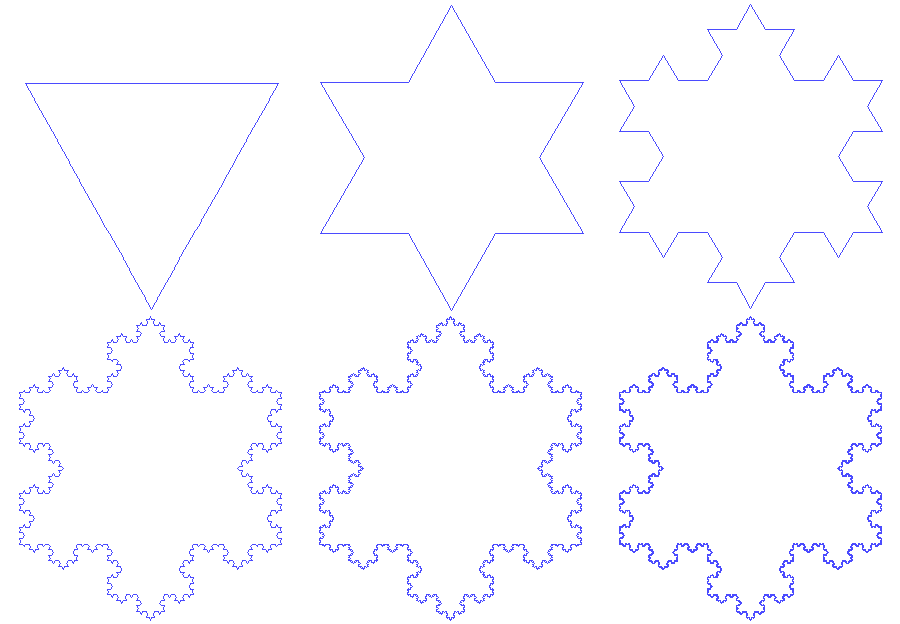
Interestingly enough, if Alpha and Zeta were interested only in increasing the length of their boundaries, then it is entirely possible for them to do so without eventually running into direct competition. If you don't believe that a shape can have a finite area and infinite perimeter, then you haven't yet met the Koch Snowflake which has exactly those properties:
Now what has all this got to do with the Church? It's clear that most churches measure growth by way of numbers. Various statistics are drawn up from regular church attendance as well as the numbers of people attending the major feasts. I blogged on this last year, Of course, this view is rather difficult for the ACC here in England. We are tiny in number and that makes us appear to be the lunatic fringe. some people look at our size and, because it is insignificant in comparison with the Church of England and the Church of Rome, we are regarded as a cult or bunch of people playing dressing-up. Naturally, they dismiss us and walk away before we can demonstrate to the contrary. What can we do to prevent people from viewing us as a cult? We need to grow more so that our views are seen to be more acceptable. For the secular culture, people will not join because we are too small - it's a vicious circle.
The ACC in the UK, like many other small catholic denominations, will never quite be seen as socially acceptable until it has become significantly larger.There are more people who describe themselves as being Jedi on Census forms than who would describe themselves as Anglican Catholic.
For the Church of England, the issue of growth presents itself at odds with the Five Principles. Already we see that, on the issue of Chrism Masses, the independent adjudicator has been called in to examine a dispute between WATCH and SSWSH. The trouble is that WATCH (the organisation pressing for the ordination of women) is diametrically opposed to the Society of St Wilfrid and St Hilda. These represent the countries Alpha and Zeta in my mathematical thought experiment above. Given that the CofE is committed to the mutual flourishing of those who can and those who cannot accept the ordination fo women, it becomes difficult to see how that mutual flourishing can take place if they are competing for the same resource of congregation numbers, or synod votes for that matter. Of course, what happens is none of my business, but one factor that I know needs to grow in this whole debate is that of generosity.
While I was on retreat, I resolved to be as generous as I can be. I'm no longer in communion with my community, but I still love them dearly. It was a joy to be with them and to say the offices with them and to take part in their living. I attended Masses, but did not go up for communion - there is only so far I can go and the differences between our theologies are so different as to be prohibitive. I resolved to be generous because I know that I can be much less than generous on occasions. I do reject the doctrine of the CofE with a clear conscience, and will continue to do so on the grounds that I believe fundamentally that she has erred and strayed like a lost sheep. Yet I cannot afford to reject its people because they are not just like me but, indeed, they are still part of me, and I part of them. I spoke to my first clergywoman since leaving the CofE, and I did not burst into flames. She told me of the work that she had been doing taking toothpaste to the deprived Palestinians on the West Bank. I have to say, that her actions show greater faith than many of mine! I accept her as I would a Methodist minister and pray that the fruit of her labour for Christ may be rich and glorious.
The strength of the ACC is that it has a clarity of doctrine which allows everyone to see what we mean. We cannot hide the truth and indeed we follow the Lord's command not to hide the light of truth under a bushel. This is vitally important. The danger that I face as a member is that I may be guilty of not just shining the light but burning people with it. That's a very medieval response. I still shudder at the thought of poor Archbishop Cranmer bravely enduring the flames that seared his aged flesh, or the noble St John Cardinal Fisher losing his head before his naked remains were pitifully left on display. This behaviour really should have died out by now, but has it? Looking around the internet the answer is "no"!
Real Christianity is not lived on the internet but in the lives of those struggling to live the Gospel through the desire of drawing closer to God. You will not find real Christianity in any sermon unless it is viewed with the eyes of the Truth which will necessarily involve compassion and love. Any internet tirade that ties people to stakes will not have the fullness of God's Word in it. The Word of God will always be a call to repentance from sin, but it will also be a call to love. We have to take pains here to ensure that above all things it is love that truly grows.
The Love that God is is not tame, it will not be cosy or gentle, but it will burn with a passion fiercer than any flame. We have to dare to let that flame grow in us, burning us so that no sin remains in us. We have to stoke that fire that was ignited paradoxically through grace that comes from the water of Baptism and fanned into fire at Confirmation. If we bear the flame of the Love of God, then we should wield it in a way that only we get burned, not other people. The only thing that people should see is the light that comes from our burning. We will not be consumed, for we have the potential to be burning bushes like that which Moses saw. We burn as beacons, not as stakes, and we do this by practical action and examined living in the light of the fire wherewith we burn.
If the Church really wants to grow in the UK, then she must bring kindling with which to be ignited. We must bring to the Holy Ghost ourselves to burn and burn brightly with His light. Notice how a fire spreads. It may have separate tongues of fire, but it is still the same flame. It will compete against itself for fuel and oxygen, but if these are in plentiful supply, then there is no competition. We are the fuel for the fire, the Holy Ghost is the oxygen for the fire. We can grow only by burning with love for God and working His will in the world by loving others. That's the growth that the Church needs - not the number of candlewicks but the brightness of the flame with which they burn!
If our words and actions contain no Love, then there will be no kindling of the fire and no growth at all. How bright is your Church?
With the numbers of religious believers declining in the West, we often find ourselves praying for growth. The trouble with growth is that it often involves competition. There is a mathematical parallel that I can draw here, but I realise that not many people will be comfortable with it - I beg their indulgence. Suppose that the world consisted of two countries Alpha and Zeta on the surface of the globe. Both countries can grow in area only so far as they are necessarily competing for area. Eventually the international boundaries of Alpha and Zeta will meet in one common boundary and the two countries will make up the whole of the globe. From that moment on, for Alpha to increase in area will mean that Zeta must decrease in area. There will come a point where there can be no mutual flourishing for Alpha and Zeta. One must decrease so that the other decreases.
Interestingly enough, if Alpha and Zeta were interested only in increasing the length of their boundaries, then it is entirely possible for them to do so without eventually running into direct competition. If you don't believe that a shape can have a finite area and infinite perimeter, then you haven't yet met the Koch Snowflake which has exactly those properties:
Now what has all this got to do with the Church? It's clear that most churches measure growth by way of numbers. Various statistics are drawn up from regular church attendance as well as the numbers of people attending the major feasts. I blogged on this last year, Of course, this view is rather difficult for the ACC here in England. We are tiny in number and that makes us appear to be the lunatic fringe. some people look at our size and, because it is insignificant in comparison with the Church of England and the Church of Rome, we are regarded as a cult or bunch of people playing dressing-up. Naturally, they dismiss us and walk away before we can demonstrate to the contrary. What can we do to prevent people from viewing us as a cult? We need to grow more so that our views are seen to be more acceptable. For the secular culture, people will not join because we are too small - it's a vicious circle.
The ACC in the UK, like many other small catholic denominations, will never quite be seen as socially acceptable until it has become significantly larger.There are more people who describe themselves as being Jedi on Census forms than who would describe themselves as Anglican Catholic.
For the Church of England, the issue of growth presents itself at odds with the Five Principles. Already we see that, on the issue of Chrism Masses, the independent adjudicator has been called in to examine a dispute between WATCH and SSWSH. The trouble is that WATCH (the organisation pressing for the ordination of women) is diametrically opposed to the Society of St Wilfrid and St Hilda. These represent the countries Alpha and Zeta in my mathematical thought experiment above. Given that the CofE is committed to the mutual flourishing of those who can and those who cannot accept the ordination fo women, it becomes difficult to see how that mutual flourishing can take place if they are competing for the same resource of congregation numbers, or synod votes for that matter. Of course, what happens is none of my business, but one factor that I know needs to grow in this whole debate is that of generosity.
While I was on retreat, I resolved to be as generous as I can be. I'm no longer in communion with my community, but I still love them dearly. It was a joy to be with them and to say the offices with them and to take part in their living. I attended Masses, but did not go up for communion - there is only so far I can go and the differences between our theologies are so different as to be prohibitive. I resolved to be generous because I know that I can be much less than generous on occasions. I do reject the doctrine of the CofE with a clear conscience, and will continue to do so on the grounds that I believe fundamentally that she has erred and strayed like a lost sheep. Yet I cannot afford to reject its people because they are not just like me but, indeed, they are still part of me, and I part of them. I spoke to my first clergywoman since leaving the CofE, and I did not burst into flames. She told me of the work that she had been doing taking toothpaste to the deprived Palestinians on the West Bank. I have to say, that her actions show greater faith than many of mine! I accept her as I would a Methodist minister and pray that the fruit of her labour for Christ may be rich and glorious.
The strength of the ACC is that it has a clarity of doctrine which allows everyone to see what we mean. We cannot hide the truth and indeed we follow the Lord's command not to hide the light of truth under a bushel. This is vitally important. The danger that I face as a member is that I may be guilty of not just shining the light but burning people with it. That's a very medieval response. I still shudder at the thought of poor Archbishop Cranmer bravely enduring the flames that seared his aged flesh, or the noble St John Cardinal Fisher losing his head before his naked remains were pitifully left on display. This behaviour really should have died out by now, but has it? Looking around the internet the answer is "no"!
Real Christianity is not lived on the internet but in the lives of those struggling to live the Gospel through the desire of drawing closer to God. You will not find real Christianity in any sermon unless it is viewed with the eyes of the Truth which will necessarily involve compassion and love. Any internet tirade that ties people to stakes will not have the fullness of God's Word in it. The Word of God will always be a call to repentance from sin, but it will also be a call to love. We have to take pains here to ensure that above all things it is love that truly grows.
The Love that God is is not tame, it will not be cosy or gentle, but it will burn with a passion fiercer than any flame. We have to dare to let that flame grow in us, burning us so that no sin remains in us. We have to stoke that fire that was ignited paradoxically through grace that comes from the water of Baptism and fanned into fire at Confirmation. If we bear the flame of the Love of God, then we should wield it in a way that only we get burned, not other people. The only thing that people should see is the light that comes from our burning. We will not be consumed, for we have the potential to be burning bushes like that which Moses saw. We burn as beacons, not as stakes, and we do this by practical action and examined living in the light of the fire wherewith we burn.
If the Church really wants to grow in the UK, then she must bring kindling with which to be ignited. We must bring to the Holy Ghost ourselves to burn and burn brightly with His light. Notice how a fire spreads. It may have separate tongues of fire, but it is still the same flame. It will compete against itself for fuel and oxygen, but if these are in plentiful supply, then there is no competition. We are the fuel for the fire, the Holy Ghost is the oxygen for the fire. We can grow only by burning with love for God and working His will in the world by loving others. That's the growth that the Church needs - not the number of candlewicks but the brightness of the flame with which they burn!
If our words and actions contain no Love, then there will be no kindling of the fire and no growth at all. How bright is your Church?
Sunday, August 09, 2015
Collect for the tenth Sunday after Trinity
Prayer book of 1549
LET thy merciful eares, O Lord, be open to the praiers of thy humble servauntes; and that they may obteine their peticions, make them to aske suche thinges as shal please thee; Through Jesus Christe our Lorde.
Reflection
This is, on the face of it quite a simple collect in its content, yet there is a quite an eyebrow
-lifting quality to it when we consider what it's asking for. We ask God to be willing to hear our prayer, but then only to ask the things which please Him, because then He will grant them. It seems more like a statement of fact: "Please, dear God, grant that I may only pray for the things that you will grant."
Of course, there is so much more to this little prayer that we can consider and perhaps it was so powerful that it caused the composer whose name is Mudd to compose the wonderful anthem on this collect. The centre of this collect is a plea to God to align our wills to His Divine Will. We want to want what He wants, we want to be part of the things that He wants us to be part of. This is a prayer that recognises within ourselves the corruption of our free-will that acts perversely. Our humanity yearns for God, and yet in the pursuit of our free-will, we find ourselves walking further and further away from His Love. We want to want God, yet often we find that we do not want Him. The human soul is composed of many complicated levels of desire. Yet, peel all of those levels back and we find that simple, deep-seated and basic longing to be loved perfectly, for who we are, without the need to be anything other than what we are, indeed despite what we are. Only God can supply that Love.
Because we cannot be saved by our own efforts, we need God first to open our eyes with His grace. We are then able to know that what we want, and that what we want is not actually what we really want. The best thing in our life is to do exactly as Our Lord commanded. Seek ye first the Kingdom of God.
Monday, August 03, 2015
Why I am not a protestant - no, not what you think.
I am not a protestant. Before anyone leaps on me to say whether I am or am not, let me make it clear that I'm not actually talking about churchmanship or belief. I'm talking about protesting.
I will admit to not being very good at protesting. What do I mean? Well, I feel very strongly about many issues that affect human beings in the world. In the past week, I have been desperately upset by the following things: the death of Cecil the Lion at the hands of a hunter; being told that because I care about the death of Cecil, I am not caring enough about the starving millions; because I care about the starving millions, I am not caring enough about the millions of aborted babies; being told that because I care about the millions of aborted babies, I am not caring enough about the needs of women in the most appalling situations; because I care about the women in the most appalling situations, I am not caring enough about climate issues and the effect on the global population; because I care about climate issues and the effect on the global population, I am not caring enough about the effects of human beings on animals, namely the death of Cecil the lion. It seems that I cannot care enough.
I often find myself presented with the most horrible pictures of aborted foetuses, or animals being put to the slaughter in inhumane ways, or the sight of men being beheaded by ISIS. Every day, I see men women, and even children holding up banners which say "Abortion kills babies". Every day, I find myself in some form of despair because, actually, I cannot care enough. I physically cannot. What can I do, become inured to protect myself, or go slowly mad by trying to care for all of these issues?
You see, I cannot just care about a baby; I have also to care about its mother too in exactly the same way. They are both human beings, so I care about both of their rights to life, liberty and love. I cannot just care about human beings. Human beings are part of God's creation. While, indeed, we can be compared with the beasts that perish, that to my mind actually raises up the dignity of animal kind because we share that same intrinsic goodness of being created by the Divine Master. For every issue, there is another issue that impacts it massively and all of these issues are intrinsically linked. To concentrate too much on one prevents a clear view of the bigger problem. Yet we must concentrate on issues.
Every day, a thousand million voices cry out demanding that I support this issue and, to make their point louder than anyone else, they resort to more and more extreme measures to be heard. Given that I subscribe to the fact that life begins at conception, every image of an aborted foetus that SPUC and its ilk promulgate, the more that I am grievously pained, but the more helpless I feel. I simply cannot do anything about it. Yet, on the flip side, the more graphic the images, the less people will listen to SPUC and so the more shrill they become and the more shrill they become, the more unpleasant they become, the more they actually begin to drive people away from listening to them, or supporting them, or even doing something about the underlying causes that lead to unwanted pregnancies in the first place. I cannot see how these types of protest actually work. They concentrate on symptoms and not on causes. To my mind, SPUC have it completely wrong: they need to concentrate on positive, edifying and generous action rather than being loud and unkind outside clinics.
If we want to eradicate abortion, human trafficking, hate crimes, global climate change, discrimination, then being confrontational on a general level of labelling and stimulus-response is simply not going to work. Confrontation breeds fear, hate, more generalisation and sectarianism. If we really want to sort out the evils in the world then we need to be silent and listen, We need to listen to the real problem. We need to listen to why people go out and kill lions rather than making a general assumption about all hunters. Above all, we need desperately to listen to God.
This is why I cannot be a protestant in this sense. I simply cannot go out holding a banner and making angry noises. I do not subscribe to the all-guns blazing approach - I will not carry a gun and yet pray that I may be someone who seeks to heal rather than to coerce. I know within myself that I get angry - so very, very angry - and yet I know that the way I would use that anger would spill over into wrath and I would do horrible things in the name of God. Too many people have had that same idea in history. Witch-hunts have only sought to damage and even lead to some form of ethnic cleansing somewhere along the line. Loud, shrill and ill-considered protests do not work, and make people ill morally and spiritually. All I can do is give my anger to God and allow Him to show me what I can do. Often, this is too little on my part. Yet, if we are asking people to trust God in difficult circumstances, are we following our own advice?
Oh dear. Methinks I do protest too much!
I will admit to not being very good at protesting. What do I mean? Well, I feel very strongly about many issues that affect human beings in the world. In the past week, I have been desperately upset by the following things: the death of Cecil the Lion at the hands of a hunter; being told that because I care about the death of Cecil, I am not caring enough about the starving millions; because I care about the starving millions, I am not caring enough about the millions of aborted babies; being told that because I care about the millions of aborted babies, I am not caring enough about the needs of women in the most appalling situations; because I care about the women in the most appalling situations, I am not caring enough about climate issues and the effect on the global population; because I care about climate issues and the effect on the global population, I am not caring enough about the effects of human beings on animals, namely the death of Cecil the lion. It seems that I cannot care enough.
I often find myself presented with the most horrible pictures of aborted foetuses, or animals being put to the slaughter in inhumane ways, or the sight of men being beheaded by ISIS. Every day, I see men women, and even children holding up banners which say "Abortion kills babies". Every day, I find myself in some form of despair because, actually, I cannot care enough. I physically cannot. What can I do, become inured to protect myself, or go slowly mad by trying to care for all of these issues?
You see, I cannot just care about a baby; I have also to care about its mother too in exactly the same way. They are both human beings, so I care about both of their rights to life, liberty and love. I cannot just care about human beings. Human beings are part of God's creation. While, indeed, we can be compared with the beasts that perish, that to my mind actually raises up the dignity of animal kind because we share that same intrinsic goodness of being created by the Divine Master. For every issue, there is another issue that impacts it massively and all of these issues are intrinsically linked. To concentrate too much on one prevents a clear view of the bigger problem. Yet we must concentrate on issues.
Every day, a thousand million voices cry out demanding that I support this issue and, to make their point louder than anyone else, they resort to more and more extreme measures to be heard. Given that I subscribe to the fact that life begins at conception, every image of an aborted foetus that SPUC and its ilk promulgate, the more that I am grievously pained, but the more helpless I feel. I simply cannot do anything about it. Yet, on the flip side, the more graphic the images, the less people will listen to SPUC and so the more shrill they become and the more shrill they become, the more unpleasant they become, the more they actually begin to drive people away from listening to them, or supporting them, or even doing something about the underlying causes that lead to unwanted pregnancies in the first place. I cannot see how these types of protest actually work. They concentrate on symptoms and not on causes. To my mind, SPUC have it completely wrong: they need to concentrate on positive, edifying and generous action rather than being loud and unkind outside clinics.
If we want to eradicate abortion, human trafficking, hate crimes, global climate change, discrimination, then being confrontational on a general level of labelling and stimulus-response is simply not going to work. Confrontation breeds fear, hate, more generalisation and sectarianism. If we really want to sort out the evils in the world then we need to be silent and listen, We need to listen to the real problem. We need to listen to why people go out and kill lions rather than making a general assumption about all hunters. Above all, we need desperately to listen to God.
This is why I cannot be a protestant in this sense. I simply cannot go out holding a banner and making angry noises. I do not subscribe to the all-guns blazing approach - I will not carry a gun and yet pray that I may be someone who seeks to heal rather than to coerce. I know within myself that I get angry - so very, very angry - and yet I know that the way I would use that anger would spill over into wrath and I would do horrible things in the name of God. Too many people have had that same idea in history. Witch-hunts have only sought to damage and even lead to some form of ethnic cleansing somewhere along the line. Loud, shrill and ill-considered protests do not work, and make people ill morally and spiritually. All I can do is give my anger to God and allow Him to show me what I can do. Often, this is too little on my part. Yet, if we are asking people to trust God in difficult circumstances, are we following our own advice?
Oh dear. Methinks I do protest too much!
Sunday, August 02, 2015
Collect for the ninth Sunday after Trinity
The Latin Collect
LARGIRE nobis, quæsumus domine, semper Spiritum cogitandi quæ recta sunt, propitius [periter] et agendi, ut qui sine te esse non possumus, secundum te vivere valeamus. Per Jesum Christum Dominum nostrum.
[My translation: Grant to us, we pray O Lord, the spirit always to think those things which are right, and to do them mercifully [expertly], that we, who cannot exist without Thee, may be worthy to live following Thee. Through...]
The 1549 prayer book
GRAUNT to us Lorde we beseche thee, the spirite to thinke and doe alwayes suche thynges as be rightfull; that we, which cannot be without thee, may by thee be able to live accordyng to thy wyll; Through Jesus Christe our Lorde.
The 1662 prayer book
GRANT to us, Lord, we beseech thee, the spirit to think and do always such things as be rightful; that we, who cannot do any thing that is good without thee, may by thee be enabled to live according to thy will; through Jesus Christ our Lord. Amen.
Reflection
The text of the 1549 Latin version has the word periter instead of the word propitius. The former has the sense of acting in a skilled manner, deftly and expertly; the latter has the sense of acting kindly or mercifully. It may appear that the English translation provided by Archbishop Cranmer and amended over the course of the century has dcided tor remove the controversy by omitting the word completely. However, just as Latin and Greek are precise, the English language has a richness which allows both ideas to be incorporated into the word "rightful". We are to think the things that are right, and perform them rightly. After all, as St Thomas Aquinas would say, fire is a good thing in itself, but when used to burn people it is not being used rightly. St Benedict would also counsel us to refrain from using many words, even if they are good words. Good things can be misused.
The translation given by Archbishop Cranmer also clarifies the phrase sine te esse non possumus. For him, it is not enough just to exist in ourselves. We are created by God and everything that God has created by God is good in itself. Yet, the presence of Evil in Creation causes us to choose to act in ways that are not Good. We cannot be good without God creating us so; we cannot do good without following God's command and His Example in Our Lord.
We were born blind until the light of God's revelation opened our eyes to His love and to what is good. Yet, we can shut our eyes to the light of God so that we do not know the moral worth of our actions, but this act of shutting our eyes prevents us from knowing the difference between what is truly good and what is superficially good. In praying this collect, we commit ourselves to walking with our eyes open to the light of God and knowing that our free choices can turn us from the path back to Him. We need to become expert in being merciful, and skilled in being kind through God's teaching so that this light of God may shine ever more apparently on those who still walk in darkness.
LARGIRE nobis, quæsumus domine, semper Spiritum cogitandi quæ recta sunt, propitius [periter] et agendi, ut qui sine te esse non possumus, secundum te vivere valeamus. Per Jesum Christum Dominum nostrum.
[My translation: Grant to us, we pray O Lord, the spirit always to think those things which are right, and to do them mercifully [expertly], that we, who cannot exist without Thee, may be worthy to live following Thee. Through...]
The 1549 prayer book
GRAUNT to us Lorde we beseche thee, the spirite to thinke and doe alwayes suche thynges as be rightfull; that we, which cannot be without thee, may by thee be able to live accordyng to thy wyll; Through Jesus Christe our Lorde.
The 1662 prayer book
GRANT to us, Lord, we beseech thee, the spirit to think and do always such things as be rightful; that we, who cannot do any thing that is good without thee, may by thee be enabled to live according to thy will; through Jesus Christ our Lord. Amen.
Reflection
The text of the 1549 Latin version has the word periter instead of the word propitius. The former has the sense of acting in a skilled manner, deftly and expertly; the latter has the sense of acting kindly or mercifully. It may appear that the English translation provided by Archbishop Cranmer and amended over the course of the century has dcided tor remove the controversy by omitting the word completely. However, just as Latin and Greek are precise, the English language has a richness which allows both ideas to be incorporated into the word "rightful". We are to think the things that are right, and perform them rightly. After all, as St Thomas Aquinas would say, fire is a good thing in itself, but when used to burn people it is not being used rightly. St Benedict would also counsel us to refrain from using many words, even if they are good words. Good things can be misused.
The translation given by Archbishop Cranmer also clarifies the phrase sine te esse non possumus. For him, it is not enough just to exist in ourselves. We are created by God and everything that God has created by God is good in itself. Yet, the presence of Evil in Creation causes us to choose to act in ways that are not Good. We cannot be good without God creating us so; we cannot do good without following God's command and His Example in Our Lord.
We were born blind until the light of God's revelation opened our eyes to His love and to what is good. Yet, we can shut our eyes to the light of God so that we do not know the moral worth of our actions, but this act of shutting our eyes prevents us from knowing the difference between what is truly good and what is superficially good. In praying this collect, we commit ourselves to walking with our eyes open to the light of God and knowing that our free choices can turn us from the path back to Him. We need to become expert in being merciful, and skilled in being kind through God's teaching so that this light of God may shine ever more apparently on those who still walk in darkness.
Manipulating Mammon
Sermon preached at Our Lady of Walsingham and St Francis on the ninth Sunday after Trinity 2015
Let’s get this straight. Our Lord says to us, “Make to yourselves friends of the mammon of unrighteousness; that, when ye fail, they may receive you into everlasting habitations.”
What does he mean here? Can we enter into Eternal life with God with unrighteous things? What is Jesus talking about?
[PAUSE]
Let’s just review things.
A rich man’s steward squanders the rich man’s belongings. The rich man says, “Right! Make a list of where you’ve got to, because you’ve got the sack.” The steward says, “Oh dear, what am I going to do. I can’t do manual work and I’m too proud to beg. What I need to do is to get myself into people’s good books.” So, as he writes up the accounts for his master, he halves the debts of those who owe his master. The master sees this, and what does he do? Does he actually condone what the steward has done? After all, the steward is doing exactly the same thing that he was fired for – he’s wasting the master’s belongings.
Well, no, it isn’t the squandering that the master is commending. The master essentially says to himself, “what a clever rascal this chap is! He’s used his wits to ensure that he has somewhere to go.” That’s typical of Children of the World, they can always use their wits to get themselves out of trouble. The Children of Light are not so good at that.
[PAUSE]
The Children of Light tend to get themselves into difficulties because they don’t know how to use material things. Sometimes they’re too honest and find themselves paying more tax when they could have gotten away with paying less. Sometimes, they are too kind by holding a door open for one person only for a whole coachful of slow-moving tourists to appear at the door just behind. Sometimes, they help someone pick up the coins that they have dropped only then to be accused of stealing. Sometimes, they give money to the homeless man on the street only for that man to use that money to buy drugs.
Children of Light are always being trodden down and taken advantage of. Perhaps we need to become more worldly wise.
[PAUSE]
It seems that Our Lord is saying precisely that, but not in a way that we become dishonest, uncaring, mean, or unhelpful. We are to make use of the unrighteous things of this world in order to make friends in Heaven. If we see ourselves as stewards of God’s Creation, then we need to use that Creation to win friends. If we are Children of Light, then we seek the friendship of God and a deepening of that relationship by ensuring that we act as He would want us to act, and do things that he would approve of.
The riches of this world are finite and can be wasted by giving them away. If we live as Children of the World then we can indeed waste our lives. If we live as stewards of God’s world then we are stewards of His love. God’s can only be wasted if we refuse to give it to other people. God’s love is infinite, so being generous with it actually makes more of it.
The writer to the Hebrews reminds us, “Be not forgetful to entertain strangers: for thereby some have entertained angels unawares .” These very angels will be the ones who receive us into Eternity at the end of our stewardship of God’s love.
Let’s get this straight. Our Lord says to us, “Make to yourselves friends of the mammon of unrighteousness; that, when ye fail, they may receive you into everlasting habitations.”
What does he mean here? Can we enter into Eternal life with God with unrighteous things? What is Jesus talking about?
[PAUSE]
Let’s just review things.
A rich man’s steward squanders the rich man’s belongings. The rich man says, “Right! Make a list of where you’ve got to, because you’ve got the sack.” The steward says, “Oh dear, what am I going to do. I can’t do manual work and I’m too proud to beg. What I need to do is to get myself into people’s good books.” So, as he writes up the accounts for his master, he halves the debts of those who owe his master. The master sees this, and what does he do? Does he actually condone what the steward has done? After all, the steward is doing exactly the same thing that he was fired for – he’s wasting the master’s belongings.
Well, no, it isn’t the squandering that the master is commending. The master essentially says to himself, “what a clever rascal this chap is! He’s used his wits to ensure that he has somewhere to go.” That’s typical of Children of the World, they can always use their wits to get themselves out of trouble. The Children of Light are not so good at that.
[PAUSE]
The Children of Light tend to get themselves into difficulties because they don’t know how to use material things. Sometimes they’re too honest and find themselves paying more tax when they could have gotten away with paying less. Sometimes, they are too kind by holding a door open for one person only for a whole coachful of slow-moving tourists to appear at the door just behind. Sometimes, they help someone pick up the coins that they have dropped only then to be accused of stealing. Sometimes, they give money to the homeless man on the street only for that man to use that money to buy drugs.
Children of Light are always being trodden down and taken advantage of. Perhaps we need to become more worldly wise.
[PAUSE]
It seems that Our Lord is saying precisely that, but not in a way that we become dishonest, uncaring, mean, or unhelpful. We are to make use of the unrighteous things of this world in order to make friends in Heaven. If we see ourselves as stewards of God’s Creation, then we need to use that Creation to win friends. If we are Children of Light, then we seek the friendship of God and a deepening of that relationship by ensuring that we act as He would want us to act, and do things that he would approve of.
The riches of this world are finite and can be wasted by giving them away. If we live as Children of the World then we can indeed waste our lives. If we live as stewards of God’s world then we are stewards of His love. God’s can only be wasted if we refuse to give it to other people. God’s love is infinite, so being generous with it actually makes more of it.
The writer to the Hebrews reminds us, “Be not forgetful to entertain strangers: for thereby some have entertained angels unawares .” These very angels will be the ones who receive us into Eternity at the end of our stewardship of God’s love.
Sunday, July 26, 2015
On being Nice a second time
I must always take note that some of the Christian practices that I find natural, uplifting and of great value are regarded with no little discomfort by my Protestant friends. I am a Catholic after all, and I do not apologise for praying to and with the saints, venerating ikons, or officiating at Benediction. Yet, I want them to be assured that I understand the basis of their concerns.
As an Anglican Catholic, it is important for us to accept the first Seven Oecumenical Councils. This, we believe is not an arbitrary decision, but rather reflects the position of the Church before East and West went their separate ways. The Ninth so-called Oecumenical Council - the first Lateran Council - met in 1123, the Eighth Council - the fourth of Constantinople met to depose Patriarch Photius I of Constantinople and ran into the controversies of the filioque clause which has not been resolved, and therefore cannot be a binding Oecumenical Council in the pre-Schismatic sense. For us, it is not an arbitrary decision, but based on clear historical facts of the councils.
Actually, I don't want to go into intellectual argument about being an iconodule - there are perfectly decent and valid defences of the nature of the Second Council of Nicaea out there on the internet. I have rightly been criticised that I can allow the intellect to overrun human interaction, and I think I see signs of that in my blogging. I did say that I was going to pull back from blogging, but I find that I've had a more productive year since the blog began. So let me answer the question of why I am an iconodule from a more personal angle.
The time was that I too found the saints, Ikons and the Real Presence a bit uncomfortable. In some sens I still do, especially when I see
This behaviour still does make me uncomfortable. It's an unfortunate accident that destroys a beautiful statue of Our Lady, but it is only that! It's a nuisance when one breaks a mirror, and very sad when one breaks a mirror into heaven as statues and ikons are, but the whole point is that they are only mirrors and if we react in hysterics because a statue falls, then I think one is in danger of idolatry. Our Lady is crowned in Heaven. She will not fall off her throne because her Son has given her Eternity. We will always see ikons disfigured, hosts desecrated, and statues destroyed, such is the nature of this world, and such is the nature of Satan in confusing the mind.
Yet, as I reflect on my discomfort, I notice that I long for the Real Thing, for God, for His Son, Our Lord Jesus Christ. I'm sure that this is true ofr every Christian. I long to see the angels and saints and to join their song of praise to the great God in Heaven. Atheists will thus say that I believe in order to give vent to unresolvable longings, yet that doesn't prove that my longings do not have a solution. I believe that God is the fulfillment of all my unrequited longings. Most of all, I believe that God is real, that He wants Himself to be known and loved freely without coercion. The Word was made flesh and dwelt among us; our eyes have seen Him, our hands have touched Him. We have heard Him speak, we have seen His miracles. He has allowed His face to be seen for what it really is. We shall be like Him because we shall see Him as He really is.
It's this fact that convinces me that it's wrong not to venerate ikons. My practice is to look at the ikon and to look deeply at the picture and try to use it as a window into the divine. At the end, I thank God for allowing me to use this image to see realities that go beyond this world, and I touch it remembering that it is just a piece of wood used for God's purpose. If my little set of ikons at home were to be burned or broken, I'd be annoyed, but it would affect my faith not one jot. It it not the wood that I'm worshipping, it is God.
Of course, my Protestant brothers will see me bowing before an ikon, and will be led to think that I am worshipping a graven image. I do struggle to see how this can be, but I am intent on doing so accurately so that we can find some common agreement and, at least a bit of perspective on issues on which we differ. If I were at the temple of Zeus worshipping in front of his statue, then I could be correctly convicted of idolatry, because Zeus is not God. Likewise, I could be convicted of idolatry if I worshipped in front of any statue of anything that is not God. If I actually worshipped the statue, then I would not be worshipping God.
I will bow before an ikon of any saint, but I do so in context. I usually bow a little when I meet new people, it's a peculiarity of mine. Yet, for me, the saints are the ones who have run the race before me and whose presence in the heavenly courts are affirmed by the Church. I recognise their efforts and bow gently in response to their lives and the examples they have given me. Since I believe in the reality of Heaven, and of Eternal life and the Communion of Saints, it just makes sense that I must live that reality. These folk are real, they have passed through death to life and they have some communion with us. We have a unity, a conversation, a mutual belonging to the Church. How do I live that belief if I completely disregard their ability to pray for us and with us? Their earthly lives teach me, and their prayers help me and their merits ensure that I have some form of "landing light" for me as I progress in the faith and aspire to be in their glorious company.
I also once struggled with the Real Presence. I know that some atheist polemicists like to desecrate consecrated hosts with the express purpose of upsetting Catholics. To me they fail miserably. What convinced me? For me, it was simply trusting Our Lord at His word. I am convinced that He was not going to try and bring great dialogues of metaphysics to people who may not be capable of metaphysical thought. Being a Christian isn't what you know, it's Who you know. Our Lord seeks to reach the simple farmer, unschooled in Aristotle just as much as any Oxonian Doctor of Divinity (perhaps more). If Our Lord then says, "this is my body" and "for my flesh is meat indeed" then He must mean that at the very basic level, because it is the way that He give us His substance so that we can indeed become more like Him. It has to be simple enough for a child to understand. No, the host does not look like the body of Christ - we have to trust Him in His promise that it is indeed His body.
But the deliberate desecration of a consecrated Host only bothers me in as much as I am concerned for the desecrator. I know full well that the Body of Christ underwent the most awful tortures for mankind, and I know that Our Lord Himself suffers in the bodies of persecuted Christians throughout the world. Persecute a Christian and you persecute Christ Himself. The desecration is then merely the violent act of the world of Darkness against its Creator. He suffers in us just as He suffers in His one sacrifice on the Cross in which we participate today. The desecrator upsets me because he demonstrates how Hell-bound he is and no-one should choose to go to Hell. My faith in Christ will not be destroyed by someone who hates Him, though I must always pray for strength when the Devil seeks to tear me from Christ.
The office of Benediction gives me the opportunity to focus on Christ being really present, though not in any way that I can see. Subjectively, I have actually felt Him with me, a ray of warmth coming down out of the monstrance upon me, and I hope upon my congregation. In seeing Him sacramentally enclosed in the monstrance, I have a greater hope and resolve that He is always with me.
It is Our Lord Jesus Christ Whom I worship, I revere His saints and angels and seek to be part of that company of Heaven. It is possible that I may yet shipwreck my faith and fall from that way, but concentrating on the realities that God has given me will surely help me to steer clear of the stumbling rocks in the way. I firmly believe that ikons, statues, saints and sacraments are gifts of God as objective realities for Christians to use to bring them ever closer to God. If Protestants find that only in the pages of Holy Scripture, then, as long as they are using Holy Scripture wisely, I am convinced that they will get ever closer to God too. I just happen to see the facts of Holy Scripture corroborated in the ornaments and sacraments of the Church.
A good Christian, Protestant and/or Catholic, will always look to the commandments and see, very clearly stated:
Thou shalt not make to thyself any graven image, nor the likeness of any thing that is in heaven above, or in the earth beneath, or in the water under the earth. Thou shalt not bow down to them, nor worship them: for I the Lord thy God am a jealous God, and visit the sins of the fathers upon the children unto the third and fourth generation of them that hate me, and shew mercy unto thousands in them that love me, and keep my commandments.For this reason, many Protestants will reject the Second Council of Nice (or rather Nicaea) on the grounds that it contravenes this commandment. I notice that many Anglicans will only accept the first four of the Oecumenical Councils, but I believe that the second book of the Homilies actually quotes from the first six.
As an Anglican Catholic, it is important for us to accept the first Seven Oecumenical Councils. This, we believe is not an arbitrary decision, but rather reflects the position of the Church before East and West went their separate ways. The Ninth so-called Oecumenical Council - the first Lateran Council - met in 1123, the Eighth Council - the fourth of Constantinople met to depose Patriarch Photius I of Constantinople and ran into the controversies of the filioque clause which has not been resolved, and therefore cannot be a binding Oecumenical Council in the pre-Schismatic sense. For us, it is not an arbitrary decision, but based on clear historical facts of the councils.
Actually, I don't want to go into intellectual argument about being an iconodule - there are perfectly decent and valid defences of the nature of the Second Council of Nicaea out there on the internet. I have rightly been criticised that I can allow the intellect to overrun human interaction, and I think I see signs of that in my blogging. I did say that I was going to pull back from blogging, but I find that I've had a more productive year since the blog began. So let me answer the question of why I am an iconodule from a more personal angle.
The time was that I too found the saints, Ikons and the Real Presence a bit uncomfortable. In some sens I still do, especially when I see
This behaviour still does make me uncomfortable. It's an unfortunate accident that destroys a beautiful statue of Our Lady, but it is only that! It's a nuisance when one breaks a mirror, and very sad when one breaks a mirror into heaven as statues and ikons are, but the whole point is that they are only mirrors and if we react in hysterics because a statue falls, then I think one is in danger of idolatry. Our Lady is crowned in Heaven. She will not fall off her throne because her Son has given her Eternity. We will always see ikons disfigured, hosts desecrated, and statues destroyed, such is the nature of this world, and such is the nature of Satan in confusing the mind.
Yet, as I reflect on my discomfort, I notice that I long for the Real Thing, for God, for His Son, Our Lord Jesus Christ. I'm sure that this is true ofr every Christian. I long to see the angels and saints and to join their song of praise to the great God in Heaven. Atheists will thus say that I believe in order to give vent to unresolvable longings, yet that doesn't prove that my longings do not have a solution. I believe that God is the fulfillment of all my unrequited longings. Most of all, I believe that God is real, that He wants Himself to be known and loved freely without coercion. The Word was made flesh and dwelt among us; our eyes have seen Him, our hands have touched Him. We have heard Him speak, we have seen His miracles. He has allowed His face to be seen for what it really is. We shall be like Him because we shall see Him as He really is.
It's this fact that convinces me that it's wrong not to venerate ikons. My practice is to look at the ikon and to look deeply at the picture and try to use it as a window into the divine. At the end, I thank God for allowing me to use this image to see realities that go beyond this world, and I touch it remembering that it is just a piece of wood used for God's purpose. If my little set of ikons at home were to be burned or broken, I'd be annoyed, but it would affect my faith not one jot. It it not the wood that I'm worshipping, it is God.
Of course, my Protestant brothers will see me bowing before an ikon, and will be led to think that I am worshipping a graven image. I do struggle to see how this can be, but I am intent on doing so accurately so that we can find some common agreement and, at least a bit of perspective on issues on which we differ. If I were at the temple of Zeus worshipping in front of his statue, then I could be correctly convicted of idolatry, because Zeus is not God. Likewise, I could be convicted of idolatry if I worshipped in front of any statue of anything that is not God. If I actually worshipped the statue, then I would not be worshipping God.
I will bow before an ikon of any saint, but I do so in context. I usually bow a little when I meet new people, it's a peculiarity of mine. Yet, for me, the saints are the ones who have run the race before me and whose presence in the heavenly courts are affirmed by the Church. I recognise their efforts and bow gently in response to their lives and the examples they have given me. Since I believe in the reality of Heaven, and of Eternal life and the Communion of Saints, it just makes sense that I must live that reality. These folk are real, they have passed through death to life and they have some communion with us. We have a unity, a conversation, a mutual belonging to the Church. How do I live that belief if I completely disregard their ability to pray for us and with us? Their earthly lives teach me, and their prayers help me and their merits ensure that I have some form of "landing light" for me as I progress in the faith and aspire to be in their glorious company.
I also once struggled with the Real Presence. I know that some atheist polemicists like to desecrate consecrated hosts with the express purpose of upsetting Catholics. To me they fail miserably. What convinced me? For me, it was simply trusting Our Lord at His word. I am convinced that He was not going to try and bring great dialogues of metaphysics to people who may not be capable of metaphysical thought. Being a Christian isn't what you know, it's Who you know. Our Lord seeks to reach the simple farmer, unschooled in Aristotle just as much as any Oxonian Doctor of Divinity (perhaps more). If Our Lord then says, "this is my body" and "for my flesh is meat indeed" then He must mean that at the very basic level, because it is the way that He give us His substance so that we can indeed become more like Him. It has to be simple enough for a child to understand. No, the host does not look like the body of Christ - we have to trust Him in His promise that it is indeed His body.
But the deliberate desecration of a consecrated Host only bothers me in as much as I am concerned for the desecrator. I know full well that the Body of Christ underwent the most awful tortures for mankind, and I know that Our Lord Himself suffers in the bodies of persecuted Christians throughout the world. Persecute a Christian and you persecute Christ Himself. The desecration is then merely the violent act of the world of Darkness against its Creator. He suffers in us just as He suffers in His one sacrifice on the Cross in which we participate today. The desecrator upsets me because he demonstrates how Hell-bound he is and no-one should choose to go to Hell. My faith in Christ will not be destroyed by someone who hates Him, though I must always pray for strength when the Devil seeks to tear me from Christ.
The office of Benediction gives me the opportunity to focus on Christ being really present, though not in any way that I can see. Subjectively, I have actually felt Him with me, a ray of warmth coming down out of the monstrance upon me, and I hope upon my congregation. In seeing Him sacramentally enclosed in the monstrance, I have a greater hope and resolve that He is always with me.
It is Our Lord Jesus Christ Whom I worship, I revere His saints and angels and seek to be part of that company of Heaven. It is possible that I may yet shipwreck my faith and fall from that way, but concentrating on the realities that God has given me will surely help me to steer clear of the stumbling rocks in the way. I firmly believe that ikons, statues, saints and sacraments are gifts of God as objective realities for Christians to use to bring them ever closer to God. If Protestants find that only in the pages of Holy Scripture, then, as long as they are using Holy Scripture wisely, I am convinced that they will get ever closer to God too. I just happen to see the facts of Holy Scripture corroborated in the ornaments and sacraments of the Church.
Devotion from Benediction: July 2015

O Lord Jesus Christ here present with us, open our eyes of faith to gaze upon Thyself and to know in our hearts that Thou lovest us so much as to stoop down to feed these Thy little children here assembled and be present with them. Grant us, O Lord, that as we believe that Thou art here, so we may learn to be in the world and not of it. Give us Thy strength to cope with the changes and chances of this fleeting world.
Give grace, O Lord Jesu Christ, to Thy bishops, priests and deacons that, in following the most excellent example of Thy humility, they may serve Thy congregations, especially this little flock here present so that they, working at life's coal face may ever more diligently bring the Good News of Thy love to a world that loveth darkness and live lives that shine with Thy light for all Eternity.
Therefore we before him bending...
Collect for the eighth Sunday after Trinity
Gelasian Collect
DEUS, cujus providentia in sui dispositione non fallitur, te supplices exoramus, ut noxia cuncta submoveas, et omnia nobis profutura concedas. Per Dominum nostrum Jesum Christum.
[My translation] O God Whose providence faileth never in its disposition, we supplicants beseech Thee that Thou wouldst remove from us all hurtful things, and grant all that would be profitable for us, through Jesus Christ Our Lord.
Prayer book of 1549
GOD, whose providence is never deceived, we humbly beseche thee that thou wilt put away from us al hurtfull thinges, and geve [us] those thinges whiche be profitable for us; through Jesus Christe our Lorde.
Prayer book of 1662
O GOD, whose never-failing providence ordereth all things both in heaven and earth; We humbly beseech thee to put away from us all hurtful things, and to give us those things which be profitable for us; through Jesus Christ our Lord. Amen.
Reflection
The trouble is that human language struggles with God and His attributes. We know that we can more often say what God is not and that what ever we can say about God is more about what He is like. Clearly, Archbishop Cranmer had his own ideas about how to translate this collect from the Latin. How might the providence of God be deceived? Not, as Archbishop Cranmer says, that it ever is deceived, but what would it mean?
The 1662 translation is freer, but yet shows that idea of the supreme authority of God in that His Providence is not just unable to be deceived but is actually in control of everything- a view that lends itself to Reformed Protestant ideas. The crucial Latin word here is dispositio a word that can be translated as "disposition" but also as "arrangement" or, more unhelpfully, "providence". The idea is that of how God's great providence has been arranged so as to provide a framework in which humanity can live and move and have our being. God's Providence is arranged so that human beings can be precisely that, human beings with all the concomitant successes and failures of that species.
The fact is that this great framework, this edifice that God has created for us, is not going to be brought down by the sins of men. We may destroy and pollute our environment, and thus destroy our species as well as the other species on this Earth, but on the whole, in the pangalactic point of view that only God possesses, His Creation cannot lose the goodness which He put into it. We recognise this even in our smallness, because we recognise the greatness of Our Creator even if we cannot comprehend how great He is. Thus we pray to rely completely on God's control and providence and to work within its limitations so that we may gain the greatest profit of all - God Himself.
DEUS, cujus providentia in sui dispositione non fallitur, te supplices exoramus, ut noxia cuncta submoveas, et omnia nobis profutura concedas. Per Dominum nostrum Jesum Christum.
[My translation] O God Whose providence faileth never in its disposition, we supplicants beseech Thee that Thou wouldst remove from us all hurtful things, and grant all that would be profitable for us, through Jesus Christ Our Lord.
Prayer book of 1549
GOD, whose providence is never deceived, we humbly beseche thee that thou wilt put away from us al hurtfull thinges, and geve [us] those thinges whiche be profitable for us; through Jesus Christe our Lorde.
Prayer book of 1662
O GOD, whose never-failing providence ordereth all things both in heaven and earth; We humbly beseech thee to put away from us all hurtful things, and to give us those things which be profitable for us; through Jesus Christ our Lord. Amen.
Reflection
The trouble is that human language struggles with God and His attributes. We know that we can more often say what God is not and that what ever we can say about God is more about what He is like. Clearly, Archbishop Cranmer had his own ideas about how to translate this collect from the Latin. How might the providence of God be deceived? Not, as Archbishop Cranmer says, that it ever is deceived, but what would it mean?
The 1662 translation is freer, but yet shows that idea of the supreme authority of God in that His Providence is not just unable to be deceived but is actually in control of everything- a view that lends itself to Reformed Protestant ideas. The crucial Latin word here is dispositio a word that can be translated as "disposition" but also as "arrangement" or, more unhelpfully, "providence". The idea is that of how God's great providence has been arranged so as to provide a framework in which humanity can live and move and have our being. God's Providence is arranged so that human beings can be precisely that, human beings with all the concomitant successes and failures of that species.
The fact is that this great framework, this edifice that God has created for us, is not going to be brought down by the sins of men. We may destroy and pollute our environment, and thus destroy our species as well as the other species on this Earth, but on the whole, in the pangalactic point of view that only God possesses, His Creation cannot lose the goodness which He put into it. We recognise this even in our smallness, because we recognise the greatness of Our Creator even if we cannot comprehend how great He is. Thus we pray to rely completely on God's control and providence and to work within its limitations so that we may gain the greatest profit of all - God Himself.
Wednesday, July 22, 2015
Our Archbishop preaches to the Anglo-Catholic Congress
The full text of Archbishop Haverland's address in Fort Worth, TX:
"Evensong, Forward-in-Faith/North America
15 July 2015
15 July 2015
Psalm cxxxiii, verse 3 - Jerusalem is built as a city that is at unity in itself.
In the Name of the Father, and of the Son, and of the Holy Ghost. Amen.
I was trained to believe that sermons are not meant primarily to prove or to instruct, much less to argue. Rather sermons are primarily meant to proclaim: to proclaim the Incarnation, the Cross, and the Resurrection of our Lord. I hope this idea animates my Sunday Mass sermons. But Evensong or Evensong and Benediction are somewhat different from Sunday morning. We read in a delightful miscellany on the Church and clergy by A.N. Wilson of a priest who for forty years ‘preached on a variety of themes at his morning Mass, but thought it inappropriate, at…Benediction, to preach on any subject other than the Empress Josephine.’ (A.N. Wilson, ed., 1992, p. 240) I don’t plan to be quite that bad. But when Bishop Ackerman invited me last year to this event I told him that I would have to address what seems to me the central problem with most of the efforts of Forward-in-Faith and its precursors and now also with the ACNA. I was invited nonetheless, so here is something with a bit of polemic in it, as promised. I will not say with Trevor Huddleston that I have naught for your comfort. But neither will I speak smooth things.
The central problem of which I just spoke is a lack of theological clarity and consistency and, to be blunt, catholicity. That is a rather provocative assertion. Let me offer an initial qualification, if not apology. I know that the religious world is filled with huge problems which are of much greater apparent importance than the intramural fusses of soi-disant Anglo-Catholics. In a world of resurgent and violent Islam and a secularizing America, our intramural differences may seem minor. I do not wish to indulge in the sadism of small differences. But then I happen to think that Anglicanism is central to the fate of the West, and that the near collapse of orthodox Anglicanism since the mid-20th century is at least indirectly tied to our wider troubles. So, back to the question of theological clarity, which I do not think is in fact a minor problem.
The Anglican alternative to the paths taken by Forward-in-Faith and ACNA is Continuing Anglicanism. Despite all of our checkered history and with all our failures, I think we Continuers have theological integrity. That integrity is not a subjective or personal matter, but rests on an objective theological base, expressed clearly in the Affirmation of Saint Louis. This foundation situates us irrevocably within the central Tradition of Catholic Christendom. All Anglican formularies are seen by the Affirmation through the lens of the central Tradition. Anglican formularies are not a kind of Occam’s razor to limit what is acceptable in Catholic tradition for Anglicans. Rather the Catholic consensus and central Tradition are the lens through which we read and appropriate our Anglicanism. This central Tradition is found in the Fathers and the Seven Councils and in the consensus of East and West, ancient and modern and living still. For us, the central problem of the Episcopal Church and of the Anglican Communion is not Gene Robinson or an error concerning any particular person or issue. Rather the fundamental problem was an implicit assertion, decades ago, that the central Tradition of Christendom is at the disposal of Episcopalian Conventions or Anglican Synods or Lambeth Conferences. It is not. The Affirmation and my own Church’s formularies firmly, decisively, and forever reject doctrinal ambiguity, comprehensiveness, or the attempt to make our peculiarities decisive and determinative. We are not Anglicans first and Catholics second. We are members of the One Holy Catholic and Apostolic Church first, and Anglicans second. We will vigorously pursue unity with all others who share this central belief. No unity, at least no full or Eucharistic communion, is possible or desirable with those who do not share this starting point.
I congratulate the ACNA for leaving the Episcopal Church and Anglican Church of Canada. Every one of you who made that change did a good thing and one, I hope, that you do not regret. But that departure can only be a good first step. For ACNA is really not a Church but a coalition of dioceses. The coalition is for some purposes only, and the communion of the dioceses is impaired and imperfect. The ACNA has retained the central flaw of the recent Lambeth Communion because it permits member dioceses to ordain women to the three-fold ministry, and therefore implicitly claims that the central Tradition is not decisive and may be set aside. ACNA is not a return to orthodox Anglicanism, but only a return to the impaired state of the Lambeth Communion that began in 1975 and 1976.
Continued ambiguity or confusion about the central tradition and women’s ordination is very dangerous. It is very dangerous because it encourages Catholic churchmen to compromise themselves in a variety of ways. Perhaps just as bad, fine, bright, and consistent Catholics will perceive that there is no certain trumpet, no clear ecclesiology, and no real future in a world of such compromises – and so you will continue to suffer the death by a thousand cuts, as people go to Rome or Orthodoxy or the Continuing Church or just stay home.
There are excellent reasons to be both Catholic and Anglican. Anglo-Catholics enjoy the great strengths of the Anglican patrimony. We have the Authorized Version of the Bible and the classical Book of Common Prayer. Together these are not only compelling literary and cultural monuments, but also provide us with an well-balanced spirituality. In some Christian bodies the Bible is loosed from tradition and from the praying Church. Of these bodies Richard Hooker wrote:
When they and their Bibles were alone together, what strange fantastical opinion soever at any time entered into their heads, their use was to think the Spirit taught it them. (Laws, Preface, VIII.7)
The Prayer Book tradition in contrast provides an anchor, an objective interpretative lens, and a prayerful setting for traditional and orthodox interpretation of Scripture. In other Christian bodies the sacraments have been loosed from Scripture and its constant fertilizing influence. Scripture is neglected and the jewel of the Eucharist is pried loose from its golden setting in a round of offices centered on the systematic reading of Psalms and Scripture. But for Anglican Catholics the sacraments are truly Scripture so prayed and read and presented as to be a large part of the very sacramental forms through which God pours forth his grace into our hearts. In short, our tradition has an almost perfect balance of Bible and sacrament. We begin with the Bible as presented in and with Common Prayer, but then add our Anglican patrimony of architecture, music, literature, spirituality, and theological method. Those are formidable strengths. How sad that so many neo-Anglicans have jettisoned the bulk of this patrimony by abandoning the classical Anglican liturgical tradition.
When they and their Bibles were alone together, what strange fantastical opinion soever at any time entered into their heads, their use was to think the Spirit taught it them. (Laws, Preface, VIII.7)
The Prayer Book tradition in contrast provides an anchor, an objective interpretative lens, and a prayerful setting for traditional and orthodox interpretation of Scripture. In other Christian bodies the sacraments have been loosed from Scripture and its constant fertilizing influence. Scripture is neglected and the jewel of the Eucharist is pried loose from its golden setting in a round of offices centered on the systematic reading of Psalms and Scripture. But for Anglican Catholics the sacraments are truly Scripture so prayed and read and presented as to be a large part of the very sacramental forms through which God pours forth his grace into our hearts. In short, our tradition has an almost perfect balance of Bible and sacrament. We begin with the Bible as presented in and with Common Prayer, but then add our Anglican patrimony of architecture, music, literature, spirituality, and theological method. Those are formidable strengths. How sad that so many neo-Anglicans have jettisoned the bulk of this patrimony by abandoning the classical Anglican liturgical tradition.
Dear friends, if you compromise with the ordination of women, and if you abandon the largest part of our Anglican patrimony by adopting modernist liturgy rooted in the Novus Ordo or, worse, in the Anglo-Baptist ideas of Sydney, there is little to hold people. Then you can only trust in a kind of slightly more decorous imitation of Charles Stanley or the already-fading mega-churches. You’ve given up both your Anglican past and also any future that can be meaningfully described as Anglican.
We must abandon all sectarian, provincial ideas that separate us from the central consensus of the Tradition of the great Churches. We must take this duty seriously by systematically rooting our doctrine and practice in Catholic agreement. Seven Councils, seven sacraments, invocation of the saints, objective sacramental efficacy, the Real Eucharistic Presence, clear moral teaching, male episcopate and priesthood and diaconate: those are all matters of Catholic consensus. That is what we must believe if we take seriously Archbishop Fisher’s assertion that we have no faith of our own.
The Catholic Movement in the Church of England began as an attempt to call all Anglicans back to the fullness of the Catholic Faith. The goal was nothing less than the wholesale conversion of the entire Church to the fullness of the Faith. The partial success of the Movement may have been its downfall. When Anglo-Catholics became too successful to ignore or suppress, and were invited to the table to enjoy a share of the spoils – a percentage of the mitres and deaneries and professorships and plum parishes – Anglo-Catholics too often lowered their sights and quieted their voices. From the conversion of the whole, we became satisfied with a slice of the pie, with a comfortable status as a recognized party. But half-Catholic is as unreal as half-virgin.
If you still are in the Episcopal Church: get out. Get out today. Anything else threatens your soul’s state. Dear friends in ACNA: you must present a clear and unmistakable demand. The ordination of women must end, soon and completely, for it is directly contrary to Catholic doctrine. No grand-fathering – or grand-mothering is possible – because such compromise leaves intact the central, revolutionary, and false implication that the deposit of the faith is negotiable and at our disposal.
Until there is such clarity, there will be no unity among those of us who like to think of ourselves as Catholic and Anglican Churchmen. There will be no unity because you cannot be a pure cup of water in a dirty puddle. That is the simple, basic message of the Continuing Church to the neo-Anglicans. You have gone a very long way down a very wrong path, and that is true even if all the time you were avoiding a still worse path. You have a journey home to make, things to unlearn and to remember and recover. We want to welcome you at home. But there can be no restored communion with us without hard decisions and firm actions from you.
Glory be to the Undivided Trinity. Glory be to Jesus Christ on his throne of glory in heaven and in the Most Blessed Sacrament of the Altar. All honor to the glorious and ever-Virgin Mother of our Lord. Peace be to the Holy Churches of God. May God forgive us our sins, which are many and great. May God give us wisdom to discern a safe path forward. May God grant us true humility and unshakable fidelity and great love. May God bring our Church to glorious days and may he bring us to unity with all his holy people, so that Jerusalem may be as a city that is at unity in itself.
In the Name of the Father, and of the Son, and of the Holy Ghost. Amen."
St Mary Magdalene: The Scandal of Christian Intimacy

St Mary Magdalene has been treated very oddly in history and not always with the greatest respect. She has received the reputation of being a former prostitute or a loose woman. We do know that she has seven devils cast out of her and that she is fundamentally instrumental in bearing witness to the Resurrection and declaring that news to the Apostles.
Then, thanks mainly to folk who don't understand the meaning of "non-canonical" and who want to make up some argument on Gnostic texts, St Mary Magdalene becomes the wife of the Lord and bearer of His children. Yet, I think one can be justified in thinking that, given the love that she has for the Lord, if His mission requires marriage, I am convinced it would be St Mary Magdalene who becomes His wife. But she is not. She is His devoted follower in life, His caretaker in Death and His principal witness to the resumption of His life. This makes her very intimately unique in the life of Our Lord.
Intimacy is something that has Christians blushing all over. Pope St Gregory the Great is somewhat responsible for identifying St Mary Magdalene with the anonymous woman who weeps over Our Lord's feet, dries them with her hair and anoints him with oil in preparation for His burial. That is a rather scandalous image of a woman caressing Our Lord with such affection and gratitude for His love. If such a thing was happening to us, we would feel very awkward indeed, but then we aren't the Saviour of the world. Clearly in this woman, St Gregory sees characteristics in common with St Mary.
Our Lord does say, "noli me tangere" - "do not touch me" or more accurately, "do not cling on to me" as if she were accustomed to doing so. It is clear that she has much affection for Him but given His calling to celibacy (a calling itself scandalous at that time) she respects that this intimacy has a limit.
By being made man, Our Lord attains limitation. In the flesh, He cannot be as intimate with human beings as He is with the other persons of the Trinity. The closest intimacy for human beings is that of marriage and of sexual intercourse in the confines of commitment and love where husband and wife are as naked and as vulnerable as they can be to each other. Even then, there must be a limit to that intimacy for immortal souls remain invisible until Judgment Day where all things are revealed.
The Church has no problem with sex. It is people who have the problem with sex, for they align their whole being with a biological urge, however good and natural that urge may be. No-one has a right to sex, for sex is not jst an urge or a drive: it is a privilege given by God for those willing to expose themselves completely to another human being in an atmosphere of trust and solemn commitment, respecting the two bodies that God has given, and seeking another peculiar intimacy, that of pregnancy. Pregnancy is an even deeper intimacy peculiar only to women in which God creates, through laws of His own making, a new, beautiful individual. Sexual intimacy is the gateway to unique miracles of God in new persons, and thus its profanation through fornication and lack of chastity contradicts the very thing it is to be human, returning us back to our comparison with the beasts which perish.
For God, there is a deeper intimacy available. It may appear one-sided as He enters the very depths of our soul and waits there for us to seek Him out in the depths of our being through prayer and devotion, even as St Mary Magdalene did. We cannot cling to Him for His very Divine Nature is not something we can grasp, but is constantly just out of reach until we become truly like Him. Yet, for someone like St Thomas, the Body of Christ affords an intimacy as we reach into the wounds in His body which He suffered to be opened for us and there find our humanity wrapped up in His person inextricably linked with His Divinity.
St Mary Magdalene finds this deeper intimacy by being present with Our Lord in His life on earth and now in His life in Heaven. For her, there is no need of sexual intimacy which is limited and earth-bound, but she seeks that which she cannot cling to before death and she finds it for God Himself seeks intimacy with her. We may find God's desire for intimacy with us scandalous because we are all to aware of our brokenness and shame. Like Adam and Eve, we seek to hide ourselves from God's penetrating knowledge of all His Creation. However, by letting Him into every single aspect of our lives - yes, even our sexual being - we find ourselves ready for our perfection and that strange and wonderful prospect of being re-united intimately with God Himself!
Monday, July 20, 2015
The Tyranny of Identity
I have to admit that one of my favourite films is Donnie Darko. It's a convoluted tale of physics, metaphysics and ignorance that just doesn't quite make sense. I guess that's why I like it!
There is one particular scene... Ah! here it is (and apologies for the profanity therein - it may actually be justified)
Of course, life is not as simple as the rather closed-minded and simplistic authority figure shows in this clip. However, I do think that there is a grain of truth in what she is trying to say. I just don't think she has the intellect to understand the profundity, unlike Donnie.
Human beings are a wonderful hybrid of mind and body whatever one's philosophy. We can indeed be compared unto the beasts that perish. We are biological organisms and therefore servant to biological necessities. Love and fear are indeed two powerful emotions that indeed command some degree of control over our lives. They are, however, not as one dimensional as Mrs Farmer seems to think. There is fear, and there is fear, just as there is love, and there is love. We are all familiar with the four loves, there are probably a similar number of fears.
Human beings do indeed have some intrinsic morality that does not come from the physical world. I am sure that any reader of this little blogling would regard the rape, torture, and murder of a little child to be abhorrent, vile and unequivocally evil. We would also reason that anyone who thinks that these are morally okay, is not in possession of their right mind or is simply a person consumed by evil. Yet, this happens in the animal kingdom every day. There is no physical prohibition, like trying to walk on the ceiling, there is no social reason as this sort of thing does happen among social animals such as chimpanzees, so where does it come from? Regardless of our answer, we are glad that there is such a moral repugnance for such an awful act.
Yet we know that we can, and often do, go against any moral code that we have. Our reasons for doing so are rooted in our own self-orientation. I'm going to be bold and say that many of the troubles of the human condition are caused by self-orientation, and that it is the desperate protection of our precious identity that gives rise to our personal angst as well as the problems of living in society.
I like to think that the seven deadly sins are reasonably comprehensive in their encapsulation of human misery. All of them possess some recourse to some fear about our identity.
Gluttony
Not only is this the over-indulgence with food, it is the preoccupation with having things just the way we like them. C.S. Lewis points out that the lady who wants just a little bit of toast but done a very specific way. There is here a desire to control our resources and to impress our will upon what we consume.
Lust
As I've said somewhere before, Lust is an unbridled and uncontrolled passion that infects our consciousness. We perceive it markedly in the lust for sex, but it also seeks a complete possession of what is desired. Again, we see a desire to exercise our power over the thing we desire.
Avarice
This idea of hoarding things so that others cannot possess them again demonstrates a desire for control not only of what we have but what we don't want other people to have. Why does someone seek to be rich if not to take complete control over one's life and to protect oneself from the vicissitudes of fortune and the demands of others on our lives.
Envy
The saddest sin - a desire to possess that which another has. Here there is always that fear of missing out, of entitlement, of seeing those whom we want to be and wanting to be them so that they cease to become who they are to our benefit.
Wrath
The uncontrolled desire to force one's will on others. In wrath, we seek to impress our own justice upon others in revenge for an injustice perceived against us. Note that, in wrath, again we seek to impress our identity on the world around - in this case, our own sense of justice regardless of whether that justice is indeed just!
Sloth
In sloth, we find the disinclination to make any contribution to the world. We seek only to maintain our own comfort at the expense of the needs of those around us. We do not wish to lift a finger because the matter of other people being human doesn't matter. In sloth, we seek the comfort of contemplating our own identity from the warmth of our bed.
Pride/Vanity
Need I say more. Like sloth is formed being comfortable with our identity, pride and vanity seek only to dress up our view of ourselves with empty importance and the belief that our will is more supreme than those around us. In seeing ourselves as the most important aspect of our lives, we find only ourselves to worship.
We can see from these that at the heart of each of these sins, there is a desire to protect and develop our identity. In a sense, this is natural. The one thing that all the experiences and sensations of my lives have in common is me.
Many people in the world today believe that this Me is the only thing they can rely on. Possessions get lost or break, people leave, love fades. The only constant appears to be Me, and if the Me gets damaged or broken or lost, then I have lost absolutely everything! The Me is small, naked and fragile. What do we then do to protect the Me? We seek to keep people away from it and wrap it up in things. Controlling other people keeps them from coming near the Me and thus keeps it safe from invasion. Thus our desire for power comes from making sure that our will is supreme and that the Me cannot be touched by others demands upon it. Not caring for others again releases the Me from being changed from what we want the Me to be. We seek only to become the Me we want to be. But what happens if I actually become the Me I Want To Be?
If I were to become the Me I Want To Be, then I could never change. If the Me changed, then it would not be the Me I Want To Be. If what I wanted changed, again, the Me would not be what I wanted it to be. If both changed together, how would we know? We could look back and see that we have changed, but we would see that the past Me would not have been the Me I Want To Be that I now am.In that case, I would conclude that I was deluded in thinking that I was the Me I Want To Be because I wanted to be the past Me, and that I could not be sure that I am now the Me I Want To Be, and I would want to be sure that I am the Me I Want To Be! I'm sorry for the linguistic jiggery-pokery, but I think this proves that it is impossible for me ever to be the person I want to be, unless I suddenly become changeless, i.e. either becoming God, or becoming dead. We find ourselves slaves to the tyranny of our identity.
The way out is simple. If we want to be free, then we must let go of the illusion that we can ever be in control of who we are. We have to let others have some investment in our identity. We must let them help us find some self-definition. Concern for others is indeed vital if we wish to find some fulfilment in life. I can become a better Me, by seeing the good in others and assimilating that good in Me so that still others can see the good in Me.
Yet, the Me still has one final surrender. What is the point of Me if I am doomed to die and wink out of existence. If there is nothing after this life, then all this work in finding fulfilment in truly being me is worthless. I might as well strive in the futility of seeking to become the Me I Want To Be even if it is impossible. It will make no difference either way, since, eventually if there is nothing else, there will not only be no Me, there will be no other Mes at all! With the end of this planet comes the end of all the Mes, and there will be no Good nor Evil, just dust and then nothing at all.
But there is Good and Evil. This leads me to conclude that there is something beyond our existence that determines Good and Evil, and further something that determines the Me that I am gives me the idea of a better Me I Want To Be because there is some idea of perfection. There needs to be an end if there is any real sense of meaning in this universe other than the arbitrary meaning that human beings impose upon it. That end can only ever be God, and we can only ever see the perfection of humanity in Our Lord Jesus Christ.
If we seek truly to be happy in this life, then we will never find it in ourselves and the pursuit of developing and protecting a false identity will prevent us from ever really finding satisfaction in simply being ourselves. We can only look for an identity in God and, if we do, we can find and develop sufficient confidence in Him to become the Me He Wants Me To Be which will be the Me I Want To Be!
There is one particular scene... Ah! here it is (and apologies for the profanity therein - it may actually be justified)
Of course, life is not as simple as the rather closed-minded and simplistic authority figure shows in this clip. However, I do think that there is a grain of truth in what she is trying to say. I just don't think she has the intellect to understand the profundity, unlike Donnie.
Human beings are a wonderful hybrid of mind and body whatever one's philosophy. We can indeed be compared unto the beasts that perish. We are biological organisms and therefore servant to biological necessities. Love and fear are indeed two powerful emotions that indeed command some degree of control over our lives. They are, however, not as one dimensional as Mrs Farmer seems to think. There is fear, and there is fear, just as there is love, and there is love. We are all familiar with the four loves, there are probably a similar number of fears.
Human beings do indeed have some intrinsic morality that does not come from the physical world. I am sure that any reader of this little blogling would regard the rape, torture, and murder of a little child to be abhorrent, vile and unequivocally evil. We would also reason that anyone who thinks that these are morally okay, is not in possession of their right mind or is simply a person consumed by evil. Yet, this happens in the animal kingdom every day. There is no physical prohibition, like trying to walk on the ceiling, there is no social reason as this sort of thing does happen among social animals such as chimpanzees, so where does it come from? Regardless of our answer, we are glad that there is such a moral repugnance for such an awful act.
Yet we know that we can, and often do, go against any moral code that we have. Our reasons for doing so are rooted in our own self-orientation. I'm going to be bold and say that many of the troubles of the human condition are caused by self-orientation, and that it is the desperate protection of our precious identity that gives rise to our personal angst as well as the problems of living in society.
I like to think that the seven deadly sins are reasonably comprehensive in their encapsulation of human misery. All of them possess some recourse to some fear about our identity.
Gluttony
Not only is this the over-indulgence with food, it is the preoccupation with having things just the way we like them. C.S. Lewis points out that the lady who wants just a little bit of toast but done a very specific way. There is here a desire to control our resources and to impress our will upon what we consume.
Lust
As I've said somewhere before, Lust is an unbridled and uncontrolled passion that infects our consciousness. We perceive it markedly in the lust for sex, but it also seeks a complete possession of what is desired. Again, we see a desire to exercise our power over the thing we desire.
Avarice
This idea of hoarding things so that others cannot possess them again demonstrates a desire for control not only of what we have but what we don't want other people to have. Why does someone seek to be rich if not to take complete control over one's life and to protect oneself from the vicissitudes of fortune and the demands of others on our lives.
Envy
The saddest sin - a desire to possess that which another has. Here there is always that fear of missing out, of entitlement, of seeing those whom we want to be and wanting to be them so that they cease to become who they are to our benefit.
Wrath
The uncontrolled desire to force one's will on others. In wrath, we seek to impress our own justice upon others in revenge for an injustice perceived against us. Note that, in wrath, again we seek to impress our identity on the world around - in this case, our own sense of justice regardless of whether that justice is indeed just!
Sloth
In sloth, we find the disinclination to make any contribution to the world. We seek only to maintain our own comfort at the expense of the needs of those around us. We do not wish to lift a finger because the matter of other people being human doesn't matter. In sloth, we seek the comfort of contemplating our own identity from the warmth of our bed.
Pride/Vanity
Need I say more. Like sloth is formed being comfortable with our identity, pride and vanity seek only to dress up our view of ourselves with empty importance and the belief that our will is more supreme than those around us. In seeing ourselves as the most important aspect of our lives, we find only ourselves to worship.
We can see from these that at the heart of each of these sins, there is a desire to protect and develop our identity. In a sense, this is natural. The one thing that all the experiences and sensations of my lives have in common is me.
Many people in the world today believe that this Me is the only thing they can rely on. Possessions get lost or break, people leave, love fades. The only constant appears to be Me, and if the Me gets damaged or broken or lost, then I have lost absolutely everything! The Me is small, naked and fragile. What do we then do to protect the Me? We seek to keep people away from it and wrap it up in things. Controlling other people keeps them from coming near the Me and thus keeps it safe from invasion. Thus our desire for power comes from making sure that our will is supreme and that the Me cannot be touched by others demands upon it. Not caring for others again releases the Me from being changed from what we want the Me to be. We seek only to become the Me we want to be. But what happens if I actually become the Me I Want To Be?
If I were to become the Me I Want To Be, then I could never change. If the Me changed, then it would not be the Me I Want To Be. If what I wanted changed, again, the Me would not be what I wanted it to be. If both changed together, how would we know? We could look back and see that we have changed, but we would see that the past Me would not have been the Me I Want To Be that I now am.In that case, I would conclude that I was deluded in thinking that I was the Me I Want To Be because I wanted to be the past Me, and that I could not be sure that I am now the Me I Want To Be, and I would want to be sure that I am the Me I Want To Be! I'm sorry for the linguistic jiggery-pokery, but I think this proves that it is impossible for me ever to be the person I want to be, unless I suddenly become changeless, i.e. either becoming God, or becoming dead. We find ourselves slaves to the tyranny of our identity.
The way out is simple. If we want to be free, then we must let go of the illusion that we can ever be in control of who we are. We have to let others have some investment in our identity. We must let them help us find some self-definition. Concern for others is indeed vital if we wish to find some fulfilment in life. I can become a better Me, by seeing the good in others and assimilating that good in Me so that still others can see the good in Me.
Yet, the Me still has one final surrender. What is the point of Me if I am doomed to die and wink out of existence. If there is nothing after this life, then all this work in finding fulfilment in truly being me is worthless. I might as well strive in the futility of seeking to become the Me I Want To Be even if it is impossible. It will make no difference either way, since, eventually if there is nothing else, there will not only be no Me, there will be no other Mes at all! With the end of this planet comes the end of all the Mes, and there will be no Good nor Evil, just dust and then nothing at all.
But there is Good and Evil. This leads me to conclude that there is something beyond our existence that determines Good and Evil, and further something that determines the Me that I am gives me the idea of a better Me I Want To Be because there is some idea of perfection. There needs to be an end if there is any real sense of meaning in this universe other than the arbitrary meaning that human beings impose upon it. That end can only ever be God, and we can only ever see the perfection of humanity in Our Lord Jesus Christ.
If we seek truly to be happy in this life, then we will never find it in ourselves and the pursuit of developing and protecting a false identity will prevent us from ever really finding satisfaction in simply being ourselves. We can only look for an identity in God and, if we do, we can find and develop sufficient confidence in Him to become the Me He Wants Me To Be which will be the Me I Want To Be!
Subscribe to:
Posts (Atom)


